
500 Words: "Invisible Trade"
Exclusive Fiction from the Rabbit's Den

Invisible Trade
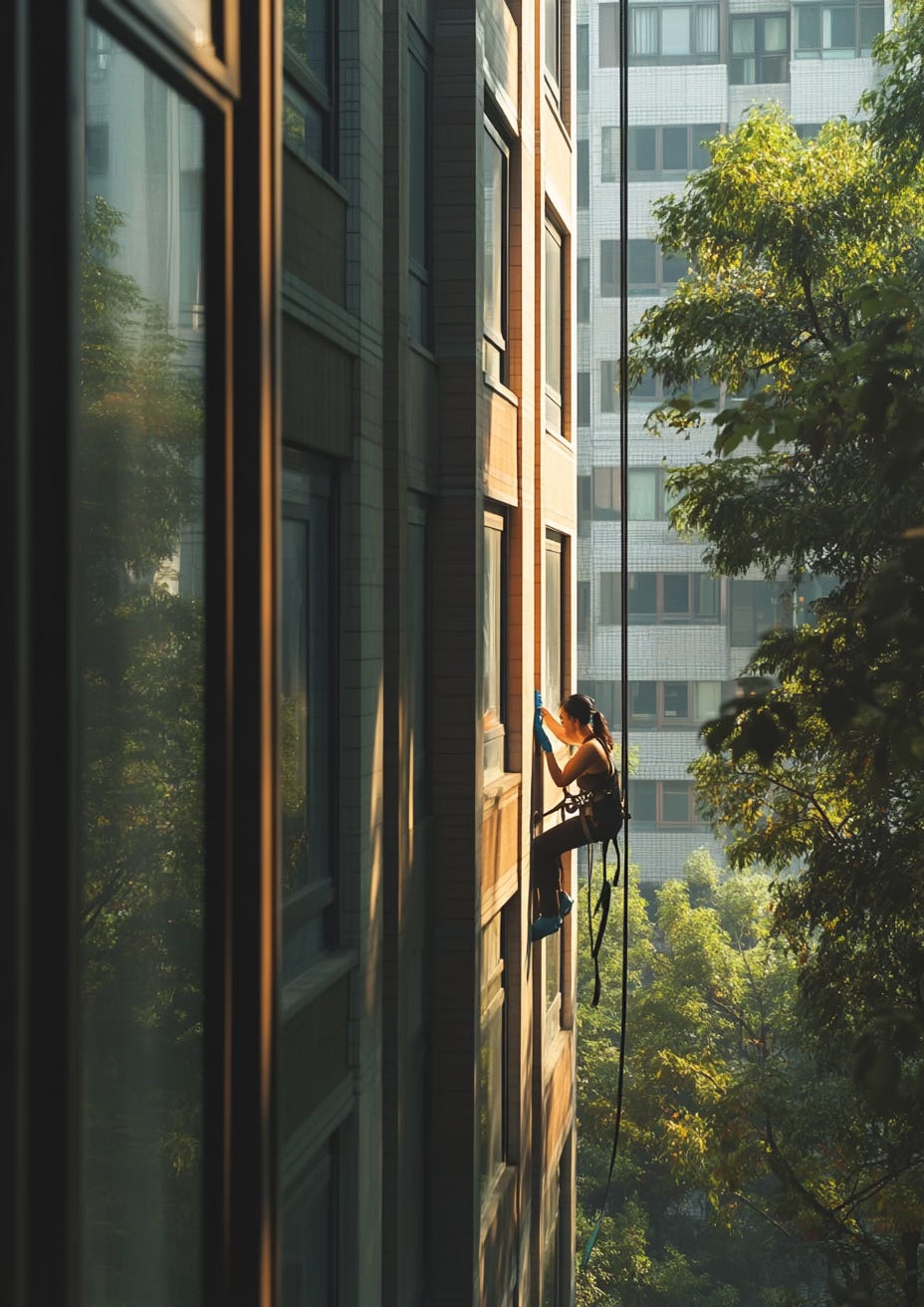
One hundred and eighty-two feet above Madison Avenue, outside the 15th floor of The Monarch, Mei holstered her squeegee. The April sun glinted off the neighboring glass towers. She rubbed both eyes with the heel of her palm, then, looking side to side as if committing a small crime, she turned her cap askew, cupped her hands around her eyes, and leaned against the window. She felt the harness bite into her thighs.
There was no doubt about it. Identical. The exact same arrangement as the apartment on twenty-three, and the one on nineteen. The mahogany desk with its leather chair positioned at precisely the same angle—imposing, unused. The landscape painting—Cézanne, she knew from art books at the Queens library, brushstrokes like something her grandfather might have painted—hanging exactly one handspan from the tiled fireplace. Several rows of books: red, blue, green, black, white. Five miniature figurines arranged in descending size along the windowsill—elephants here, not horses. And beside them, a ficus in a large Chinese pot with the same leftward lean, as though perpetually caught in an easterly wind.
As a child, Mei was secretly proud, arrogant even, regarding her photographic memory, although she never revealed her gifts to her family. A trim for auntie's hair, a chair moved three inches to the right after vacuuming, a book borrowed and shelved out of place in her father's collection, her mother's flush skin the morning after an evening's intimacy. She didn't exactly notice these changes; it was more akin to being yelled at by them. LOOK AT ME, I AM NOT THE SAME! they screamed at her. But the voice was screaming something different now: LOOK AT ME, I AM THE SAME.
Mei felt shame. Six years. Six years and thirty-seven stories of The Monarch. Over two thousand windows, countless lives framed in glass. She had been washing these windows for six years. Six years of expensive stereos and sleeping cats and abandoned breakfast trays. Six years of morning arguments, frozen mid-gesture when she appeared. Six years of naked encounters hastily covered. Six years of invisible women like herself, cleaning inside while she cleaned outside, avoiding eye contact. She had collected an atlas of these strangers' lives, or so she thought. How could she not have noticed these identical parallels until now?
Her reflection stared back, transparent. Inside, outside. Watching, watched.
The next day, Mei brought a small pocket notebook. Instead of moving her harness and tackle to the east facade, she revisited the south side again. The city below was getting smaller; she was getting larger. No one was watching. She intended to document the anomalies. She would work quickly and then move on, so as not to fall behind. Twenty-third, nineteenth, fifteenth, and another one, on the eleventh. Four apartments, four strangers, with interiors arranged as mirror images.
Did they know each other? Were they related? Were they coordinating their homes, their lifestyles? "Bù kě néng," Impossible, she whispered to herself in Mandarin, her breath fogging the glass, briefly obscuring the interior. Something simpler, she thought, a reasonable explanation. A corporate apartment maybe. Model units.
The pattern extended beyond furniture. The Cézanne in one apartment became a Monet in another, but always French, always landscapes. The figurines changed—elephants became cats became birds became horses—but always five, always arranged by size. She made precise annotations, measuring with her thumb against the glass.
In her cramped apartment in Flushing, Mei sketches out the layouts, calculating the distance between objects, looking for patterns. The October light grudgingly enters through the single window facing the airshaft. The geometry is perfect, the distances proportional despite the different apartment sizes. But she can’t decode the mystery.
"Shǎ guā," silly melon, her father says from the kitchen, listening in on her video chat with her mother. "They use the same interior designer. These rich Americans, nothing unique for them, they all want to be the same." Mei doesn’t argue.
Seasons have passed, and Mei returns to The Monarch to wash the windows, nervous with anticipation, a secret smile in her heart. In her pocket, a small green object—a tiny jade horse, her mother's parting gift before Mei left Guangzhou. With trembling fingers, she unclips her safety harness and slides open the windows on the eleventh floor. Heart racing, she places the horse beside the ceramic elephants on the windowsill, arranging them precisely by size, her horse complimenting the set. She hesitates, hand mid-air. She takes a deep breath, looks quickly at the street below, and completes her act. She closes the window and continues her descent.
In bed that night, Mei smiles to herself, turning the tiny elephant over and over in her fingers. She places it beside her lamp and turns out the light. In the dark, the elephant is invisible. In this vast city of strangers, she imagines, someone is holding her gift.
🐘 love it