
500 Words: "Marginalia"
Short Fiction from the Rabbit's Den

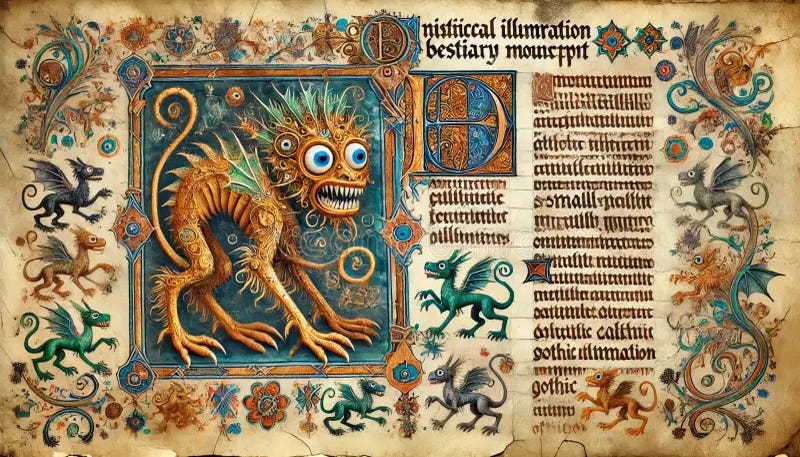
I am not, by temperament, given to superstition. My work as a researcher of medieval manuscripts has always been governed by reason and evidence. What I’m about to describe occurred three weeks ago, and I’ve told no one, though I have deleted my Internet Archive account and cancelled my library privileges at the university.
It began, as these things often do, with curiosity about a minor detail. I was examining a digitized fifteenth-century Book of Hours when I noticed something peculiar within the ornate marginalia, barely visible among the golden vines and flourishes. Three circular forms in a triangular configuration, with angular marks beneath. At first, I assumed it was merely decoration. But the geometry was subtly wrong. The circles weren’t quite equal, their arrangement followed no pattern I recognized, and the angular marks varied in length and depth in ways that seemed almost deliberate.
What struck me was its placement: always in the lower left margin, half-hidden within the gilded decoration.
Professional interest led me to search for similar markings. The Archive’s collection is vast, and I spent two evenings examining comparable manuscripts. I found it again in a fourteenth-century French psalter dated October 1342, then in a German breviary from October 1487. Each time, the same pattern, woven into the marginal decoration.
By the third night, I had documented seventeen instances across five centuries and four countries—all dated to October. The consistency was remarkable, too consistent for coincidence, yet the manuscripts shared no known provenance. I began to notice something else. The longer I examined the pattern hidden within the gilded vines, the more the three circles seemed arranged like eyes watching—two above, one below—and the angular marks beneath began to resemble scratches or the crude suggestion of a mouth. I told myself this was projection.
It was past midnight when I found the pattern in a ninth-century Carolingian manuscript—far earlier than the others. But here, the copyist had added something new: a single word in faded Latin scratched beneath the marks. Videt.
It sees.
I should’ve stopped then. Instead, I searched for the word. Eleven more manuscripts. Always the same: the pattern in the marginalia, the word, each dated in October. And in the most recent—a sixteenth-century Italian work—there was more text, nearly illegible: Videt qui videt. It sees those who see.
The rational part of my mind suggested a medieval scribal tradition, perhaps a guild marking. But that part of my mind was growing quieter.
On the seventh night, I found what I now believe was meant to be found. A seventeenth-century manuscript from a dissolved monastery in Yorkshire contained the pattern, and the copyist had written beside it: “I have seen it drawn in thirteen books now, and last night I saw it upon my chamber wall. I shall not copy it again.”
The entry was dated October 19th, 1663. The remaining pages of the manuscript were blank.
I checked the date on my computer. October 19th.
I sat staring at the screen. After several minutes, the display dimmed to conserve power, and in that moment before it went black, I saw it clearly—on the wall behind me, reflected in the darkening screen. The three circles. The angular marks beneath.
I have not looked back at my study wall since. I packed my laptop away and have not opened it since. I sleep with the lights on, and I have been seriously considering whether to move. The rational explanation is that I have stared at this pattern so many times that my mind has begun to project it, pareidolia born from obsessive study.
But this morning, I found seventeen emails in my spam folder, each from a different defunct university account, all sent at exactly 3:47 AM. The subject lines were empty. The messages contained only a single attachment—in each case, a photograph of a wall. In each photograph, in the lower left corner, I could see it.
The seventeenth email’s photograph showed a wall I immediately recognized. The faded blue paint. The corner where the baseboard meets. The exact angle.
It was taken from inside my study, facing the wall behind where I sit.
I’ve been writing this at a coffee shop. I don’t know if I’ll go home. I don’t know if it matters whether I go home. The pattern isn’t in the manuscripts. The manuscripts are merely where it’s been recorded by others who, like me, saw.
And having seen, are seen. - ∞