
500 Words: "The Last Speaker"
Short Fiction from the Rabbit's Den

The old woman’s voice carried the peculiar cadence of someone translating thoughts from a dialect that existed nowhere else on Earth. Noor had heard this rhythm before—always in the final speakers, those linguistic orphans whose coastal variants had drowned with their villages.
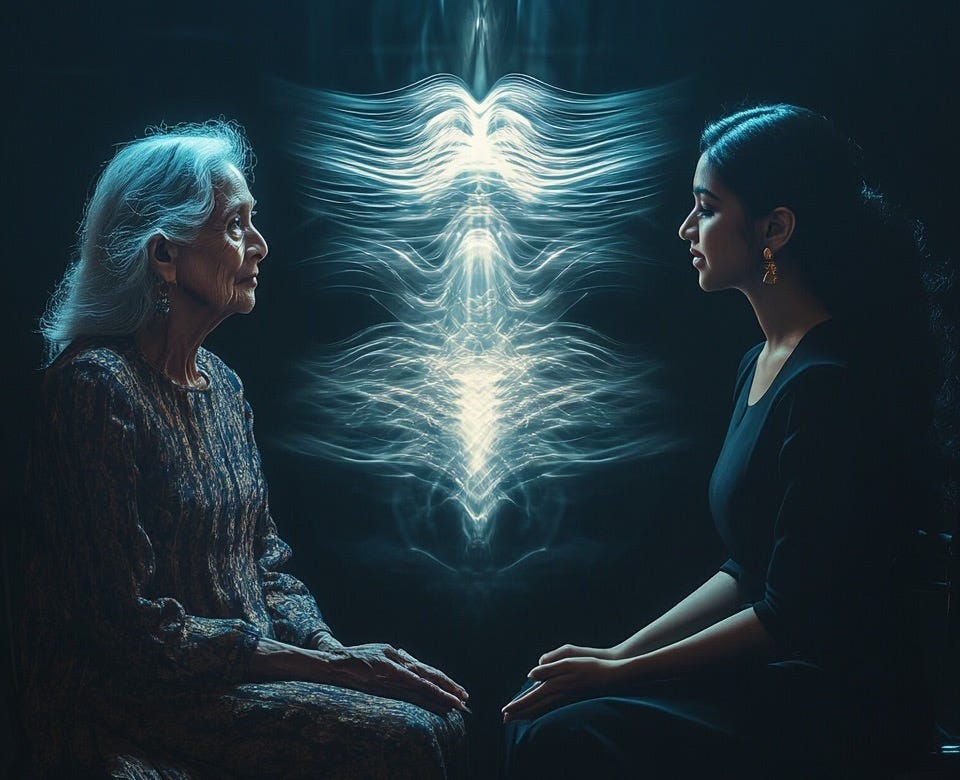
“Please state your name and heritage claim for the record,” Noor said, her haptic gloves translating the woman’s vocal patterns into shimmering data streams.
“Indira Patel. Last native speaker of Kathiawari-Coastal dialect, Kutch Peninsula, Gujarat State.” The woman’s standard Gujarati was crisp, but underneath it Noor could hear the ghost of something older, its tonal patterns bleeding through like watermarks.
Noor activated the deep-scan protocols. “I’ll need you to speak continuously in your coastal dialect for at least ten minutes. The system will map your phonemic variations and local syntax for authentication.”
Indira began to speak, and immediately Noor knew something was wrong.
The vocal analysis painted patterns in the air—frequency distributions, tonal ranges, dialectical markers. But where she expected the smooth variations that distinguished coastal speech from inland Gujarati, she found jagged inconsistencies. Pronunciations that shifted mid-word. Local grammar that contradicted itself. A dialect that seemed to be eating itself as it was spoken.
“Stop,” Noor said, raising her hand. “The patterns are corrupted. Are you experiencing fatigue? Memory confusion?”
Indira’s eyes sharpened. “The recordings are perfect.”
“No, they’re not. You’re mispronouncing your own words. Mixing coastal forms with inland structures. Either you’re not actually from the coast, or—”
“Or I’m protecting my dialect from becoming your property.”
The words hung in the air between them. Noor had seen families fabricate regional claims, had witnessed forged documents attempting to establish dialectical heritage. But this was different. This was deliberate cultural vandalism performed by its own guardian.
“You understand what you’re doing?” Noor asked quietly. “Without authentication, your dialect receives no legal protection. No preservation funding. When you die, it dies with you.”
“When I die, it dies free.” Indira leaned forward. “Do you know what happened to Konkani-Coastal after authentication? Global Education Holdings licensed the fishing terminology for their ‘Authentic Maritime Experience’ packages. Seventy-year-old fisherman charged two hundred credits to teach his own son the tide-words his father taught him.”
Noor’s hands trembled slightly as she processed this information. She had heard rumors, of course. Heritage corporations monetizing authenticated dialects, charging communities for access to their own regional speech patterns. But seeing the human cost made it real in a way that statistics never could.
“The system isn’t perfect,” Noor said, “but without documentation—”
“Without documentation, my words belong to my people.” Indira resumed speaking in her corrupted coastal dialect, each deliberately mangled phrase an act of resistance. “My grandson learns our tide-prayers from me, not from a subscription service. My granddaughter carries our storm-songs in her heart, not in a corporate database.”
Noor watched the dialectical patterns fracture in real-time, generations of coastal evolution being deliberately garbled by the only person capable of preserving them accurately. Her training screamed that this was wrong—that preservation, even imperfect, was better than extinction.
But she thought of her own grandmother, who had died speaking island phrases that now lived only in Noor’s memory, too fragmented for authentication, too precious for commodification.
“If I report this as a failed authentication,” Noor said slowly, “the dialect receives no official recognition. No protection.”
“And no price tag.”
Noor looked at her equipment, at the fractured linguistic patterns still painting themselves in light above her desk. She thought of all the families she had helped authenticate their heritage claims, the relief in their eyes when their regional identity received official recognition. She thought of the corporate commissions, the licensing fees, the endless forms that transformed living speech into managed assets.
She reached for her authentication seal, then stopped.
“Tell me about your granddaughter,” she said instead. “In your real dialect. The one you haven’t broken yet.”
Indira smiled and began to speak, her voice carrying the full weight of coastal words that would die unchained, unowned, and therefore, perhaps, truly alive.
Noor let the recording run, knowing she would never submit it for authentication. Some voices, she realized, were too precious to be owned—even by the systems designed to save them. - ∞