

I don’t want to scare anybody, believe me, but there’s something on my mind lately that I feel we as a country cannot sit back and ignore any longer, especially during an election year with so much riding on the outcome. Dogs are socialists. All dogs. That’s right, you heard me. There’s a huge percentage of America, albeit non-voting, that are card-carrying socialists (well, metaphorically, although there’s a case to be made that anyone required by local government to wear a collar with their medical history prominently displayed is effectively a tag-wearing socialist). Every dog in America is currently living under a comprehensive, cradle-to-grave welfare system, and not one of them has been called out, until now!

I ran the numbers, because someone had to, and I need company in this. Housing: provided. Food: provided, on a schedule, regardless of individual merit (a dog who has done nothing all day but sleep on the couch receives the exact same dinner as a dog who “worked,” and by worked I mean barked at a squirrel for eleven minutes). Healthcare: fully subsidized, including elective procedures the dog never consented to and, in at least one case involving my neighbor’s bulldog, actual orthodontia. Retirement: begins immediately upon acquisition and lasts the dog’s entire life. Transportation: subsidized. Recreation: subsidized. Legal representation, should the dog bite a mail carrier: also, somehow, subsidized.
Every single one of those needs is being met by an entity the dog didn’t elect, can’t fire, and has never once thanked in a manner appropriate to the scale of the arrangement. That entity is you. You are the nanny state, and you should probably sit with that for a second, because it doesn’t stop at dogs. If you have ever owned a cat, a horse, a guinea pig, a turtle, or a fish you gave a name to, you have been running the exact same program — full benefits, no means-testing, no accountability, indefinitely — for a creature that has never once produced anything you could put on an invoice.
To be fair, this particular brand of socialism comes with real, well-documented upside: lower blood pressure, fewer trips to the cardiologist, a built-in excuse to leave the house at six in the morning, and someone in the building who’s thrilled to see you regardless of how your day went. Say what you want about the nanny state. She gives excellent belly rubs.
There are no capitalist dogs. I want to be very clear about this, because I know some of you are already composing an email about your neighbor’s dog who “guards the property” and therefore “earns his keep.” No. That dog is not “working for a living.” That dog has been assigned a bureaucratic function within a planned economy and receives full benefits regardless of performance, which, if you squint, is essentially a federal job.
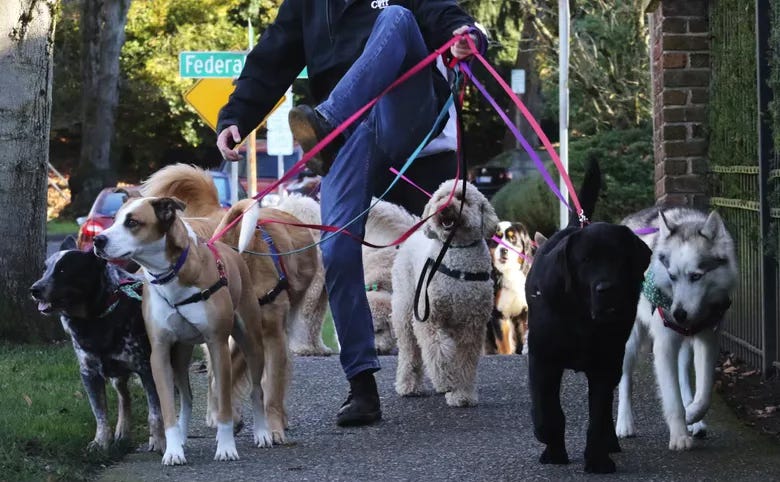
I arrived at this conclusion the honest way, which is to say by accident, while pet-sitting in the rarefied air of Seattle’s Capitol Hill neighborhood. Two golden retrievers, one week, and a lot of time to think while walking them through Volunteer Park, watching an entire city’s worth of dogs interact with each other like they’d all individually signed the same nondisclosure agreement. Six feet of leash. A polite nod, maybe a sniff if both owners make eye contact and silently negotiate terms, then everyone moves along, nothing to see here, citizen.
This was a change of pace for me, because at home in Gig Harbor, dogs mingle. Not recklessly, we’re not talking about a canine rave, but with a kind of relaxed, semi-rural confidence, like neighbors who’ve decided the fence is more of a suggestion. City dogs, by contrast, have been raised under a regime of Just Enough Leash to remind them, at all times, that freedom is conditional and someone bigger is holding the other end of it.
Which got me thinking, somewhere around the fourth polite non-interaction of the morning: these dogs have zero autonomy, and they don’t seem to mind one bit, which is either the most relaxing thing I’ve witnessed or a small, furry preview of exactly where the rest of us are headed.
Now, and this is important, because not all dogs are equally socialist, any more than all countries are, there’s a spectrum here, and Volunteer Park gave me a front-row seat to it. The Capitol Hill dogs I was walking are your Scandinavian-model socialists: tightly regulated, extremely well cared for, six feet of personal space guaranteed, a kind of orderly cradle-to-grave arrangement where everybody’s needs are met and nobody’s allowed to bite anybody. My Gig Harbor dog friends are closer to a mixed economy. Still fully dependent, still getting the full welfare package, but operating with a looser regulatory environment and a general sense that the rules exist more as vibes than statute. And then there’s the farm dog, who actually has a job (moving sheep, terrorizing the mail truck), earns a little moral credit for it, but still gets fed, vetted, and housed by the same benevolent state apparatus as everybody else. That’s your labor-union welfare-capitalism dog.
The only dog on the entire spectrum who could plausibly claim to be a libertarian is the stray, and I would encourage anyone tempted to romanticize the stray’s rugged independence to spend an afternoon actually looking at a stray dog. That is not freedom. That is a creature whose healthcare plan is “hope” and whose retirement plan is “no hope.” Nobody, dog or otherwise, actually wants to live there. We just like to name-check it as a philosophy from the safety of our own fenced yard.
I bring all this up because we are approaching an election, and if you’ve turned on the news even glancingly, you’ve noticed that “socialist” has become the go-to accusation for anyone whose politics you’d rather not engage with, a kind of all-purpose seasoning sprinkled on anyone left of “I pay my own taxes and resent it.” Meanwhile, actual self-identified democratic socialists are doing rather well in actual elections, which suggests a fairly significant percentage of the country either doesn’t know what these words mean, doesn’t care, or more likely, has made peace with the fact that, and let’s just say it out loud: we’re all already living inside the thing we’re yelling about.
Because here’s the part (at the risk of you scrolling away to greener pastures) where I feel compelled to pull out that Ivy League diploma nobody (ever) asked to see, so let me just gently set this on the table - “socialism” is not a horror-movie villain, it’s an economic framework with a lot of internal variation, like the spice rack in your kitchen with seven variations of paprika. In fact, most Americans have started using “socialism” the way Gen Z uses “mid,” as in, “that new superhero movie was mid,” “Taco Bell is mid,” “my ex, in hindsight, was high taper mid” (don’t ask me, I don’t get it either), but it’s a verdict that requires zero supporting evidence, ends the conversation immediately, and cannot be appealed. That’s what “socialism” has become. Not an economic term. A vibe check.
Consider for a moment the actual American welfare state you’re already enrolled in and have rarely tried to opt out of. Public trash cans: socialism. A shared municipal resource funded by tax dollars that you did not personally negotiate for. And yet, barring a Super Bowl victory or World Cup defeat, you have never once flipped one over in protest. Public restrooms: same deal, and arguably more socialist, given the sheer number of you who have used one without a second thought about who paid for the plumbing. Roads, bridges, the entire interstate system: pure socialism, built and maintained collectively, used by everyone, resented by nobody until that pothole takes out your front axle. Public schools: an enormous collective investment in other people’s children, which somehow remains uncontroversial right up until somebody finds a Toni Morrison book in the school library. Police and fire departments: a shared insurance policy against catastrophe that we all pay into and hope never to need, which is, structurally, socialism with a badge. And then there’s Social Security and Medicare, the two biggest, most successful, most broadly popular socialist programs in American history, which most beneficiaries will nonetheless insist, with a straight face, are not socialism, they’re something else, something more dignified, something they earned, which, fine, is also basically true, and is also exactly the kind of nuance that gets lost the second the word gets tossed into a stump speech.
None of this means every program is worthwhile, or that the same policy scales cleanly from a town of four thousand to a country of three hundred and forty million with wildly different needs, incomes, and expectations. But the honest case for a little socialism was never really about charity, it’s about logic. A shared system of roads, schools, and safety nets tends to improve conditions not just for the least fortunate among us, but for practically everyone stacked in the middle too, the same way a sensible leash law makes the whole park more pleasant for every dog in it, not just the anxious ones. A one-size-fits-all leash length still doesn’t suit every dog (ask a border collie how he feels about six feet of nylon) but the honest answer is that we’re all already living somewhere on the spectrum, dog and human alike, and the real argument was never “socialism versus not.” It’s “how much, where, and for whom,” which admittedly makes for a much worse bumper sticker.
None of which is to say you have to like it. Nobody’s asking you to roll over, present your belly, and accept a life of well-groomed dependency (although, yes please, sign me up). If the whole arrangement genuinely offends you, the exit is nearby, and it’s more available than people pretend. Hold your pee until you get home. Throw your trash in the back seat of your car. Take the long way around, on private roads, because the highway connecting you to the rest of civilization was built, paved, and lit by the government you’re currently mad at. Most people last about as long as a dog off-leash in downtown Seattle, which is to say, admirably principled for about eleven feet, before trotting back to the sidewalk, tail wagging, no hard feelings.
I don’t think the goldens in Volunteer Park have given any of this a moment’s thought, and that’s sort of the point. They’re not making a philosophical statement by accepting the arrangement. They’ve just noticed, correctly, that a system built with a little care tends to work out fine for almost everybody in it, and they’ve stopped auditing it accordingly. Maybe the rest of us could stand to argue about the label a little less, and the plumbing a little more, fewer vibe checks, more actual policy checks. It might do the country some good this election season to argue the way dogs do it: a look, a sniff, a shrug, and back to your business.
Six feet of leash, though. That part they can keep.