

The official social media account of the President of the United States posted a meme reel last week celebrating the bombing of Iran. Not a somber address to the nation. Not a briefing with maps and objectives. A hype reel. Explosions cut to AC/DC. Clips from Braveheart. SpongeBob SquarePants asking, “You want to see me do it again?” with a missile strike for punctuation.
I want to be clear that SpongeBob is a cartoon sponge. Iran is a country with 90 million people in it. I also want to be clear that the video got 58 million views in three days, which tells you something about where we are as a civilization, though I’m not entirely sure what.
No doubt, there’s a part of me that thinks Iran is getting exactly what it deserves. After decades of an oppressive regime sponsoring terrorism, funding proxy wars, and threatening the survival of Israel, the President seized a window of opportunity. But there’s also a voice inside my head that won’t quiet down: when does military dominance become wholesale gratuitous killing?
I spent nearly thirty years in the military, the last two stationed in Taiwan as the Senior Defense Official at the American Institute in Taiwan — which is what we diplomatically pretend is not our embassy there, since officially we don’t have one (because, you know, geopolitics requires a certain amount of polite fiction). My job was to help figure out how much military support the United States should give Taiwan without accidentally starting a war with China over it. We argued about this constantly. Weapons sales, training programs, troop visits. How many tanks, how many fighter jets, what kind of missiles. Whether a particular piece of hardware was seen as a deterrent or a provocation by Beijing. That distinction sounds academic until you realize the consequences of getting it wrong fall on 23 million people who never asked to live at the intersection of American and Chinese hubris.
We never fully resolved those arguments on my watch. The answer depended entirely on how you read Beijing’s intentions, and reasonable people disagreed. That was, in fact, the whole point — that reasonable people kept disagreeing, kept asking, kept weighing the human cost of being wrong in either direction. The debate itself was the policy. Caution was the strategy. And that was the job: making sure the argument happening in conference rooms in Taipei and Washington never became the argument happening in the sky over Taipei.
That’s what I think about when I watch the White House meme reel.
Not the strategy — I wrote about the strategy last week, and I stand by every word. What I can’t get past is the giddiness. The insistence on turning a war into content. The decision, made by actual human adults with actual government salaries, to celebrate a military campaign the same way you’d celebrate a walk-off home run. All blammo, no consequence. Every explosion a money shot. Its an ESPN highlight reel.
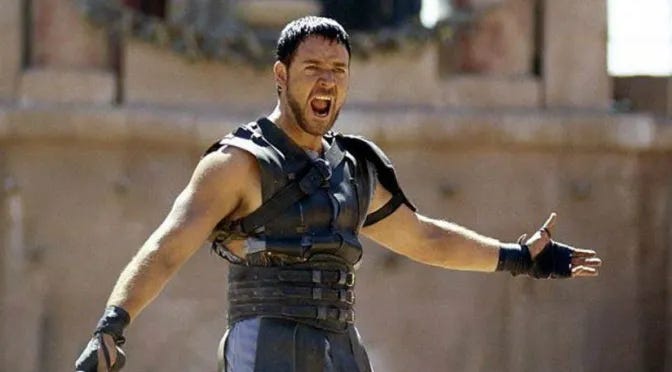
Watching all of this, I keep thinking about a scene from Gladiator — not the opening battle sequence that the White House cuts right between Braveheart and Walter White snarling “I am the danger” from Breaking Bad. I keep thinking about what Maximus says when he finally stands in the arena in Rome, after the killing is done, and turns to face the crowd. “Are you not entertained?”
He’s furious. He’s asking the question as an accusation. The crowd goes quiet with something like shame.
The White House prefers the hype video. Flawless Victory.
Here’s what those long arguments in Taipei actually came down to: the whole exercise was about the people. The 23 million people on that island who went about their lives — built businesses, raised children, developed one of Asia’s most vibrant democracies — while a rotating cast of American officers and diplomats in a building that wasn’t officially an embassy argued about how to keep them safe without making them a target. Every policy decision got weighed against that human reality. Not as sentimentality. As the actual metric of success.
You can do that math on Iran right now. Over 1,300 dead, including at least 181 children, according to current reports. Ninety million people who did not choose their government — many of whom, in fact, have been protesting against it at considerable personal risk — who got a theocratic dictatorship the same way the people of Taiwan got their geography: by being born in a particular place at a particular time, into a situation they did not design and cannot easily escape.
I think about those people all the time. Not as abstractions. As the whole point of the exercise.
I’m not saying don’t go to war. I’m not a pacifist, and I spent a career in uniform understanding that sometimes force is the only answer. What I’m saying is that somewhere between “force is sometimes necessary” and “Flawless Victory! (Mortal Kombat, 1992),” there used to be a step. The step where serious people in serious rooms asked what happens to the people underneath the explosions. Whether the pain being inflicted would actually produce the outcome we wanted. Whether we could live with it if it didn’t.
The Romans learned something we seem to have forgotten: once you turn killing into a spectacle, you start optimizing for the spectacle. The crowd doesn’t want post-conflict governance or cautionary lessons about power vacuums. The crowd wants another explosion. The crowd wants to see him do it again.
Russell Crowe’s Maximus knew what he was doing, screaming at that crowd. He was asking them to look at what they’d become.
I’m not sure we’re ready to look.
But I notice that nobody’s making meme videos about the 181 children. Nobody’s setting that footage to AC/DC.
I keep thinking about a conference room in Taipei, and arguments we never quite resolved, and 23 million people who are still prospering because thoughtful people stayed at the table long enough to keep asking the uncomfortable questions.
That used to be the job. Now they ask a different question.
Are you not entertained?