

It’s 2 AM and I’m sitting in a hotel room in Sarasota hate-watching Jurassic Park 3. I can’t sleep because no matter how heroically this 1972 air conditioner struggles to keep up, it still feels like I’m trying to sleep inside a slightly damp sock. Now for those unfamiliar with the Jurassic Park 3 plot: a twelve-year-old boy survives alone on a dinosaur island for eight weeks by collecting Tyrannosaurus urine (which turns out to be important later), and is saved when our heroes randomly encounter a satellite phone in a pile of dino poop (apparently digested after eating a random bit actor who was carrying the phone) and which, against all odds, still has battery life and a signal. I want to be clear that I didn’t make this up. It’s the actual plot (in screenplay terminology this is referred to as the McPoopin - that random item in which the entire outcome of the movie hinges).
It occurs to me that Jurassic Park 3 marks the precise turning point when Hollywood decided to stop making anything worth the $14.95 ticket price in favor of computer-generated slop. The irony is that I can’t seem to muster the energy to turn this masterpiece off. I’ve decided, apparently, that hate-watching the cinematic equivalent to brain candy is more therapeutic than lying in the dark with my own thoughts, which tells you everything you need to know about the current state of my inner life.
I need something to distract and quiet down what I’ve taken to calling my Monkey Mind. To be honest, I can’t take credit for coining the term. It comes from George Saunders, who is widely regarded as one of the finest short story writers alive and who therefore has significantly more credibility than I do on matters of the human condition. In his craft classes, he often refers to the noise inside our skulls as the “yapping monkey-mind.” When I first encountered this phrase, I experienced what I can only describe as the literary equivalent of a doctor looking at my X-ray and saying, with professional detachment, “Yup, there it is.”
The monkey-mind, as Saunders and the Buddhist tradition from which he borrows the concept describe it, is the part of your brain that cannot stop. It chatters. It swings from branch to branch. It cannot simply be in a room without also planning to leave the room, evaluating the room, mentally redecorating the room, composing a strongly-worded opinion about the room’s current décor, and wondering whether the room knows how much better it could be if it would just listen. The monkey-mind is not content to experience things. It must narrate them, improve them, correct them, and share them — preferably in that order, but really in whatever order gets the most attention.
Saunders’ solution is writing, or meditation, or some combination of the two that requires more personal discipline than I have managed to assemble on a consistent basis. His insight is that we can, with sufficient practice, quiet the monkey. Let it settle. Watch it, as he puts it, “uninflectedly” — without judgment, without the compulsive need to improve upon reality as it currently stands.
I have been attempting this practice for some years. Let’s just say my results have been mixed.
What I have discovered, through diligent research conducted largely in the company of other adults, is that the monkey-mind in its most destructive form is not the private variety. It’s not the inner critic, the creative saboteur, the 3 AM catastrophist who wakes you up to re-litigate decisions you made in 2009. Those are problems, certainly, but they’re fundamentally personal problems, contained within a single skull, amenable in theory to meditation and chamomile tea.
The truly spectacular monkey-mind is a social phenomenon. It is the monkey-mind that’s left the building, borrowed a megaphone, and begun recruiting acolytes.
Which brings me back to my 2 AM hotel hate-watch. I’m decompressing from an annual sojourn with six of my closest friends from elementary school. I want to be precise about the nature of this friendship: these are men I have known for nearly fifty years, which is long enough that we have witnessed each other’s worst haircuts, questionable romantic decisions, and every humiliating thing that happened between roughly 1976 and the present moment. This is a friendship forged in genuine history, cemented by decades of mutual improbability, and it’s one of the things in my life I am most grateful for.
It is also, increasingly, a psychoanalyst’s wet dream of a case study disguised as a vacation.
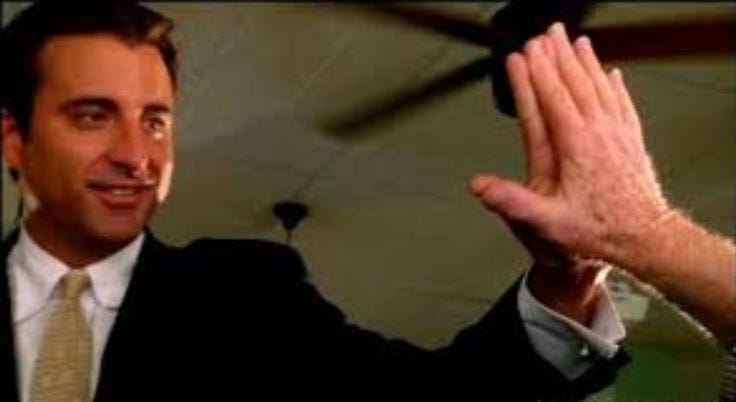
Our little Jersey reunions have a greeting. It comes from an obscure Andy Garcia movie that nobody else has seen, and it doesn't matter — what matters is that in the movie, two guys press palms and say "boat drinks," and everyone in the room knows exactly what it means: someday we'll be retired, somewhere warm, with nothing more pressing than the question of what's in the cooler. Seven men, hyperaware of their looming mortality, convening annually to remind each other what's important. To the average untrained observer, this is exactly what it appears to be — old friends catching up, laughing too loud, consuming a reasonable amount of alcohol without anyone's wife present to provide quality control. It’s boat drinks. It's the kind of friendship that deserves its own Oprah segment, or at minimum a Springsteen song, which given that we're all from Jersey is basically the same thing.
Reality however, is somewhat more complicated.
Through gradual and probably irreversible drift, what was once a relaxed annual reunion has become something closer to an improv competition in which nobody is officially performing but everybody is absolutely performing. The stories have gotten longer. The insights have become more unsolicited. The advice has grown exponentially in volume, developing a kind of compound interest that nobody asked for and nobody can seem to stop accruing. Every conversation has become an opportunity to demonstrate that your monkey has the most information and the best opinions about what to do with it.
There are, I should say, significant variations within the group. There’s Mr. White, a wine and spirits expert and man of genuine good humor who is currently navigating the turbulent waters of the over-fifty singles dating scene — a terrain so treacherous it deserves its own Discovery Channel special. Mr. Blonde, a divorced schoolteacher doing the noble work of shaping young minds on a public school salary, which in practical terms means he’s watched people who work one-tenth as hard make ten times the money for so long that he’s developed an uncontrollable body tic. Mr. Orange, who’s cracked what the rest of us are still unsuccessfully working toward: actual work-life balance, weighted emphatically toward life. And Messrs. Black and Blue, two savvy Ivy League lawyer brothers who between them can tell you exactly why whatever you’re planning to do is inadvisable, which is both impressive and, at a certain point in the evening, slightly exhausting.
And then there’s Mr. Pink, which in no way reflects the particular shade his Jersey skin turns after three minutes of unprotected Florida sun exposure. (The technical term, I believe, is “boiled lobster.”)
Mr. Pink is the least monkey of us. He’s achieved something I can only describe as a practiced stillness — not the stillness of someone who has nothing to say, but the stillness of someone who’s decided, apparently some years ago, that saying it is optional. He listens. He occasionally smiles. When he does speak, it is with the unhurried quality of a man who has verified that the sentence actually needs to exist before releasing it into the world. He is, in the context of six other men all simultaneously attempting to steer the conversation, the human equivalent of a load-bearing wall. You don’t always notice him. But if he weren’t there, the whole structure would be different.
I’ve spent considerable time studying Mr. Pink in the field, trying to identify the technique, because the technique is clearly something I could use. What I’ve concluded is that there is no technique. He is just genuinely interested in other people and genuinely unbothered by the performance of being interesting himself. This sounds simple. It is, in practice, extraordinarily difficult, which is why the rest of us spend so much energy pretending we’ve figured it out.
The annual trip’s pinnacle moment — its set piece, its third act — occurs on Sarasota Bay, aboard a rented pontoon boat. Literally “boat drinks.”
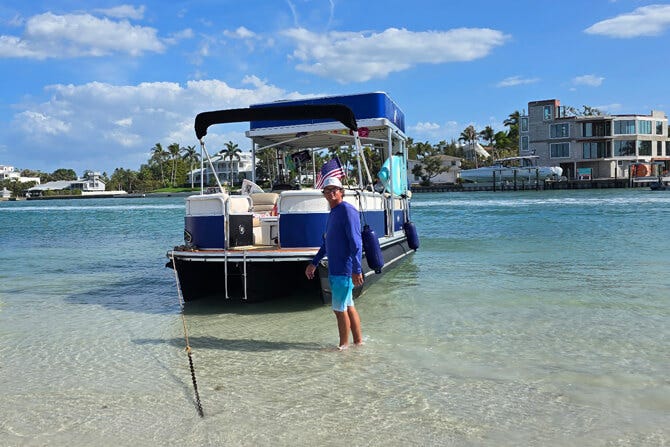
I want you to understand what a pontoon boat is, in case you have led a sheltered life: it is a flat platform mounted on metal tubes, powered by an outboard motor, designed to move at a speed that is technically faster than swimming but spiritually equivalent to drifting. It requires approximately the same level of nautical expertise as operating a very large air mattress. The controls consist of a steering wheel, a throttle, and a start/stop button. That’s the full curriculum. A motivated golden retriever could be certified.
We had seven men, a cooler full of beer, and about three hours on the water. What could go wrong.
The people who rent pontoon boats have clearly developed a sophisticated understanding of their customer base through what can only be described as accumulated trauma. They know, from extensive empirical evidence, that a vessel can have only one captain, and that this captain is traditionally the person whose credit card was put down as collateral. He’s officially in command. He has the wheel. He is also, they know, about to receive more simultaneous nautical advice than any single human being can productively absorb, from people whose combined maritime experience consists of watching the boat scene in Jaws and a 1992 inner tube trip down the lazy river.
In a just and sensible world, one person would drive the boat while everyone else occupied the perfectly comfortable benches and looked out at the water, which is the entire point of a pontoon boat and also the reason it comes equipped with maximum heat absorbing faux leather chairs. Instead, what we achieved was something rarer and more remarkable: a state of collaborative confusion so total that it had become, paradoxically, its own course of action. Seven monkey-minds, fully engaged, each one thoroughly convinced they were the only calm person on the boat.
Within approximately four minutes of departure, simultaneous instructions were being issued regarding: the proper technique for steering away from sea grass, the appropriate RPM for shallow water, the ideal angle of approach to avoid the propeller contacting the bay floor, the correct procedure for dropping anchor, the inadvisability of the anchor location we’ve just chosen, the superior anchor location that was clearly over there, the technique for exiting the boat into the water, the technique for re-entering the boat from the water (a related but distinct skill set), whether we were going too fast, and the counter-argument that we were, in fact, going too slow. At one point, to my recollection, we were actively receiving instruction on all of these simultaneously, which means we were also somehow going both too fast and too slow at the same time, a unique nautical achievement.
The water was beautiful, incidentally. The bay was flat and silver and warm. There were birds. Someone mentioned dolphins at some point; I can’t independently verify this because I was monitoring a developing dispute about sea grass. The sun was the particular late-afternoon gold that makes the Gulf Coast look like a photograph of itself. As best I could determine, none of us actually saw any of this in real time. We were too busy improving the experience.
Mr. Pink sat in a chair at the front of the boat, facing forward, watching the water. He had a beer. He appeared to be, and I use this term deliberately, at the bay. Once or twice I caught him noticing something — a bird, a shift in the light, I couldn’t tell — with the quiet attention of someone who has concluded that observing a thing is, in itself, sufficient. That you don’t necessarily have to announce it, or improve upon it, or issue corrections regarding it. He didn’t tell anyone how to steer the boat.
He also, I noticed, looked profoundly relaxed.
This is what Saunders is getting at, I think, when he talks about the monkey-mind: it’s not just about private distraction, not just the phone-checking and the dopamine-grazing and the ambient noise we pour into our skulls to avoid the discomfort of a quiet moment. It’s also about the social version of all that — the compulsive narration of experience, the performance of competence, the need to add something to every moment as proof that you were there and you understood it and frankly you understood it better than the person standing next to you.
The monkey doesn’t just want attention. The monkey wants to be the smartest monkey in the tree.
We got the boat turned around eventually. The anchor situation resolved itself, or we collectively abandoned it, which amounts to the same thing. Some of us swam. Some of us declined to swim, citing unnamed concerns about water quality that were aired at some length by someone who had just skimmed an article about brain-eating amoebas. We made it back to the dock without incident, which I attribute mostly to the bay’s patience and the boat’s basic willingness to go in the direction it was pointed if you just left it alone for five consecutive seconds.
On the drive back, I found myself next to Mr. Pink for a few minutes and asked him — because I genuinely wanted to know — if the afternoon had been as exhausting for him as it had been for me. He thought about it for a moment. Not performatively. Not with the theatrical pause of a man positioning himself to deliver an insight. Just actually thought about it.
“The water was beautiful,” he said.
That was it. That was the whole answer. He hadn’t been managing the afternoon, or surviving it, or cataloguing its operational failures. He’d been on a boat on a beautiful bay with his friends, and the water had been beautiful, and apparently that had been enough.
I’ve been thinking about that sentence for a few days now. Not because it’s profound — it’s not, or at least it’s only profound in the way that very simple true things are occasionally profound when you encounter them at exactly the right moment — but because of how much effort it represents. How much deliberate quieting of something that doesn’t want to be quiet.
George Saunders says the monkey-mind can be tamed. That with practice, with intention, with something resembling discipline, you can turn down the chatter and just look at the thing in front of you — without agenda, without the compulsive need to improve or correct or perform.
I believe him. I’m just not sure I’ve done the work.
Seven of us rented a boat on Sarasota Bay on a spectacular afternoon, and one of us actually went to the bay.
I’m trying to be that guy.
I’m not confident I’ll succeed. But it’s better than the alternative — sleeping in a damp sock and sitting through another McPoopin movie.
I think the water is beautiful too. But I'm also pretty terrified of the brain eating ameoba.
loved this thoughtful look at how we spend time together. authentic.