

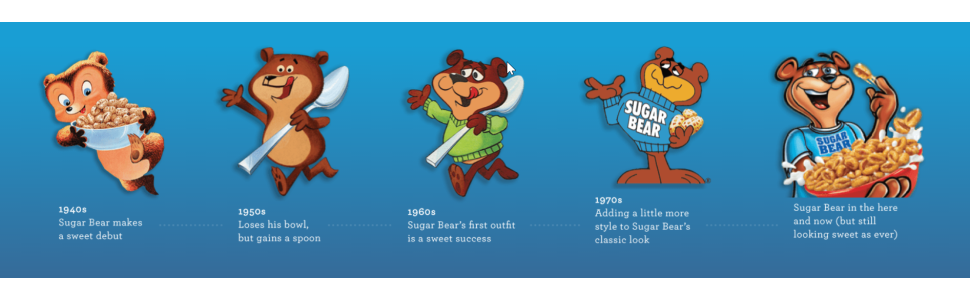
It’s a new year, 2026, which got me thinking deeply about some very existential stuff. For example, whatever happened to Sugar Bear? You remember Sugar Bear—that impossibly smooth-voiced mascot for Super Sugar Crisp? That bass-singing bear who made breakfast cereal seem cool, jazzy, like something Dean Martin might eat if Dean Martin ate sugar-coated puffed wheat. That bear convinced an entire generation that starting your day with sugar-coated puffed wheat was not just acceptable but aspirational.
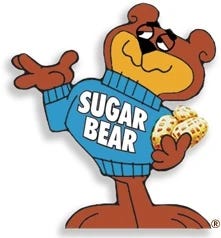
Turns out Sugar Bear is still technically around, but he’s been declawed, neutered, stripped of his swagger. Now they call it “Golden Crisp” with no mention of sugar in the name, as if we’ve agreed to pretend we’re eating it for the “golden” and not for the “sugar-coated puffed wheat” that crunches like tiny sweet stones of joy.
I understand Tony the Tiger’s still working—that tiger’s got job security—but he’s been retrofitted. Now he’s promoting “exercise” and “balanced breakfast” alongside Frosted Flakes, as if any child in history has ever associated Frosted Flakes with balance. Who knows what Toucan Sam is up to, now that he’s been CGI-animated into a soulless husk.
But ol’ Sugar Bear represented something bigger than breakfast. The day Sugar Bear lost his swagger marked the exact point at which American culture decided that joy needed to be justified, regulated, and eventually eliminated for our own good. You can’t just like Froot Loops anymore. You need to acknowledge they’re “problematic.” You need to eat them “ironically.” You need to apologize for enjoying them.
This bothers me more than it should, which is how I know I’m officially old. Which brings me to why I already hate 2026. At least each and every morning that 2026 has in store for me.
The medical people call it “elevated LDL cholesterol.” I call it “my body’s declaration of war against joy.”
“I recommend oatmeal,” Doctor Eric told me, with that casual confidence of someone who doesn’t ever have to actually eat oatmeal. “Try mixing in some psyllium fiber.”
“Psyllium fiber?”
“Like Metamucil. It binds to the cholesterol in your digestive tract.”
Think about that sentence. I’m at the age where I have to start my day by eating something that “binds to things in my digestive tract.” This is not how mornings are supposed to begin. Mornings are supposed to begin with denial and coffee, not voluntary consumption of binding agents.
So now, along with a host of other healthy habits I plan to subconsciously sabotage over the next 30 days, I’m eating oatmeal. This is not, by the way, a New Year’s “resolution.” “Resolution” is, according to Freud, a word of ill-repute (not Sigmund, but Harold Freud, my college roommate. Harold once described the use of “resolution” as permanently stigmatized, that is, ruined beyond repair, like a house where you found bodies buried in the backyard. You can repaint it, put up new shutters, plant some cheerful tulips, but everyone still knows about the bodies).
So this isn’t a resolution. Let’s call it a lifestyle ambush orchestrated by my own cardiovascular system.
My wife comes from a long line of oatmeal connoisseurs. She recommends Bob’s Red Mill organic oatmeal, produced by what I can only assume are bearded men living in a picturesque village somewhere in Oregon, running actual stone mills while shrouded in a constant cloud of oat dust. Their colons are probably magnificent. The bag features Bob himself looking at me with the quiet judgment of someone who’s never experienced the transcendent joy of Froot Loops.
Bob’s oatmeal is described as “old-fashioned,” which is marketing speak for “tastes like what pioneers ate because they literally had no other options.” The instructions are deceptively simple: Combine oats with water. Heat. Add toppings. What they don’t tell you is that the result has the taste and texture of library paste, if library paste had somehow achieved even less flavor. It’s not bad, exactly. It’s the absence of bad. It’s the culinary equivalent of beige, of elevator music, of every conversation you’ve ever had about Barry Manilow.
Then comes the Metamucil, which deserves its own paragraph because adding Metamucil to anything deserves documentation.
Apparently Metamucil has been around a long, long time. Since 1934, which explains everything. In the 1930s, naming conventions apparently were simpler. You take a vaguely scientific-sounding prefix (Meta-), add a suffix that implied medical credibility (-mucil), and suddenly you’ve got a product that sounds like it could either cure you or turn you into a superhero. By the 1950s, Metamucil ads featured women in pearls enthusiastically discussing their digestive regularity at dinner parties, because apparently that was both socially acceptable and considered sophisticated cocktail conversation. I have to admit, the brand name sounded space-age, futuristic, like Tang, like something from the Marvel Cinematic Universe before the Marvel Cinematic Universe ruined everything.
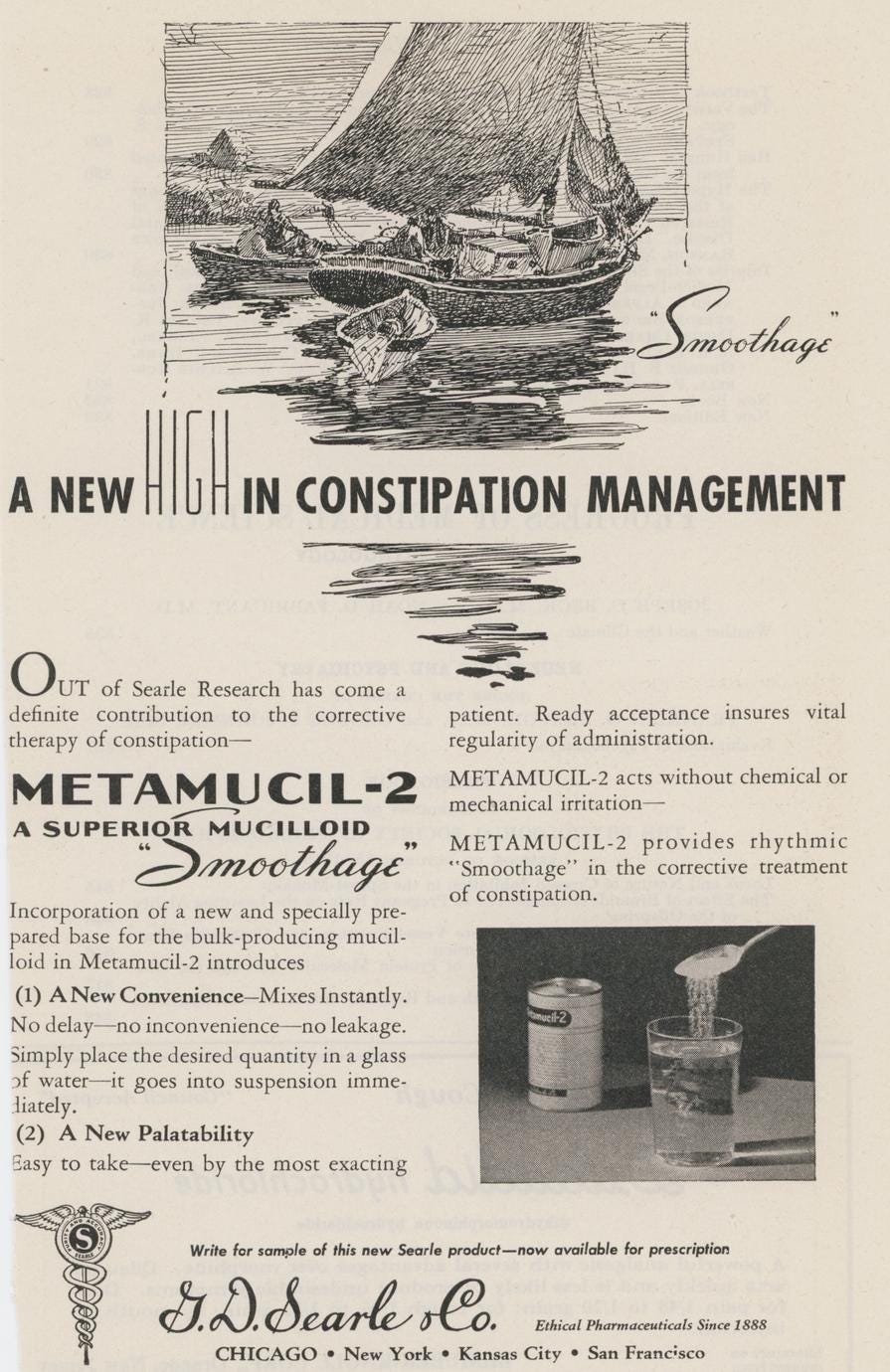
Now, in 2026, “Metamucil” sounds vaguely sinister, like a tech conglomerate that definitely has your data and possibly your DNA. I half expect to open the container and find it’s actually a surveillance device that reports my fiber intake directly to my insurance company.
The active ingredient is psyllium husk, which comes from the seeds of Plantago ovata, a plant that sounds made up but isn’t. When you add it to liquid, it forms a gel. A thick, viscous gel that “binds to cholesterol in your digestive tract” the way the Democrats bind to disappointment—thoroughly and permanently.
Speaking of Democrats, my mother-in-law subsists entirely on oatmeal, Metamucil, and what I can only describe as “optimistic denial about the passage of time.” She will probably live to be 101. She adds only raisins and banana slices to her oatmeal—foods that have already given up, foods that have accepted their fate, foods that pair naturally with binding gel because they too have lost all will to live. She eats this every morning with genuine satisfaction, which tells me either something’s broken in her taste receptors or she’s achieved a level of inner peace I’ll never understand.
I, on the other hand, require significant modification to make this breakfast remotely edible. Here’s what I add to my morning bowl of oatmeal and binding gel: brown sugar (the only sugar acceptable for adults to consume, because it looks serious), “maple-flavored syrup” (which is actually high-fructose corn syrup that had a weekend in Vermont once), cinnamon (to create the illusion of flavor), and almonds (because my wife watches, and almonds look like a choice a responsible adult male should make).
When she’s not watching: chocolate chips. Don’t judge me.
By the time I’m done, I’ve added roughly 400 calories of sugar to this healthy breakfast, which possibly might defeat the purpose, but at least I’m eating it, which I’m told is better than not eating it, though I have my doubts. My doctor assures me this is healthy. I remain unconvinced. There may be some rudimentary scientific studies that suggest psyllium husk binds to cholesterol in my digestive tract, but now that we have RFK Jr. and Elon Musk, do we really need science anymore? I prefer to maintain a healthy skepticism about voluntary consumption of plant-based binding gel.

You know what doesn’t require modification? Reese’s Puffs cereal. Reese’s Puffs come pre-modified for maximum joy. But I can no longer buy Reese’s Puffs, at least not with any sense of dignity or self-respect, and if that doesn’t perfectly capture what’s happening to America right now, I don’t know what does.
This realization hit me way back in 2025 in the cereal aisle at Safeway. I picked up a box—that beautiful, bright orange box with perfectly chocolaty and peanut buttery puffs floating in a giant, milk-filled Reese’s-shaped paper bowl, promising a mouthful of artificially-flavored, nutritionally-questionable, perfectly-sweetened ball of joy—and I saw my reflection in the freezer glass across the aisle. A 50-something man. Holding Reese’s Puffs. Alone.
It’s not that I’m ashamed of Reese’s Puffs. Reese’s Puffs are objectively delightful. Each little ball is a perfect delivery system for a perfect blend of chocolate and something vaguely reminiscent of peanut butter, but exactly like Saturday morning cartoons. The milk turns chocolaty. The balls stay crunchy for exactly the right amount of time. It’s engineered perfection, the culmination of decades of food science research and focus group testing.
But somewhere between my twenties and now, society collectively decided that adults eating cartoon-mascot cereal is a red flag, a sign of arrested development, evidence of failure to launch. You can buy wine shaped like juice boxes. You can debate the merits of Marvel vs DC Justice League as if its both real AND important, but God forbid you put Froot Loops in your shopping cart next to the arugula and artisanal cheese.
The judgment comes from multiple sources. First, there’s my wife, who discovered a box of Cap’n Crunch hidden behind the Quaker Oats last year and looked at me like I’d been having an affair. Which, in a way, I suppose I was. An affair with 1975.
“This has more sugar per serving than actual candy,” she said, reading the label with the intensity of a prosecutor presenting evidence.
“That’s the point,” I tried to explain. “That’s literally the entire value proposition.”
She didn’t throw it away. She didn’t suggest I eat it sparingly. I wish she had. Instead I got the look of disappointment and dismissal. Like it was contraband. Like I was sneaking a cigarette. That look that says, “It’s your life…” or in my wife’s case, “I just hope your life insurance is up to date…”
I now understand why some husbands hide contraband in the garage. But my garage is functionally located in another time zone for purposes of sneaking midnight cereal. Plus there’s no place to store milk or spoons. All the best hiding places are already taken anyway. I hide the edibles in the tool cabinet. The vanilla wafers go behind the camping gear. (Sigh) I’ve become the kind of person with a contraband management system.
You can’t just like things anymore. You need to explain them, justify them, apologize for them. This applies to cereal, to politics, to having opinions about anything. Everything requires a disclaimer, a caveat, an acknowledgment that yes, you know this thing is problematic but you’re engaging with it anyway in a way that proves you’re self-aware about your own complicity.
Reese’s Puffs represent nothing except the desire for your breakfast milk to turn chocolaty. But we can’t have that anymore. We have to have oatmeal with binding gel that literally attaches itself to things inside our bodies like some kind of internal TSA checkpoint.
This morning I made my oatmeal. I added my Metamucil. I watched it gel—and it does gel, I’m not being meta-phorical, it actually forms a viscous mass that moves like a sentient blob from a 1950s horror movie, which feels appropriate given that Metamucil was invented back then. I added enough brown sugar to possibly negate any health benefits. I ate it at the kitchen counter while my wife drank her coffee and looked satisfied, the way a warden looks satisfied when the prisoner eats their meals without incident.
My daughter—home from college for winter break—watched me eat with unconcealed horror.
“Is that… fiber?” she asked, pointing at the orange container.
“It’s called Metamucil.”
“Isn’t that what Grandma eats?”
“I’m aware.”
“You’re fifty.”
“I’m fifty-eight.”
“That’s so much worse.”
And that’s when it hit me: I’ve become my parents. Not gradually. Not slowly. But completely and suddenly, marked by this exact moment, with this exact breakfast. My daughter now judges my cereal choices the way I used to judge my father’s habit of eating Grape-Nuts—that cereal that wasn’t actually made of grapes or nuts and had the texture of aquarium gravel. I used to watch him eat it with milk and wonder what happened to a person that they’d voluntarily choose that for breakfast.
Now I know. What happens is your body betrays you. Your cholesterol gets “elevated.” Your doctor uses words like “cardiovascular risk.” And suddenly you’re eating binding gel and defending it.
“It’s actually not that bad,” I told my her, which is exactly what my father said about Grape-Nuts, and exactly the thing I swore I’d never say about anything.
She looked at me with pity. “Do we have Reese’s Puffs?” she asked.
There’s a box in the pantry. The same box I bought “for when the grandkids visit” even though none of my children have children. It’s been there for six months. Unopened. Waiting. Sort of like Sugar Bear, waiting for America to remember that breakfast used to be fun.
“Go ahead,” I said.
She poured herself a bowl, and the puffs rattled into the ceramic with that distinctive sound—the sound of childhood, of Saturday mornings, of a time before your body required binding gel and fiber supplements. The milk turned faintly chocolaty. She ate standing up, scrolling through her phone, completely unaware that she was participating in a small act of resistance against time itself.
I finished my oatmeal. It was fine. It was healthy. It was the breakfast of someone who’s accepted that joy must sometimes be sacrificed for LDL cholesterol reduction. This isn’t a resolution. It’s a surrender. But at least I’ve found new purpose in my life: having something age-appropriate to resent every single morning for the rest of my prolonged, fiber-supplemented life.
Which, according to my mother-in-law, could be another fifty years.
Somewhere, Sugar Bear is eating Golden Crisp and pretending it doesn’t taste like defeat. I understand completely.
The Reese’s Puffs are going in the garage tomorrow. Behind the edibles. Next to the vanilla wafers. Where they belong.
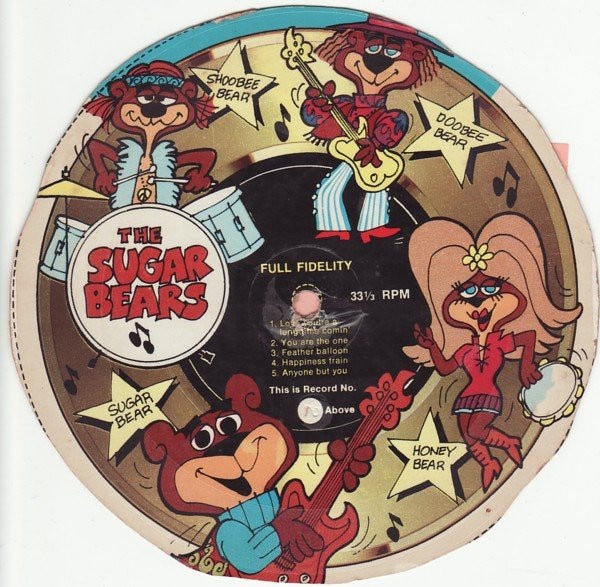
PS: From Wikipedia: “In 1971, producer Jimmy Bowen, singers Kim Carnes (yes, THAT Kim Carnes!!) and Errol Sober, songwriters Baker Knight, Mike Settle, and others created a bubblegum pop studio group named the Sugar Bears. A cardboard cut-out record was produced and printed on the back of thousands of Super Sugar Crisp cereal boxes. The illustrated record identified four members: Sugar Bear, Honey Bear, Shoobee Bear, and Doobee Bear. Five different versions of the record were printed, each with one of five songs shown on the label. A commercial album, Presenting the Sugar Bears, and three singles were released by Big Tree Records with one song, "You Are the One", reaching No. 51 on the Billboard charts.”
Listen to their Top 51 hit on YouTube here: You Are the One by the Sugar Bears