
INT HOLLYWOOD: Chariots of Fire
Ben-Hur's Epic Story from Page to Screen

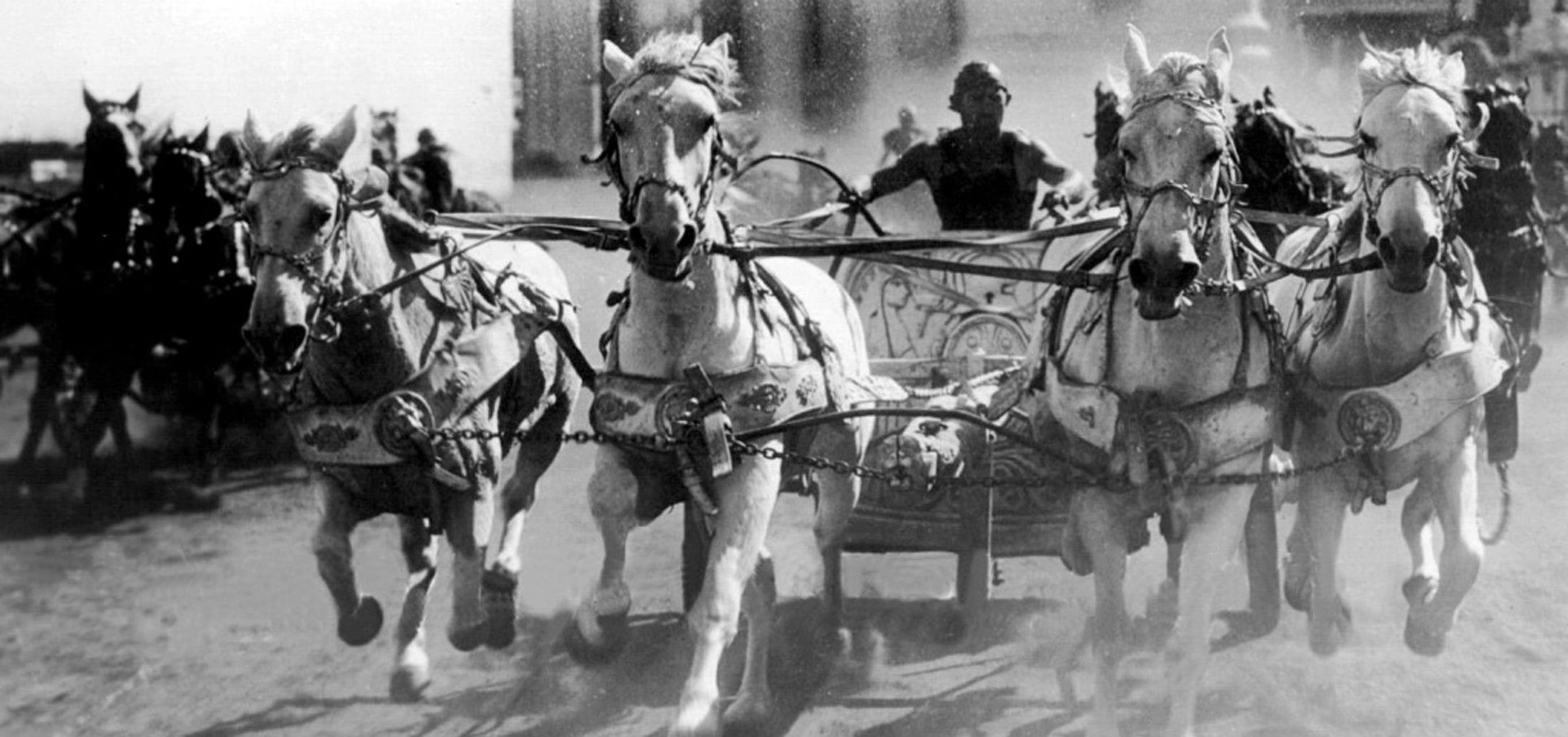
Ahhh, Easter… hope, renewal, and the triumph of life over death. And plenty of secular traditions as well: Easter baskets, marshmallow sugar bombs, cats obsessively digesting green plastic grass. But I have a secret to confess: while most of you are dying eggs and digging jelly bean residue out of your molars, I'll be rewatching the greatest Easter-adjacent epic ever filmed. That's right – it's time for my annual Ben-Hur pilgrimage, a tradition as sacred as chocolate bunnies and Cadbury eggs.
Wait…What??? You've never seen all 3 hours and 42 minutes of Ben-Hur? The Ben-Hur? Oh my...
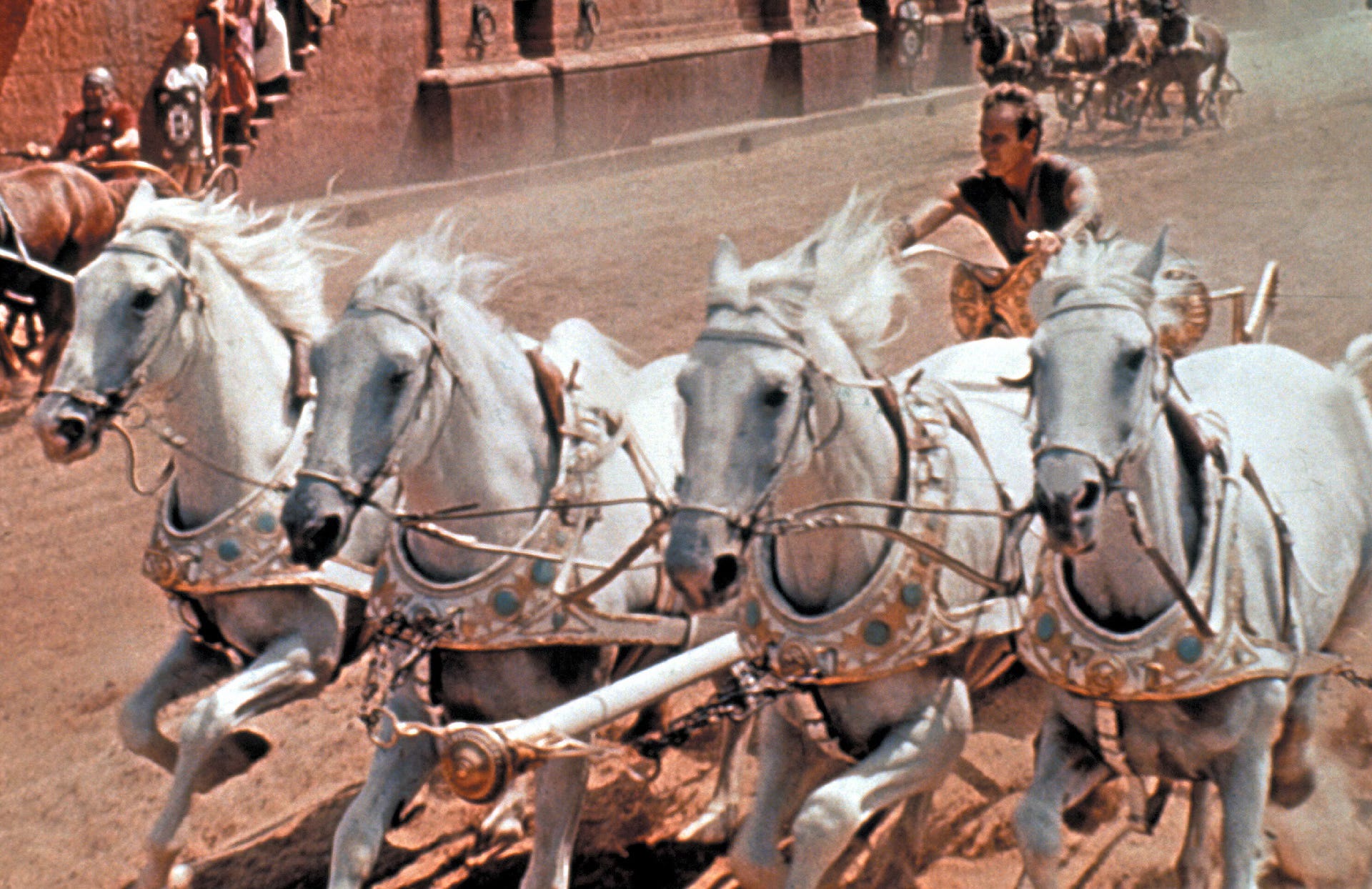
Okay, yes, its’s painfully melodramatic, historically inaccurate, slightly racist, and Charlton Heston’s acting is hammier than an Easter dinner. But (a big, fat capitalized BUT!), before you dismiss it as just another dated, overstuffed Hollywood biblical epic, consider the following: First film ever to win 11 Academy Awards; over 100,000 costumes, nearly 15,000 extras, 300 sets, and nine sound stages; 1.1 million feet of celluloid were used; at a staggering production cost of $15 million to produce (about $163 million today), and another $15 million to market that nearly bankrupted MGM! And oh, did I mention the chariot scene: nine-minutes of cinematic history that revolutionized filmmaking! This isn't just film history – it's cultural history written in celluloid and sweat. But wait, that’s not all! William Wyler’s 1959 epic wasn’t even the first Hollywood effort — it’s the third remake of the classic novel. If ever there was a cinematic rabbit hole worth tumbling down, Ben-Hur is it! So come, walk with me…
The Ben-Hur story begins not on a movie set but with a chance encounter on a train in 1876, when Union General Lew Wallace found himself in conversation with renowned agnostic Robert Ingersoll. Their discussion on faith (or lack thereof) supposedly troubled Wallace so deeply that he embarked on years of religious research, culminating in his 1880 masterwork "Ben-Hur: A Tale of the Christ." It became the 19th century's publishing phenomenon – outselling "Uncle Tom's Cabin,” becoming the best selling book in America until Margaret Mitchell’s “Gone With the Wind” 50 years later – and it created a literary hero who would eventually race his way into film history.
What fascinates me most about Wallace isn't just his literary success but the spectacular rabbit hole of his life. Here was a Civil War general, governor of New Mexico Territory (where he tangled with Billy the Kid, no less), and eventually U.S. Minister to the Ottoman Empire – writing much of his biblical epic in a custom-built study resembling a military tent because he found it easier to concentrate in surroundings that reminded him of wartime. If that doesn't scream "complicated genius," I don't know what does.
But Wallace's novel was merely the starting gate for what would become a cinematic tradition spanning more than a century. Before we get to the famous versions, there's a fascinating legal footnote: the 1907 Ben-Hur was a mere 15-minute unauthorized adaptation that inadvertently changed entertainment forever. When producers made this short film without permission, the Wallace estate sued – resulting in a landmark Supreme Court ruling that extended copyright protection to motion pictures. Without this early Ben-Hur, the entire landscape of film rights and intellectual property might look radically different today.
Then came the 1925 silent version that nearly bankrupted MGM with its then-astronomical $4 million budget (about $73 million today – practically a bargain by modern standards). This stunning and beautiful epic was revolutionary for its time, particularly in its use of two-strip Technicolor for specific sequences like the Crucifixion – a visual technique that transformed these scenes into something approaching religious art. The New Yorker's film critic Theodore Shane wasn't exactly impressed with how those millions were spent however, quipping that the production 'represents the expenditure of $4,999,999.95 on massive effects and the remaining $.05 on drama.' Ouch! But what magnificent effects they were.
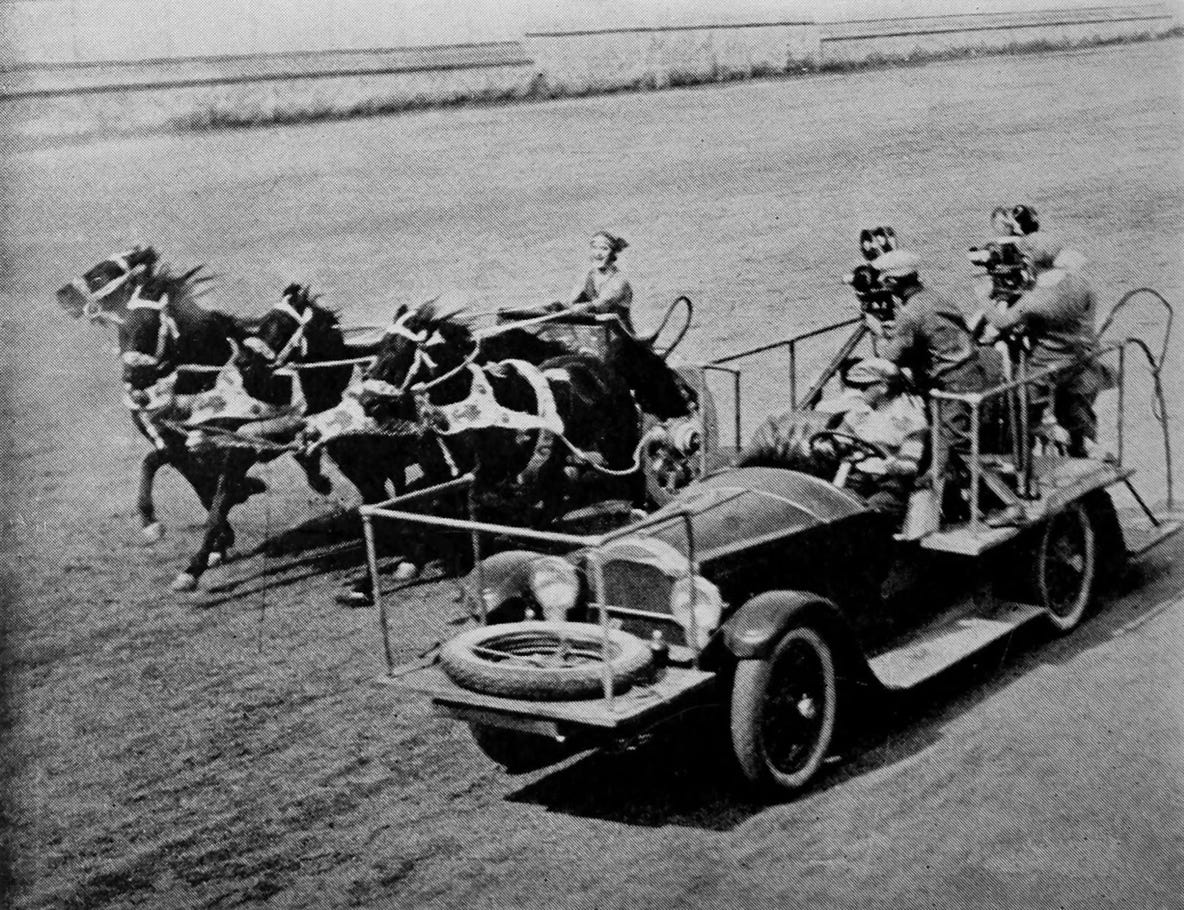
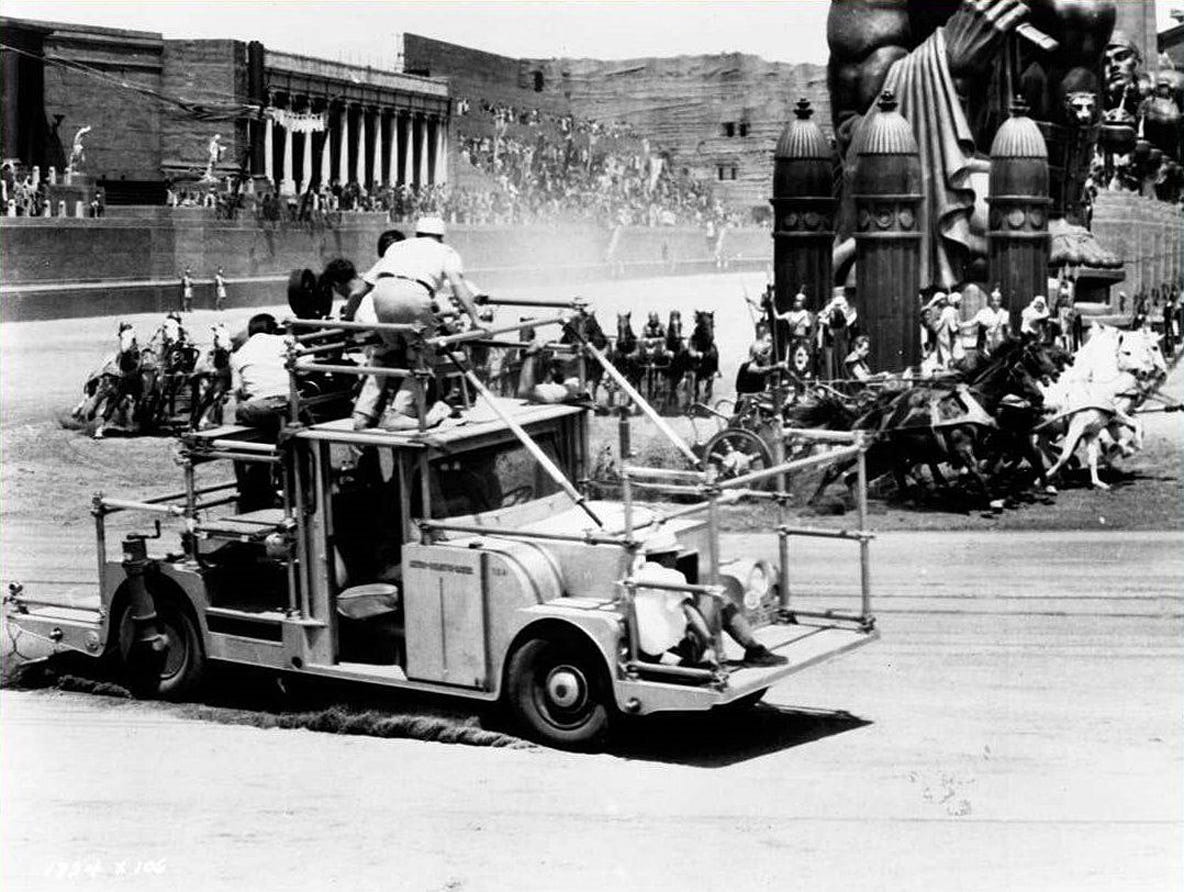
The legendary chariot race sequence was a spectacle unlike anything cinema had seen before. A hanging miniature created the illusion of thousands of spectators, while forty-two different cameras – hidden in the rafters, dug into the track, placed within statues, and even cut into the holes of guards' shields – captured every angle of the action. Never again would Hollywood deploy so many cameras for a single scene.
The crowd that day was practically a Who's Who of future Hollywood royalty – John and Lionel Barrymore, Joan Crawford, Marion Davies, Douglas Fairbanks, Dorothy and Lillian Gish, Harold Lloyd, and Mary Pickford were all recruited as extras to fill the stands. Hollywood legend has it that MGM executive Louis B. Mayer found the initial races too tame, so he offered $5,000 prize money to the winner. Riders and stuntmen took it all too seriously. The resulting pileups caused severe injuries and cost the lives of several horses. If Mayer were alive today, the American Humane Association would have burned him in effigy.
The scale of the production was staggering – for the chariot race sequence alone, cameramen captured an astonishing 200,000 feet of film. Poor editor Lloyd Nosler then faced the Herculean task of whittling that mountain of footage down to just 750 feet for the final release. Imagine cutting 99.6% of your work and still creating one of cinema's most memorable sequences! Two hours and 21 minutes of silent film mascara and melodrama may be too much for even a diehard fan to handle, but the 13 minute chariot race is cinematic history well worth the investment.
The 1925 production was plagued with other troubles, including the tragic death of a stuntman during the naval battle scene – footage that, in a decision that would be unthinkable today, remained in the final cut
Hollywood lore is filled with whispers of the "Ben-Hur Curse," and the 1925 production certainly contributed to this mythology. But curses make for compelling stories, and compelling stories are what brought audiences back for the truly definitive version: William Wyler's 1959 epic.
Wyler, in a twist worthy of our magazine's love for historical connections, had actually been an assistant on the 1925 version – a proverbial charioteer returning to take the reins (I promise that's my only chariot pun... maybe). His vision would transform a big-budget biblical adaptation into arguably the greatest epic Hollywood has ever produced, winning an unprecedented 11 Academy Awards – a record unmatched until "Titanic" tied it 38 years later.
The production stories from the 1959 version deserve their own magazine issue: Charlton Heston wasn't the studio's first choice (imagine Marlon Brando or Burt Lancaster in the role); Stephen Boyd played Messala with a homosexual attraction to Ben-Hur – a subtext deliberately kept from Heston; and during the famously dangerous chariot race, Heston's stunt double was thrown from his chariot, leading the star to perform much of the sequence himself.
That nine-minute chariot race remains a masterclass in action filmmaking, requiring five weeks to shoot, hundreds of horses, and 7,000 extras. The sequence proved so influential that filmmakers have been copying it for decades, most shamelessly by George Lucas, whose pod racing scene in Star Wars: The Phantom Menace is essentially Ben-Hur with engines – right down to the sabotage, crashes, and underdog triumph.
What stands out most about Ben-Hur's journey from page to screen is how a story originally written as "A Tale of the Christ" transformed into a Hollywood property where spectacle and revenge often overshadow its spiritual origins. Yet the film's emotional core remains profoundly Easter-centric – Ben-Hur's mother and sister are healed of leprosy through Christ's sacrifice, and the protagonist's thirst for revenge dissolves in the shadow of the cross.
For decades, Ben-Hur was Easter weekend television programming, as traditional as sunrise services. The 2016 remake attempted to recapture this cultural relevance but stumbled at the box office, perhaps confirming the curse, or perhaps just confirming that some stories are best told in specific cultural moments, with specific filmmaking approaches that can't be easily replicated.
So this Easter season, as you hunt for eggs or consume your body weight in jelly beans, consider taking a detour to ancient Rome via Hollywood. The chariot race awaits, and beyond it, a story of redemption that's managed to captivate audiences for nearly 150 years. And that’s what makes an internet rabbit hole worth the effort – discovering those unexpected connections that make our cultural landscape so rich and strange.
Until next issue, fellow travelers. May your Easter be blessed, your spring renewed, your leprosy rinsed away, and your chariot races always victorious. ∞
Links:
Ben-Hur, 1907, Silent Film
Ben-Hur, 1925, Silent Film Starring Roman Novarro and Directed by Fred Niblo
Ben-Hur, 1959, Starring Charlton Heston and Directed by the Great William Wyler
For those curious about Wallace's life beyond Ben-Hur, I highly recommend the biography "Shadow of Shiloh: Major General Lew Wallace in the Civil War" by Gail Stephens – another delightful rabbit hole for the historically inclined.