
Dogs Who Stare at Goats
And Other Quasi-Linguistic Crises of Global Proportions

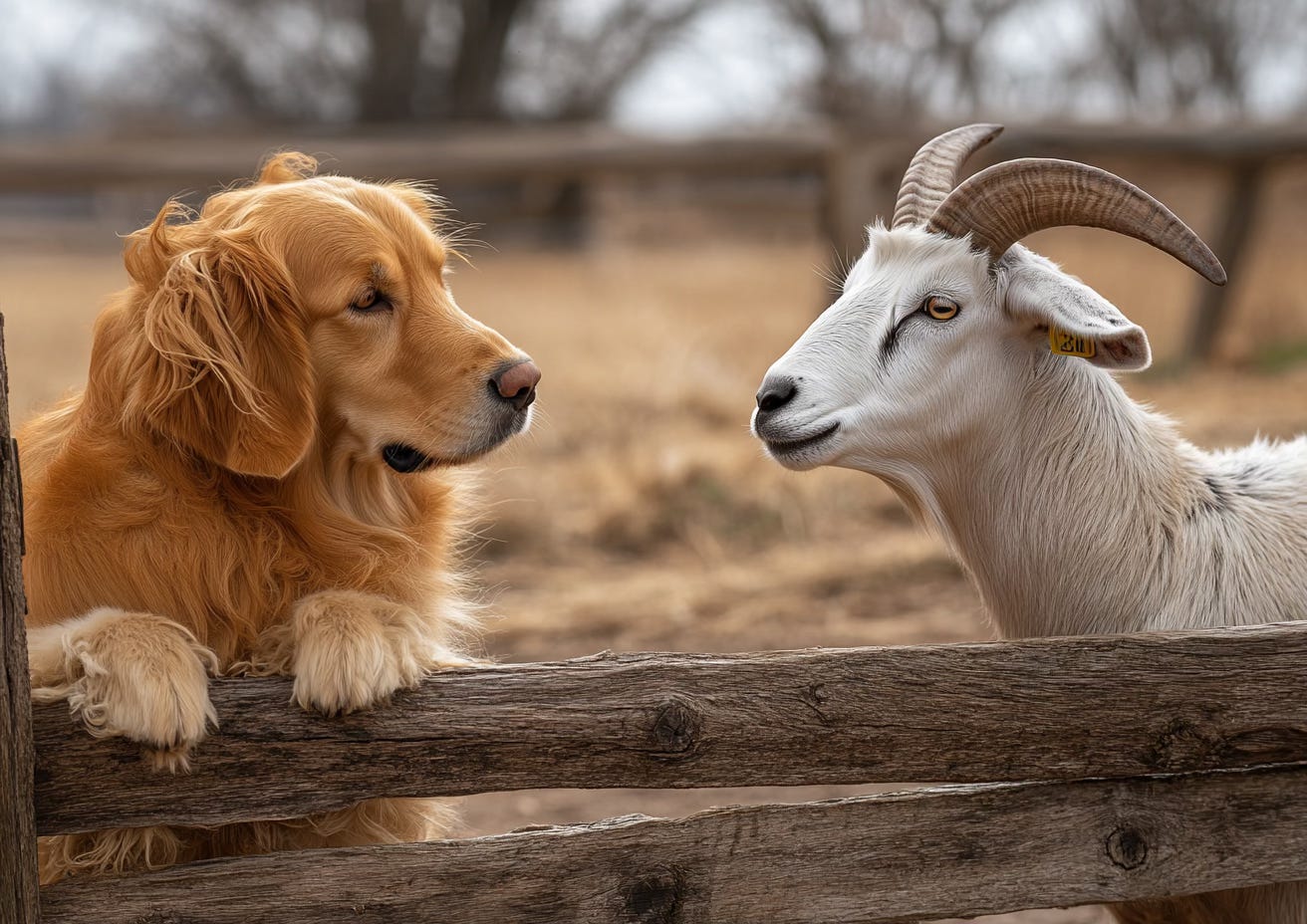
Recently, while engaged in what my wife calls "pretending to do yard work," I noticed my neighbor Joe using my garden hose to fill the water troughs for his goats. I'm completely fine with this, since a significant portion of my day involves walking my golden retriever, Pax, down to Joe’s goats where she practices what I assume are advanced canine telepathy techniques. Pax stares at the goats with laser-like focus for upwards of twenty minutes, and the goats stare back with equal intensity. I can only assume they're engaged in some form of inter-species negotiation that will become relevant when the animal uprising eventually occurs. “Four legs good, two legs baaaaaad!”
But I digress. As Joe was returning my hose, he mentioned, "By the way, your spigot has a slow leak.” Thanks Joe, I say, but secretly I’m thinking that spigot wasn’t leaking before he watered his goats—dark paranoia tends to run deep in my family genes. My dad held a deep distrust of carpets and vacuum cleaners for most of his life. But suddenly, right on cue, my mind hits a mental speed bump (or is it a guardrail?) Spigot. Spigot? Spig-it. Spee-get. SPIGOT! Where the hell does that come from? Am I even speaking English?
I thanked Joe and then spent the next three hours ignoring the leak entirely while I exercised my retiree’s right to tumble down said linguistic rabbit hole (which, unlike an actual rabbit hole, doesn't require a tetanus shot when you hit bottom).
Where did such an odd word come from? Spigot. SPIG-it. It sounds like something a Victorian child might have called their pet pig. "Come here, little Spigot! Time for your morning slop” (or is it swill??)
Turns out, "spigot" comes from Middle English "spigot," which was a small peg or plug used to control the flow of liquid from a cask. Before that, possibly from Latin "spica" meaning "ear of grain," which makes about as much sense as naming your Wi-Fi network after your favorite medieval farming implement (I suspect “ScytheLord” belongs to Joe, but I’m reluctant to ask). You'd think we'd have updated our terminology by now. "Excuse me, I need to adjust the hydrological flow modulator" sounds much more impressive than “Honey, turn up the spigot.” I mean, were we really unplugging water casks to wash dishes in 1959? When did we transition?
This got me thinking about words: evolving, disappearing, stubbornly refusing to change despite their increasing inadequacy in modern communication—which brings me to the current global identity crisis involving city names.
Once a year, my best friend's mom made Chicken Kiev for dinner (this was way back when before men knew how to cook). The event was so highly anticipated it created leftovers that were shared with friends and family for several months beyond the date scribbled on masking tape stuck to the Tupperware ™ lid. Chicken Kiev sounded wonderfully exotic and slightly Czarist for 1970’s New Jersey. At that time, we were blissfully unaware we were perpetuating a linguistic imperialism that would remain uncorrected until the current Russian Czar decided to unify his rebelling former territories. Now suddenly it's Kyiv (pronounced "KEEV," not "key-EV," a distinction I'm told is critically important though my tongue refuses to cooperate). Menus across America experienced an overnight existential crises. Was it Chicken Keev now? Shouldn’t we just call it "Breaded Chicken Stuffed with Butter and Herbs from That City That We're Not Sure How to Spell Until Ukraine Submits to Foreign Domination (aka “Liberated”)?
This isn't the only city over which English speakers have rightfully declared naming rights. No self-respecting American vacations in “Firenze.” When I want to avoid masterpieces of Renaissance art (often referred to as “crackly depictions of saintly white people”), I go to Florence! Romans don't live in Rome; they live in "Roma." The people of Copenhagen are from "København," a word that looks like I yet again mysteriously and irreversibly swapped languages on my phone’s keyboard. And whoever heard of a München Oktoberfest?
The question becomes: where do we draw the line? If we're committed to calling cities by their native names (a noble goal, to be sure), why aren't we all talking about taking a romantic getaway to Venezia instead of Venice? Why aren't tour guides shouting, "Welcome to Praha!" instead of Prague?
I recently asked my friend who teaches European history about this inconsistency. He took a deep breath, launched into a 45-minute lecture involving the Holy Roman Empire, linguistic drift, and the colonial implications of cartography. Gee, thanks increasingly irrelevant human historian… I’ll Google it myself next time. (Incidentally, in its native language, Google is pronounced “nefarious data-harvesting behemoth," but we simplify it for everyday use.)
Some city name changes are so dramatic they're practically in the witness protection program. Beijing spent decades being called "Peking" by English speakers (hence Peking Duck, which has not, as far as I know, been renamed "Beijing Waterfowl" nor bear any relationship to its actual Chinese name: “Kao-ya”). Mumbai was "Bombay" until 1995, which means anyone who still calls it Bombay is both politically incorrect and chronologically a white colonialist.
I’m planning a trip to Los Angeles, which began life as "El Pueblo de Nuestra Señora la Reina de los Ángeles del Río de Porciúncula." City planners wisely realized this wouldn't fit on highway signs and might possibly lead to massive traffic congestion, so they shortened it to Los Angeles, which we then further abbreviated to "LA," and which locals now simply refer to as "la ciudad de la congestión masiva del tráfico."
If you think city names are confusing, consider the plight of the average English speaker trying to navigate everyday conversation without accidentally saying "for all intensive purposes" instead of "for all intents and purposes," or confusing "affect" with "effect" (a distinction I've never fully grasped despite my wife explaining it to me roughly 7,989 times).
Personally, I stubbornly refuse to concede that "etymology" and “entomology” are not interchangeable (my AI colleagues were too/two embarrassed to correct me when I asked them about the ‘the entomology of spigot’—that or they assumed I was researching an obscure water-dwelling beetle, they never know with me).
When you really examine it, English is less a cohesive language and more a trench coat filled with other languages standing on each other's shoulders pretending to be one entity. We have words stolen from Latin, Greek, French, German, and dozens of other languages, all jumbled together with pronunciation rules that change based on the phase of the moon and the barometric pressure.
This explains why we have perfectly legitimate words that sound completely made up, like:
Cattywampus: Askew or awry, as in “Joe left my garden hose all cattywampus" which sounds like something a prospector would say before spitting tobacco juice.
Discombobulate: To confuse or disconcert, as in "I was completely discombobulated when I ordered Chicken Keev," a word that feels like it was invented during a particularly competitive game of Scrabble.
Flibbertigibbet: A gossipy, scatterbrained person, which sounds more like a musical instrument made of recycled cat whiskers.
Mumpsimus: A person who stubbornly adheres to old customs or ideas in spite of evidence that they're wrong, like someone who refuses to call Mumbai anything but Bombay (looking at you, Uncle Bob).
So here we are, adrift in a sea of linguistic confusion, never quite sure if we're pronouncing foreign cities correctly or if the word we just used actually means what we think it means. Meanwhile, my spigot continues to leak, drip by inexorable drip, much like the English language itself—a slow, steady flow of changes that we can neither fully contain nor redirect, leaving us all slightly damp and mildly confused.
I'd fix the spigot leak, but I'm too busy decoding goat stares. They've got those lifeless eyes... like a doll's eyes. When they stare at ya, they don't seem to be living... until they bleat.
For Your Next Balderdash Game Night:
Borborygmus: The rumbling sound your stomach makes when hungry
Widdershins: In a direction contrary to the sun's course; counterclockwise
Bumfuzzle: To confuse or fluster
Gubbins: Miscellaneous items; gadgets
Collywobbles: A feeling of fear or apprehension
P.S.: It’s Kerfuffle you cavemen, not Ker-fluffle