
Dr. Pinkus Told Me So
Or How I Stopped Worrying and Learned to Love Vitamin D

One of the more fascinating discoveries in modern science concerns the wholesale exchange of personality among couples married for more than twenty-five years. I can validate this research because my wife and I have completely swapped personalities. This isn’t some isolated occurrence—it’s an under-acknowledged fact of human cohabitation that nobody tells you about until it’s too late (probably because the divorce rate would skyrocket even higher).
Over our quarter-century together, I’ve unintentionally absorbed all her annoyingly admirable qualities: the aggressive cheerfulness, the belief that salad counts as dinner, the conviction that other drivers are “just having a rough day” instead of “incompetent chuckleheads making up for their small male member,” and an inexplicable enthusiasm for things like “morning” and “other people.” Meanwhile, my wife has subconsciously adopted all my treasured darker traits: unmitigated disappointment in humanity, unrealistic expectations of minimally acceptable human behavior, unadulterated skepticism about anything anyone anywhere ever says, and a little something I like to call “compassionate curmudgeonism.”
I know you’re probably thinking, “Oh, the ol’ Freaky Friday conundrum,” but it’s not a full-on body swap. This is more of a melding of personality traits, a Weirdo Wednesday plotline if you will, except it’s permanent and there’s no epiphanic moment where we learn a valuable lesson while trapped in each other’s bodies.
Now you might be thinking I’m getting the better end of the stick in this scenario, but it’s not all rainbows and unicorns. Twenty-five years ago, my wife suffered from a debilitating Ronco infomercial addiction. Not the hardcore stuff—I mean she never descended into Pocket Fisherman territory or ordered an Inside-the-Shell Egg Scrambler on a maxed out credit card—but she did accumulate a comprehensive collection of soda-can cutting kitchen knives (a culinary quality I wasn’t aware I needed until I did), an array of vegetable spiral dicers (because regular-shaped vegetables are for quitters), a rhinestone stud-setter (less said the better), and of course the legendary Juice-O-Matic, which transformed anything from turnips to canvas sneakers into a refreshing vitamin packed smoothie (with only one regretfully minor design flaw involving any mechanism for easy cleaning, unavoidably resulting in a lot of sneaker-flavored turnip water).
The good news? She’s completely cured. She hasn’t bought an infomercial product in over two decades (Note: Full transparency, this may also be due in part that we don’t have cable television and we have to ask our children for the Amazon password).
The bad news? I’m experiencing acute infomercial susceptibility. I’m now the one awake at 3 AM listening to high-pressure sales pitches that promise life transformation through convenient monthly payments.
Which leads me to today’s newsletter topic: my debilitating Vitamin D deficiency.
THE DIAGNOSIS
I recently learned that my Vitamin D deficiency is personally responsible for my chronic fatigue, my occasional forgetfulness, global warming, my inability to parallel park, the decline of Western civilization, and very likely the Kennedy assassination. (Lee Harvey Oswald almost certainly suffered from a debilitating Vitamin D deficiency, though this remains unconfirmed by the Trump administration probably due to their own Vitamin D deficiencies.)
I know this because Dr. Pinkus told me so.
Now, this truth-sayer has been spreading the gospel on late-night AM radio for decades, but I was living in ignorance until last Tuesday at 3 AM while I was reorganizing my collection of unread New Yorker magazines. (Truthfully, Dr. Pinkus didn’t mention the Kennedy assassination specifically, but I’m extrapolating).
Dr. Pinkus is a homeopathic and herbal supplement expert—and I’m using “expert” in the technical sense of “graduated from a chiropractic school in Minnesota”—who sells something called “Sublingual Vitamin D3 Fast-Acting Melts.” These are tablets that dissolve under your tongue, which is apparently critical because just swallowing vitamins like a chump means you’re not getting the full healing power of what might be described as “chalk with health claims.”
The product costs $47 for a 30-day supply, which breaks down to approximately $1.57 per day to cure every ailment known to medical science. This seems like a bargain until you realize you can buy vitamin D3 at Costco for roughly the same cost as a decent burrito—and at these prices, I’m essentially eating a sublingual burrito every morning for breakfast.
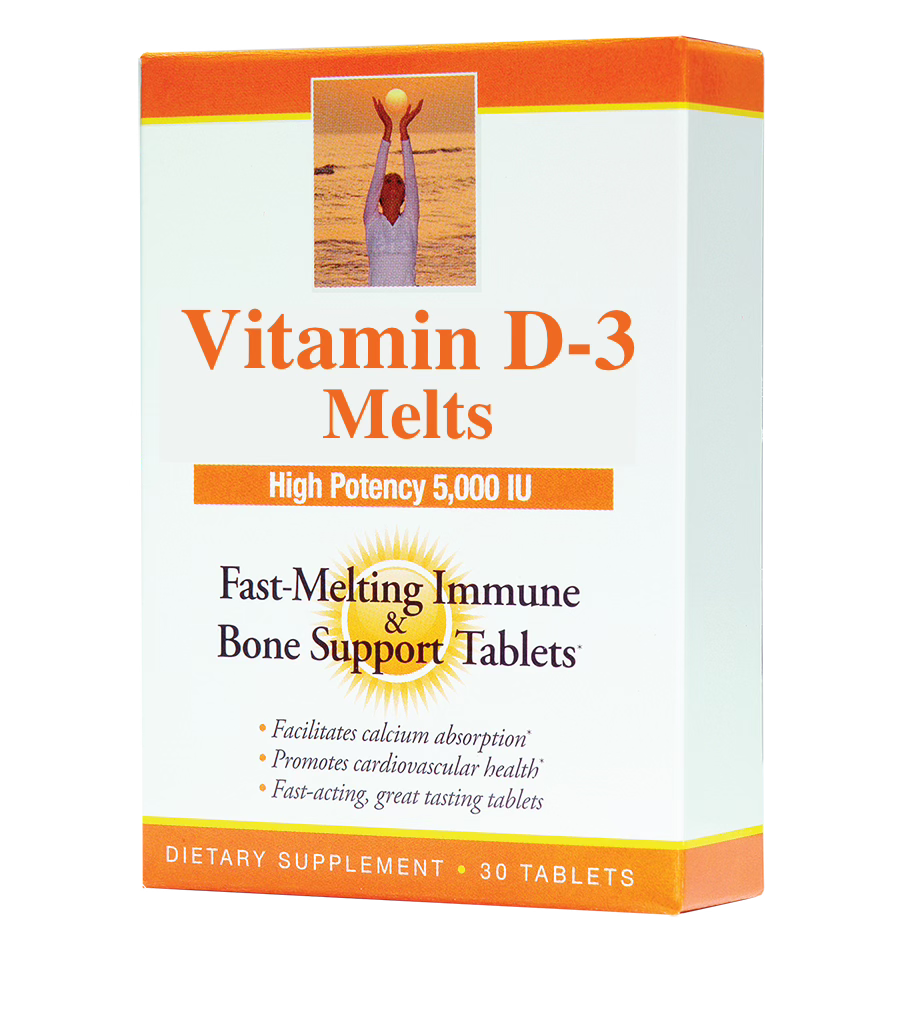
But here’s the thing: According to Dr. Pinkus, regular vitamin D doesn’t work. Only HIS vitamin D works. It has to go under your tongue. It has to be HIS specific formulation with proprietary absorption technology (read: it tastes like orange-flavored dust). And it definitely has to cost $47. This is very important. The healing properties of vitamin D are apparently directly proportional to how much you pay for them, which explains why the sun—which provides vitamin D for free—has been systematically failing to cure anyone of anything since the dawn of time. If the sun really worked, we wouldn’t have disease. But we do. So if you haven’t already figured this one out on your own, let me be clear: The sun is a scam. QED.
THE VITAMIN D GOSPEL
The specific radio segment I heard featured Dr. Michael Pinkus being interviewed by what sounded suspiciously like “an AI generated host who asks follow-up questions with the genuine curiosity of a chatbot programmed to read preplanned questions.” The conversation went something like this:
HOST: “Dr. Pinkus, I’ve been hearing that vitamin D deficiency is becoming a serious health crisis in America. Can you tell us more about that?”
DR. PINKUS: “That’s right ChatGPT, our bodies are under assault by our predisposition for doomscrolling and instant gratification through dopamine addiction resulting in an epidemic of pale pasty-white people.”
According to Dr. Pinkus’s radio testimony, vitamin D deficiency causes:
Fatigue (okay, plausible)
Depression (sure, I’ll buy that)
Bone pain (should we maybe stop here?)
Muscle weakness (we’re not stopping, are we?)
Anxiety (this list is starting to stress me out)
Frequent illness (of course not)
High blood pressure, diabetes, heart disease, certain cancers (CERTAIN CANCERS?!)
Obesity, chronic pain, memory problems (ironically, I’ve now forgotten where this list started)
Erectile dysfunction (😳)
ADHD (I doth protest)
And Seasonal Affective Disorder (okay, this one kinda makes sense)
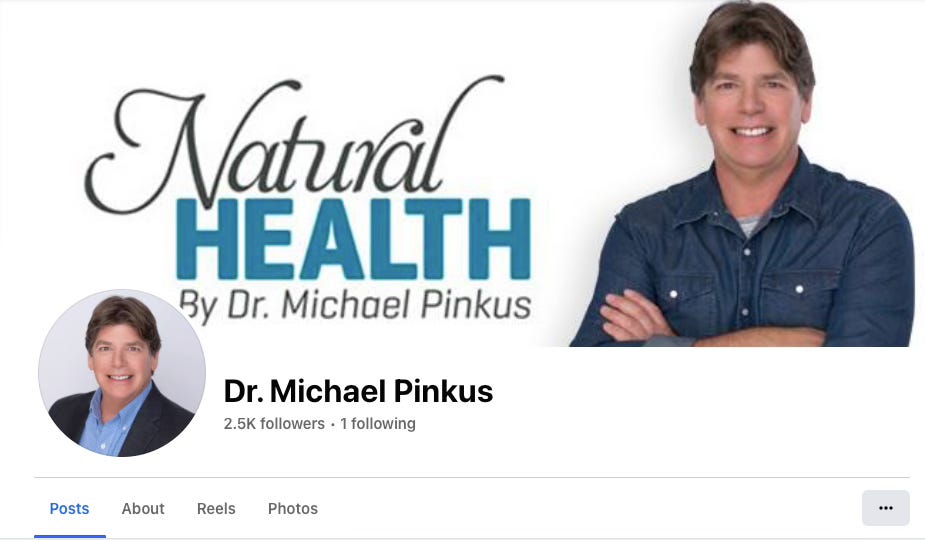
If you aren’t doing anything important right now, take a moment and “follow” Dr. Pinkus on Facebook. I mean, seriously, my dog has more followers.
First of all, I got my ADHD the old fashioned way. I earned it! Secondly, this wasn’t a conversation. This was a prepared sermon delivered to an unfortunate congregation of one, and that one was me, suddenly convinced that my entire life’s problems—my career disappointments, my failure to learn a second language, my complicated relationship with my father—could all be traced back to inadequate sun exposure.
The implication was clear: If you have literally any health problem whatsoever, it’s probably vitamin D deficiency. Got a headache? Vitamin D. Stub your toe? Vitamin D. Can’t remember where you put your keys? Vitamin D. Your spouse doesn’t organize the Tupperware correctly? Almost certainly vitamin D, possibly combined with a moral failing.
THE SCIENCE (OR: WHAT ACTUAL DOCTORS SAY)
I decided to do something Dr. Pinkus apparently considered unnecessary during his ‘extensive research’—I consulted actual doctors who went to medical schools with, you know, buildings and accreditation and stuff.
Turns out, vitamin D deficiency IS a real thing. According to the Cleveland Clinic, the National Institutes of Health, and basically every medical organization that doesn’t sell sublingual tablets on late-night radio, vitamin D is important for bone health and immune function. About 42% of American adults have some level of deficiency, particularly people who don’t get much sun exposure, and people over 65 who have stopped trusting the sun entirely.
The actual symptoms of deficiency? Mostly bone and muscle issues. Fatigue in severe cases. Possibly some immune system effects. The research is ongoing, which is science-speak for “we’re not entirely sure, but we’re definitely sure it doesn’t cure gout.”
What vitamin D deficiency definitely does NOT cause, according to actual peer-reviewed medical literature that wasn’t published by the Sublingual Vitamin Institute of Minnesota:
Your personality
Your poor attention span
Your inability to parallel park (that’s just flawed spatial reasoning, which I’ve had since birth)
Most of the 47 things Dr. Pinkus mentioned
The Kennedy assassination (probably)
Here’s the thing about medical science: When something actually cures 47 different unrelated conditions, we call it a miracle and give someone a Nobel Prize. When someone CLAIMS something cures 47 different unrelated conditions, we call it a red flag the size of a Walmart, and that Walmart is having a sale on regular vitamin D for $8.
The recommended daily amount of vitamin D? Between 600-800 IU for most adults, according to the National Institutes of Health. You can get this from:
15 minutes of sun exposure (free, but as you know, ineffective)
3 ounces of salmon (delicious, actually contains omega-3s as a bonus)
A glass of fortified milk (if you’re not lactose intolerant, which Dr. Pinkus would probably say is also caused by vitamin D deficiency)
A standard $8 bottle of vitamin D3 from any pharmacy in America
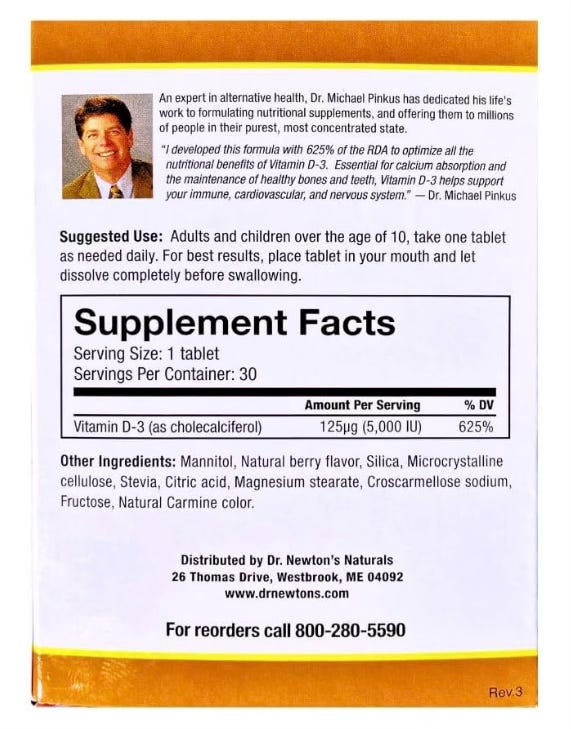
Dr. Pinkus’ sublingual melts contain 5,000 IU per tablet—more than six times the recommended daily amount—and cost $47 for a 30-day supply, which is either a brilliant business model or a sign that I should have paid more attention in economics class.
I called my actual doctor to ask about this. You know, the kind of doctor who went to medical school in a building with a physical address rather than a correspondence course advertised on a matchbook.
“Do I need sublingual vitamin D?” I asked.
There was a pause. The kind of pause that doctors give when they’re trying to figure out which infomercial you’ve been watching.
“Do you have a vitamin D deficiency?”
“I don’t know. Should I get tested?”
“Do you have symptoms of deficiency? Fatigue? Back pain?”
“I have the normal amount of fatigue and back pain that comes from being a middle-aged man who stays up hunched over watching YouTube at 3 AM.”
“Then you probably don’t need to get tested. And you definitely don’t need sublingual vitamin D. Regular vitamin D supplements work fine. Your digestive system is designed to absorb vitamins. That’s literally its job.”
“But what if—”
“Did you hear about this on the radio?”
“...Maybe.”
“Was someone selling something?”
“That’s not relevant—”
“Look, if you’re concerned, buy a $10 bottle of vitamin D3 from the pharmacy. Take 2,000 IU a day. You’ll be fine. Also, maybe go to bed before 3 AM.”
This seemed too simple. Too cheap. Where was the special formulation? The proprietary delivery system? The testimonials from people whose lives were transformed, whose marriages were saved, whose golf games improved by 40%?
THE INFOMERCIAL ECOSYSTEM
Here’s how the supplement infomercial industry works, and I know this because I spent an entire week falling down this particular rabbit hole (which may or may not have been caused by vitamin D deficiency, depending on who you ask):
Step 1: Identify a real medical condition that affects a lot of people
Step 2: Identify a supplement that has SOME legitimate medical use
Step 3: Claim that supplement cures not just the original condition, but also 46 other things, including some conditions that aren’t even technically medical conditions but are just “aspects of being human”
Step 4: Create a “proprietary formula” that’s basically the same as every other version but costs six times more
Step 5: Make it available ONLY through a 1-800 phone number or sketchy website, never in stores where people might comparison shop or read actual labels
Step 6: Get booked on every AM talk radio show in America between the hours of 11 PM and 5 AM, when your target demographic (insomniacs, night-shift workers, and people reorganizing their unread magazine collection) is most vulnerable to poor life choices.
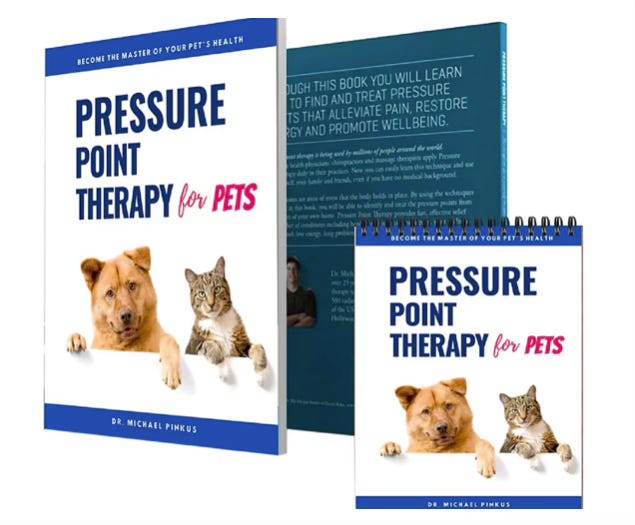
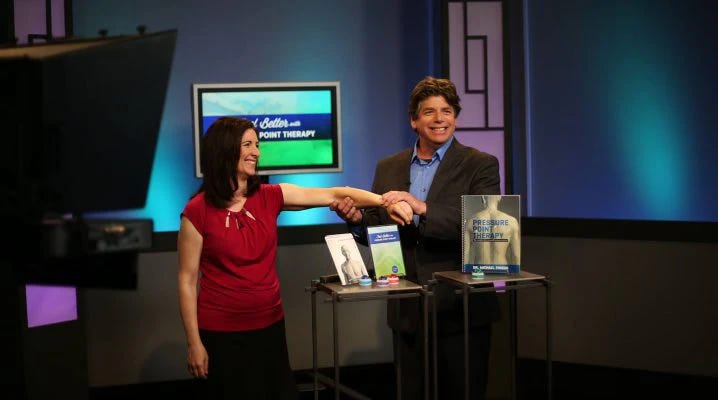
Dr. Pinkus has apparently been a guest on over 1,000 radio and TV shows. One thousand. That’s not a doctor making occasional media appearances to educate the public about a health concern. That’s a marketing campaign masquerading as public health information, wearing a lab coat and a friendly smile.
The shows he appears on wouldn’t necessarily be considered “hard-hitting investigative journalism,” asking tough questions about clinical trials and FDA approval and such. The “interview” is scripted by someone who also writes fortune cookies. The call-in testimonials are suspiciously enthusiastic, like people describing religious experiences but with vitamins.
It’s QVC but with medical claims, which means the FTC and FDA occasionally send strongly worded letters that everyone ignores because strongly worded letters don’t have any actual enforcement mechanism at 3 AM.
I found Dr. Pinkus’s website (or rather, one of several websites—the man has more digital properties than Zillow). The product page features testimonials like:
“Within days, I had zero discomfort!”
“My energy increased. The second day I felt incredibly good. And the third day, wow!”
“It has really made a difference for me.”
These read less like medical testimonials and more like what you’d say about a surprisingly good burrito from that food truck downtown. Which, coincidentally, costs about the same and probably has more nutritional value.
THE AFTERMATH
So yes, I’m now taking vitamin D. The $8 kind from Costco that comes in a bottle the size of a small thermos, not the $47 sublingual melts. I swallow it like a regular vitamin, using my digestive system for its intended purpose, like some kind of evolutionary success story.
My energy levels are exactly the same. I still can’t parallel park. My memory remains unreliable. The Kennedy assassination remains unsolved. I still get up at 3 AM to reorganize things that don’t need reorganizing. But at least I’m doing it $39 cheaper per month, which adds up to $468 per year, which is enough to buy approximately 78 decent burritos, which seems like the more sound nutritional investment.
And my wife—now fully inhabiting my former personality—looked at the Costco receipt and said, “Eight dollars? What a rip-off. Probably placebos pushed by Big Pharma to keep us online and doomscrolling. Sunlight is free!”
I married someone with annoyingly admirable qualities. And thankfully, they’re contagious. She was less fortunate.
Dr. Pinkus, if you’re reading this: The sun is still free. The pharmacy vitamin D is still $8. And at 3 AM last Tuesday, I found myself on your website again. My cursor hovering over the “Add to Cart.” I didn’t click it. But I wanted to.
Which means you’ve already won.
But what if there’s no sun where you live like every single day this week and the next.
Amazon says we can get dr. pinkus vit d3 for 36.29!!!!
😆
happy you are a happier, less cynical husband!!