

According to research, missing and mismatched Tupperware containers are the number one cause of divorce in America, narrowly edging out “leaving cabinet doors open” and “improper dishwasher loading techniques.” This might sound like I just made it up, because I did, but it feels emotionally true, and that’s good enough.
I know this because my marriage has survived 25 years despite what my wife calls my “pathological obsession with organizing plastic food containers” and what I call “basic respect for order in a universe teetering on chaos.”
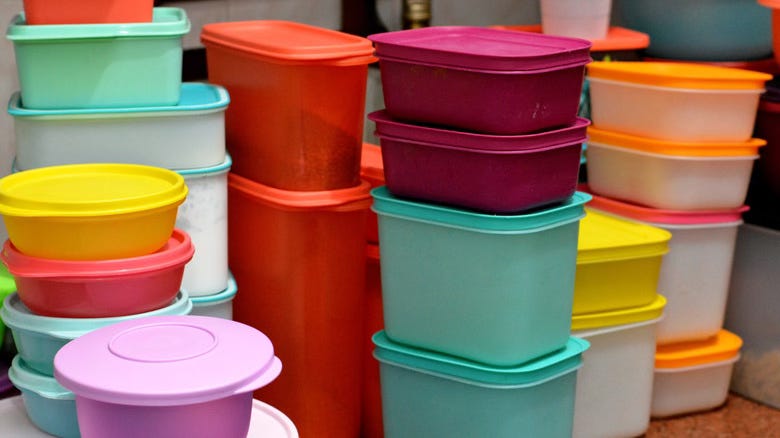
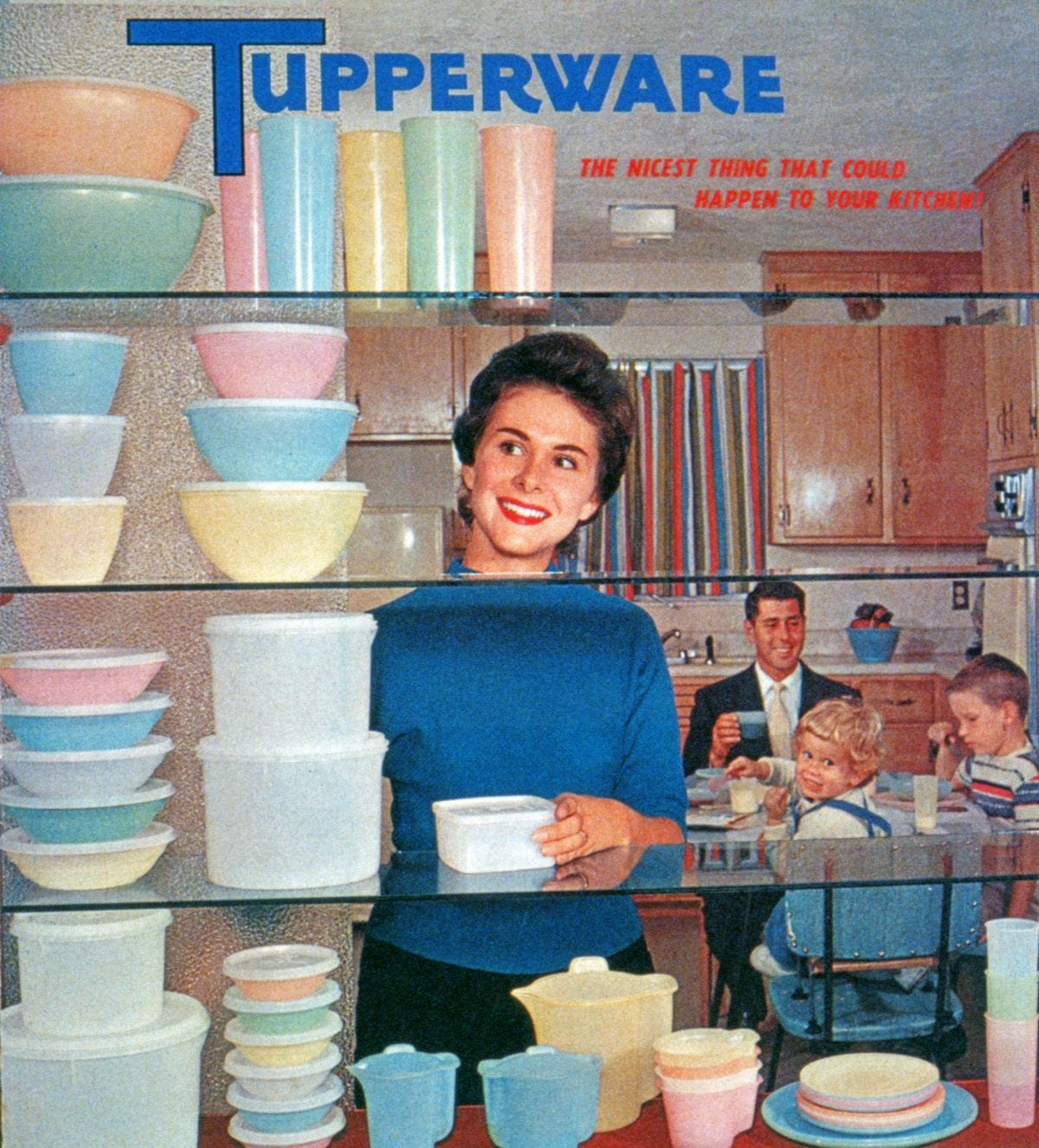
Here’s how it works in our house: I believe Tupperware containers should be nested by size, with lids stored vertically in a separate organizer, sorted by dimension and shape. My wife believes Tupperware containers should be hurled into whatever cabinet has room, ideally while she’s running late for something, with lids scattered across three separate drawers like some kind of domestic witness protection program.
When I open our Tupperware cabinet—and I use the term “our” loosely here, since clearly only one of us respects its organizational integrity—containers avalanche onto the floor with the fury of a dam breaking. Lids slide out. Some are irretrievably lost in the no man’s land behind the drawer. A bottom piece I’ve never seen before in my life appears, already stained orange from some tomato-based incident that likely occurred during the first Obama administration.
My wife’s response to my completely reasonable frustration? “It’s just Tupperware.”
JUST TUPPERWARE.
As if the systematic destruction of household order is somehow trivial. As if the fact that we own 57 containers but can only produce matching lids for 11 of them doesn’t represent a fundamental breakdown in domestic civilization.
I’ve explained my system to her. Multiple times. With diagrams. The containers nest inside each other, shallow ones on the bottom, larger ones nesting inside, like Russian dolls but useful. The lids stack vertically in a rack—I bought a specific rack for this purpose, with dividers—so you can see every lid at once and select the appropriate size. It’s elegant. It’s efficient. It’s the only way humans should store cylindrical plastic food vessels.
She has explained her system to me exactly once: “I put them away.”
That’s it. That’s the whole system. No methodology. No organizing principle. Just raw, unfiltered chaos masquerading as domesticity.
The thing is—and this is where it gets psychologically complex—I know I’m the problem here. I KNOW this. My wife has gently suggested that perhaps spending 20 minutes reorganizing the Tupperware cabinet at 11 PM on a Tuesday is “not normal behavior.” She may have used the phrase “You need help” on more than one occasion, though I prefer to interpret that as her enthusiastically offering to lend me a hand.
But I can’t stop. To be honest, I’m no paragon of domestic virtue. The basement hasn’t been vacuumed since I tripped over the Roomba cord last year. I can go weeks without cleaning a bathroom (I know this because my wife and I are currently in a bathroom cleaning standoff that’s lasted longer than the government shutdown). But Tupperware chaos—containers separated from their soulmates, lids living in exile, that one rectangular piece wedged sideways behind everything else like it’s trying to escape—I can feel something break inside me. It’s not anger, exactly. It’s more like existential despair mixed with the quiet certainty that I’ve married someone who fundamentally doesn’t understand that matching containers to lids is how we separate ourselves from the animals.
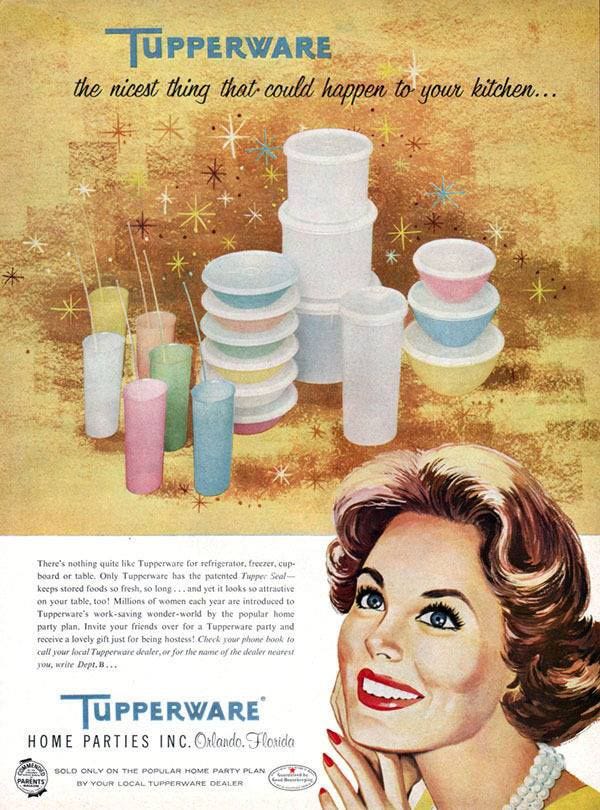
I conducted an audit last month. We own 57 containers. FIFTY-SEVEN. We are two people. Alone. We eat out roughly 0% of the time. We do not attend an inordinate amount of dinner parties. We’re not cooking for an army. We are not running a commercial food storage operation out of our kitchen.
And yet: 57 containers.
Some of the shapes and sizes stretch the bounds of credulity. Who needs containers sized for individual olives, a single slice of kiwi, or a thimbleful of ranch dressing?
What’s more, I can only account for eight, maybe nine of them. The rest appeared through some process I can only describe as spontaneous generation, like they’re reproducing in the cabinet when we’re not looking, or possibly materializing from a parallel dimension where everyone’s Tupperware has matching lids and life makes sense.
My wife insists these are “from potlucks.”
This cannot be true. We have not attended 46 potlucks. I would remember attending 46 potlucks. That’s 1.84 potlucks per year of our marriage, and I’m certain I would have blocked out that much forced socialization.
But she’s adamant. “You bring potato salad to someone’s barbecue, you don’t get the container back. That’s the deal.”
Except 1) My wife’s not a huge potato(e) salad fan, and 2) we’re NET POSITIVE on Tupperware. We have more containers now than when we were raising three picky teenagers, back when our refrigerator was literally just mountains of leftovers that no one ate (often referred to as ‘The Hot Pocket Years.’). This means either we’re accidentally stealing other people’s Tupperware—which I refuse to believe because I am a man of honor—or there’s a thriving underground Tupperware exchange economy happening at social gatherings that I’m completely unaware of, like a potluck-based currency system where containers change hands according to some secret code written on the bottom.
♳♹♶
I have a working theory: Every piece of Tupperware in America is actually communal property. We’re all just temporary custodians, holding these containers for unknown periods before they migrate to their next home. Like library books, but with more anxiety about whether I left that stain or if it was already there when it arrived.
This would explain the container currently in our cabinet with “RIVERA” written on the bottom in Sharpie. We don’t know any Riveras. We have never known any Riveras. The Riveras are presumably somewhere right now looking at a container marked “US” (we don’t label ours because I’m not a monster), wondering how they ended up with our stuff.
The Phantom Collection extends beyond borrowed containers. There are pieces in our cabinet that I’m certain we purchased ourselves, but I have no memory of purchasing them. They’re not Tupperware-brand Tupperware (which is apparently a thing you have to specify now, like “Kleenex-brand tissues”). They’re... something else. Gladware? Rubbermaid? Some store brand attempting to ride Tupperware’s coattails into our hearts and cabinets?
One of these mystery containers—a rectangular piece roughly the size of a turkey sandwich—has what I can only describe as “vintage vibes.” The plastic has that slightly yellowed quality that suggests it predates modern manufacturing standards. The lid doesn’t quite snap; it sort of... wedges on. Like it’s from an era when people were still figuring out the whole “airtight seal” concept and decided “reasonably tight” was close enough.
I asked my wife about it.
“That’s from my mom,” she said.
HER MOM.
We’ve been married 25 years. Her mother gave her this container sometime in the 1990s, which means we’ve been transporting someone else’s 30-year-old food storage device across 12 different residences. It has survived three continents. It has outlasted four presidential administrations (five depending whether you count Trump twice!). It is, at this point, a family heirloom.
I tried to throw it away once. My wife stopped me.
“That’s a good container,” she said.
The lid doesn’t fit. The plastic is cloudy. It smells like the ghost of casseroles past. But it’s a “good container.”
This is who I married.
The Permanent Stain
Every Tupperware collection has one: a stain that defies science. Ours is a medium-sized rectangular piece, vintage 2008, that once held spaghetti sauce. I say “once held” as if this was a singular event. It was not. This container has held tomato-based products on multiple occasions, despite my explicit warnings that tomato sauce and plastic storage containers have a relationship best described as “permanent commitment.”
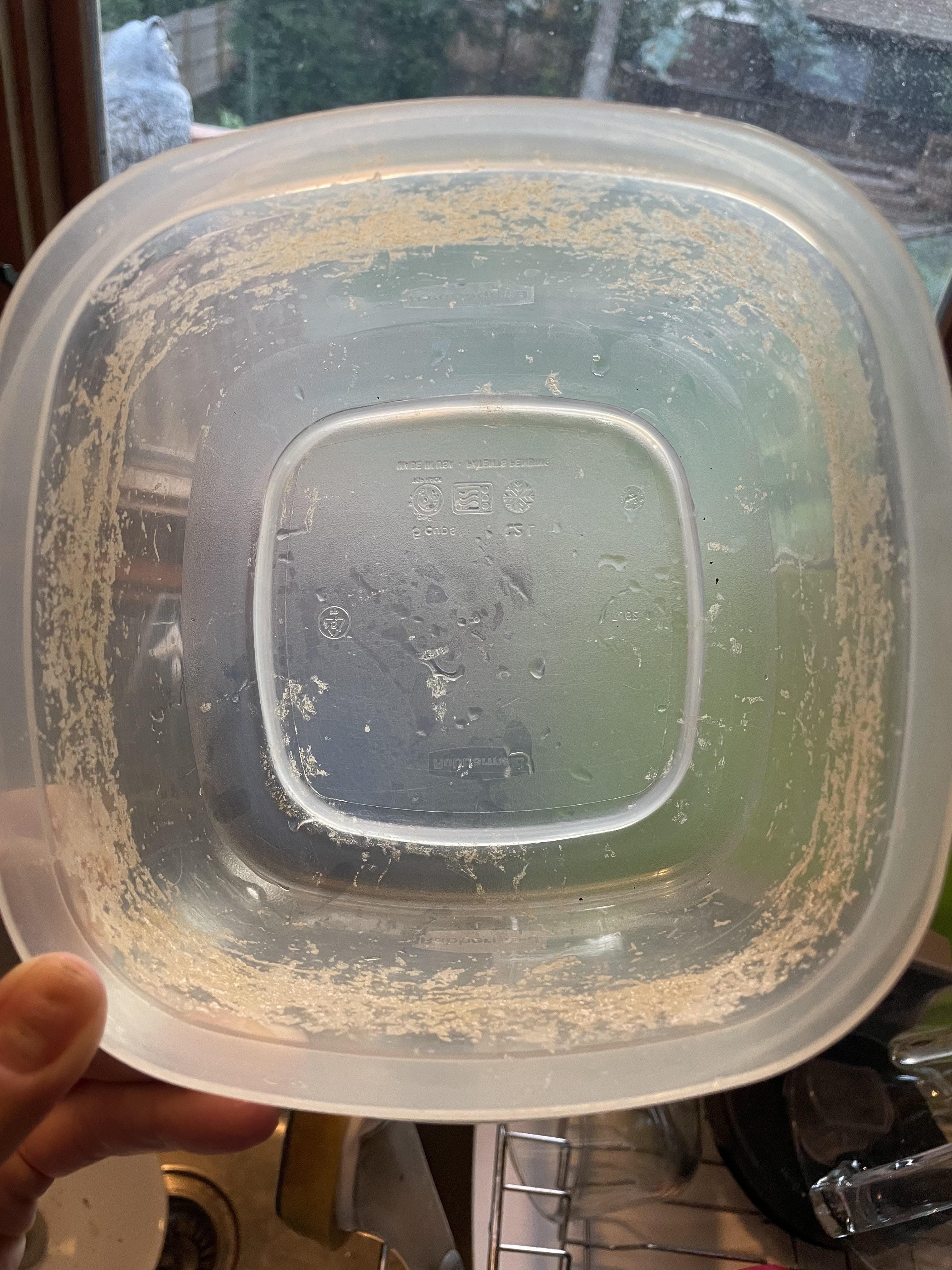
The stain is red. Not the deep, rich red of fresh tomato sauce. This is the faded, slightly orange-ish red of a stain that has bonded with the plastic at a molecular level. It has survived seventy-three trips through the dishwasher, hand scrubbing with baking soda, soaking in bleach solution, leaving it in direct sunlight for three days, and prayer.
The container is functionally clean. I’m not storing live bacteria in there. But it LOOKS dirty. It looks like I’ve given up. It looks like I’m the kind of person who just accepts that some stains are permanent and moves on with their life.
I am not that person.
Apparently tomato stains occur because tomatoes contain lycopene, which bonds with plastic polymers. This means my stained container is scientifically inferior plastic that never should have been trusted with marinara in the first place.
I tried to throw it away.
My wife stopped me. Again.
“That’s a good container,” she said. Again.
“It’s stained.”
“So?”
“So it looks dirty even when it’s clean.”
“Who’s looking at the inside of our Tupperware?”
ME. I’M LOOKING AT IT.
We had this conversation while standing in front of the open Tupperware cabinet. The stained container sat there among its brethren, a permanent reminder that some battles cannot be won, some stains cannot be removed, and sometimes you just have to accept that you’re living with imperfection.
My wife closed the cabinet door.
“It holds food,” she said. “The stain doesn’t change that.”
And that’s when I realized she was teaching me something profound about acceptance and imperfection and letting go of the need to control everything. I indicated my gratitude by hiding my disgust and secretly committing myself to throwing it away when she was at work. I’ll claim we gave it away at a potluck (I haven’t done this. Yet. But I fantasize about it.)
The Tupperware Economy
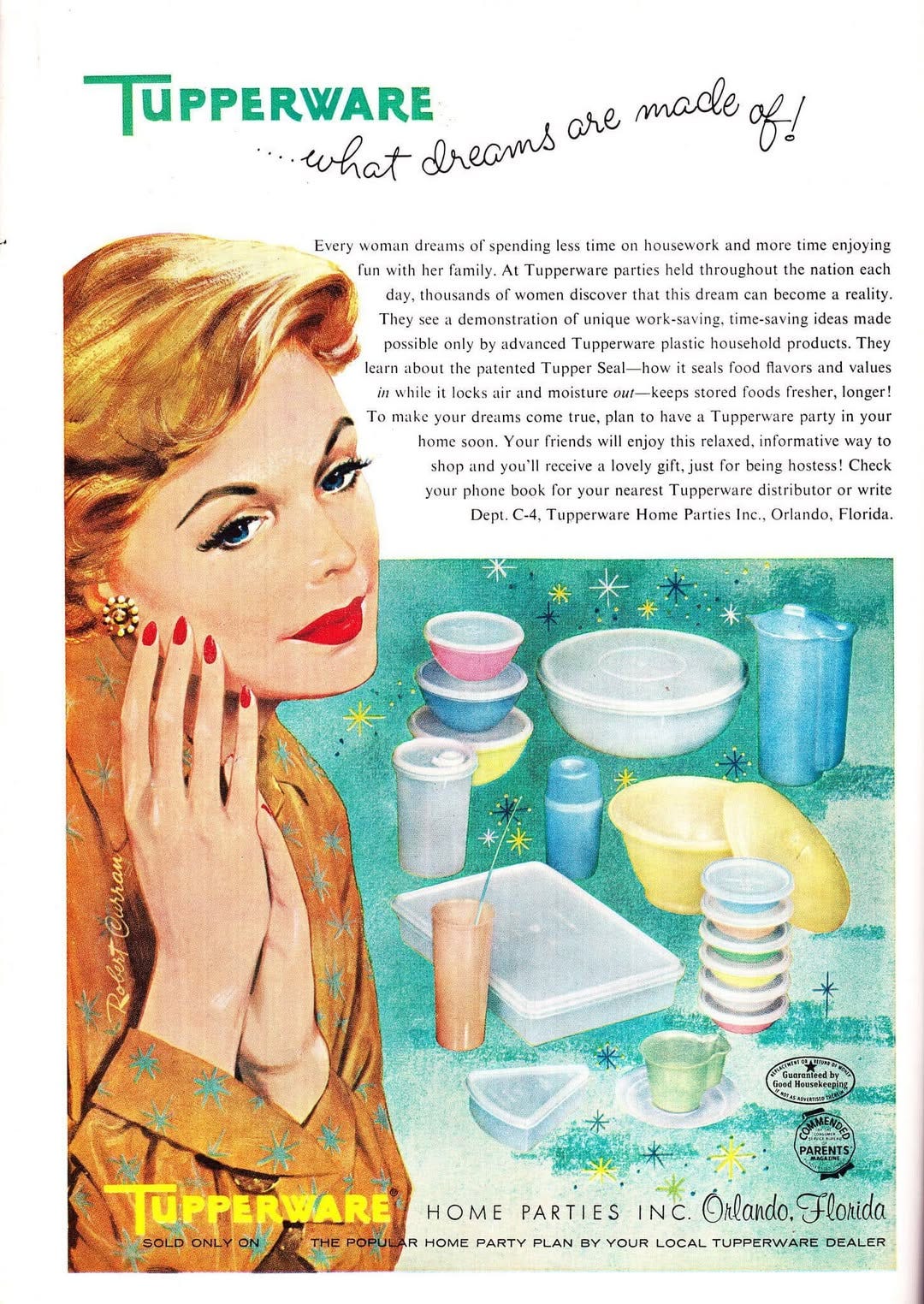
Here’s something nobody tells you about adulthood: “Tupperware” is a brand name. Like Kleenex or Band-Aid. We’re all out here calling every plastic food container “Tupperware” regardless of whether it was actually manufactured by Tupperware Brands Corporation.
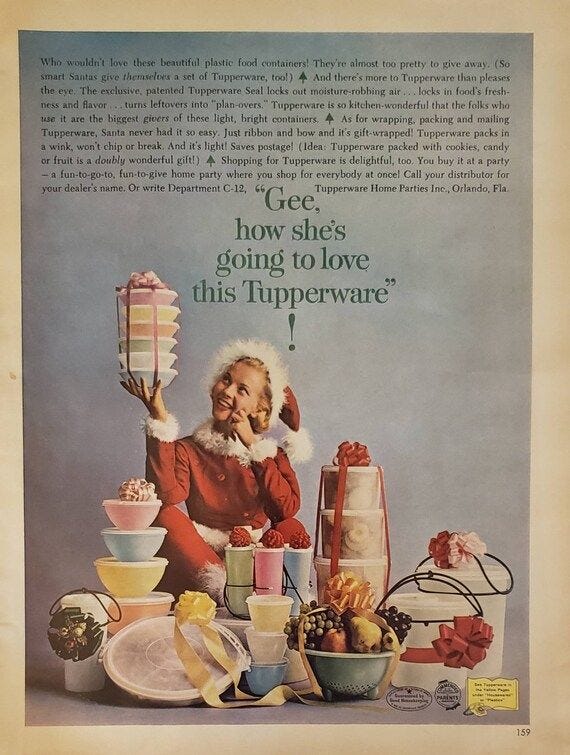
This would be like calling every car a “Ford” or every soft drink a “Coke.” It’s linguistically absurd. But we do it anyway because “plastic food storage container” is too many syllables and “food box with missing lid” is too accurate and painful. I want you to ask yourself, how many times have you spoken the phrase, “Put the leftovers in the Rubbermaid, honey”? (And be honest).
My mother-in-law burped her Tupperware. Every time. With religious devotion. She’d seal a container, press down, lift the edge, let out a tiny pfft of air, then reseal it with the satisfaction of someone who has completed an important ritual.
I tried to explain to her once that modern containers have silicone seals that create airtight environments without the burping step.
She looked at me like I’d suggested we abandon indoor plumbing.
“This is how you do it,” she said, demonstrating the burp again.
And that’s when I understood: Tupperware isn’t about food storage. It’s about tradition. It’s about believing that if you just press down hard enough and burp it correctly, everything will stay fresh and nothing will ever spoil.
It’s a metaphor for life, really. You’re constantly trying to create an airtight seal against chaos, pressing down on the edges of your life, hoping that if you just do it right, everything will stay fresh and nothing will leak.
Sometimes it works. Sometimes you open the container three days later and discover that despite your best efforts, that leftover guacamole dip has achieved sentience and is recruiting the forgotten vegetable drawer to establish a free state in your refrigerator.
The Social Contract
There’s a specific kind of social anxiety that only exists in the Tupperware economy: The Fear of Not Returning Someone’s Container.
You go to a party. Someone’s made a casserole or a dessert. You compliment it. They insist you take leftovers. They put them in a container—THEIR container—and send you home with it.
Now you’re in possession of someone else’s Tupperware.
This is not a casual responsibility. This is a sacred trust. This container must be washed, returned promptly, and ideally refilled with something homemade to show appreciation for the original food gift. These are the unspoken rules of the Tupperware exchange.
But here’s what actually happens:
Week 1: You eat the leftovers. You mean to wash the container immediately. You do not wash the container immediately.
Week 2: The container is now in your sink. It’s been there long enough that washing it feels shameful. You’ll wash it tomorrow.
Week 3: You’ve washed the container. It’s clean. You mean to return it this weekend. You do not return it this weekend.
Week 4: The container is in your cabinet. You’re not sure which cabinet. You know it’s somewhere. You’ll find it eventually.
Week 12: You’ve forgotten whose container this is. Was it Sarah? Jessica? That neighbor whose name you can never remember? The container has been absorbed into your collection. It’s yours now.
Week 52: You see the container’s rightful owner at another party. They don’t mention the container. You don’t mention the container. You both know. The container is a ghost between you now, haunting the friendship.
This happened to me with a container from our friend’s holiday party. Beth made brownies and sent the leftovers home in a nice glass container with a locking lid—the fancy kind that costs actual money.
Three months later, my wife asked, “Did we ever return Beth’s container?”
I had not returned Beth’s container. I had not thought about Beth’s container since approximately week two of its residency in our cabinet.
I found it eventually—it had migrated to the cabinet where we keep serving dishes, which meant our brains had collectively decided it was fancy enough to be elevated beyond normal Tupperware status.
I washed it. I considered making brownies to put in it as a return gift, decided that was too ambitious, considered buying brownies and pretending I made them, decided that was too dishonest, ultimately returned it empty with an apology.
Beth was gracious. She said it was fine. She probably didn’t even remember lending it to us.
But I know the truth: I’m the guy who keeps other people’s Tupperware for three months. I’m part of the problem. I’m why people write their names on the bottom in Sharpie. I’m why the Riveras’ container is in my cabinet right now.
My solution: I now exclusively bring food to social events in containers I’ve specifically designated as “sacrificial Tupperware.” These are the mismatched pieces without lids, the stained containers, the warped ones that no longer seal properly. If they come back, great. If they don’t, they’ve died in service of brownies, which is a noble death.
The Midnight Organizer
Last Tuesday, I woke my wife up reorganizing the Tupperware cabinet. Again. She appeared in the doorway, watching me as I nested containers with the intensity of someone defusing a bomb.
“You know this doesn’t actually matter, right?” she said.
“It matters to me.”
“Why?”
Because, I want to say, if I can’t match every container with its correct lid and nest everything properly—then what hope is there for organizing the garage, or the garden shed, or the junk in the top drawer of my nightstand? What hope is there for the future?
She leaned over, kissed me on the forehead and went back to bed.
At midnight, I closed the cabinet. The containers were nested. The lids were sorted. Order was restored.
It probably won’t last the week. But for now, in this moment, everything is in its place.
Twenty-five years of marriage, and I’ve learned exactly one thing: Some battles aren’t worth winning, but you fight them anyway because that’s who you are. Tupperware is chaos. The lids are mysteries. The stains are permanent.
But you keep trying. You keep reorganizing the cabinet. Because the alternative is accepting that chaos has won, and we’re not ready for that.
And that’s the secret to both Tupperware storage and lasting love. It probably sounds like I just made that up, but it feels emotionally true, and that’s good enough.
I agree, they should be nested.
This needs to be in The New York Times!