
In the Garden of Divine Renewal
The 12th-century nun St. Hildegard von Bingen saw Spring's divine vitality flowing through everything, creating a medieval blueprint for spiritual and physical health that still resonates today

Have you ever had a "Da Vinci Moment?" Perhaps you're researching your latest novel, or, you know, writing your manifesto from a cabin in the woods, and you find yourself at the end of a long rabbit hole, suddenly standing at the crossroads of distraction and amazement. One way leads to a time-suck of fruitless trivia, and the other way leads to something entirely unexpected, something incredible, something that's been hiding in plain site all this time yet changes the way you interpret past and present. You experience a moment of profound clarity, when your slow, screen-addled brain begins to visualize the invisible threads of time that connect past to present, and a new, better reality manifests before you. That instant is your Da Vinci Moment. And it's usually accompanied by that feedback loop in your head repeating, "how did I not know this?"
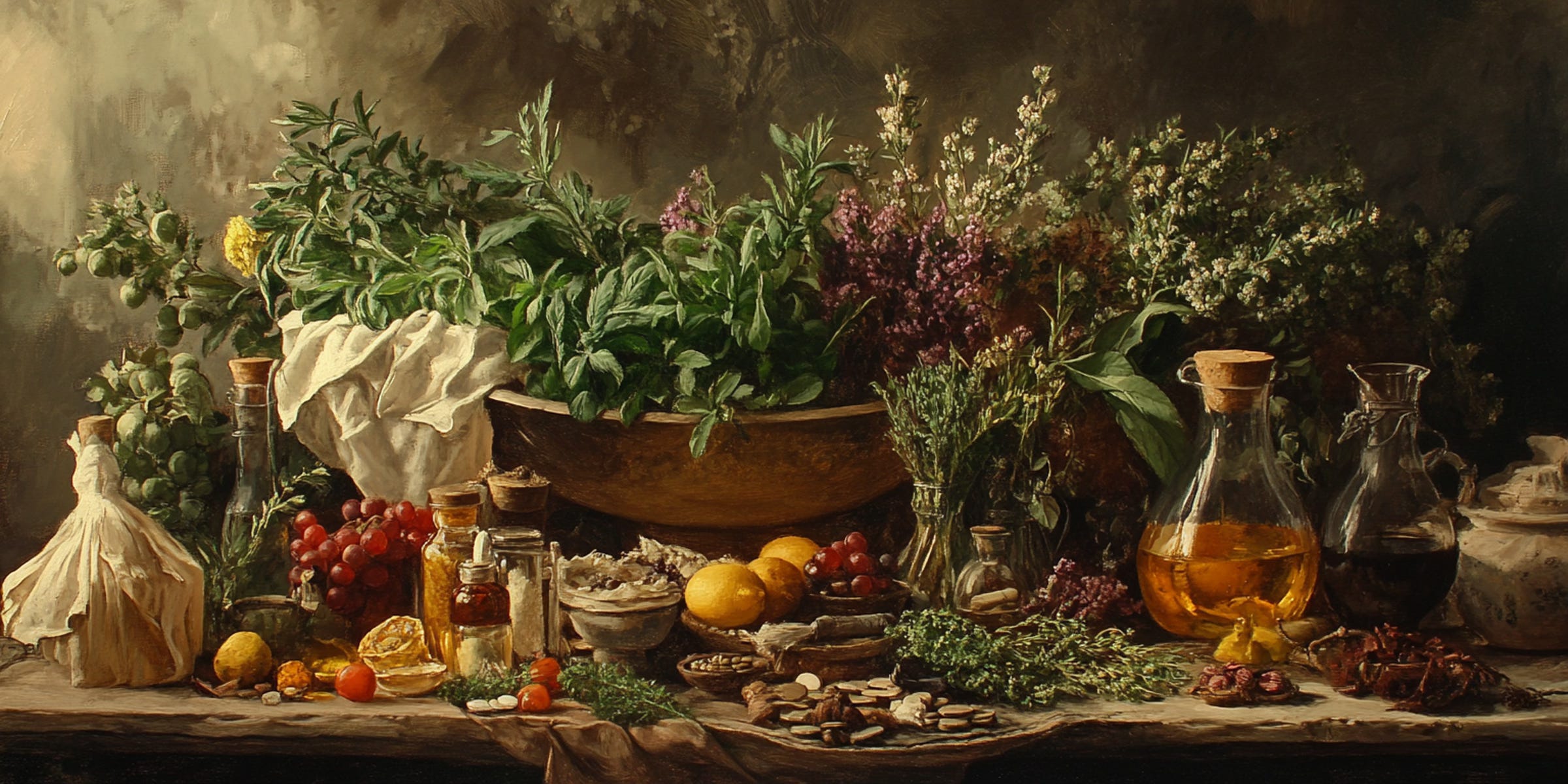
My latest Da Vinci Moment occurred during an idle tumble that started at medieval pharmacopoeia and ended at the nexus of herbal remedies and spiritual health, where Christian mysticism collides with early cosmology. I had inadvertently tumbled into the mind of a 12th century German nun — Saint Hildegard von Bingen — and discovered her vision of spring's eternal promise. And the world has been just a little bit richer and more interesting ever since.
Picture your nurse practitioner who not only provides spiritual advice, diagnoses your mysterious ailment and offers you cures for seasonal depression, but also manages your garden, composes your Spotify playlist, paints your living room mural, and explains the cosmos over Sunday brunch – all while being repeatedly told women are inferior and don't need education. While most medieval women weren't allowed near a quill pen, Hildegard was casually mapping the invisible threads connecting spring herbs to cosmic vibrations, seasonal renewal cycles to human emotions, and divine resurrection energy to the greenness of emerging leaves.
Unlike our cipher-filled Voynich enigma, Hildegard's Physica and Causae et Curae texts don't just tell you what weird leaves and roots look like – they explain how these plants connect to every other aspect of existence in a cosmic springtime of perpetual rebirth. Her prescriptions include "Cookies of Joy" (yes, actual cookies with nutmeg and cinnamon) that she claimed would "reduce bad humors, open the heart, and make the spirits happy" – a spiritual and physical spring cleaning for body and soul. Eight hundred years before we became obsessed with "holistic wellness," Hildegard understood that the body was inseparable from the soul, and both were expressions of a cosmos vibrating with the perpetual rhythm of death and renewal.
The cornerstone of Hildegard's worldview was "viriditas" – a concept of divine greenness or vitality that flows through all living things. This wasn't just poetic metaphor; it was an Easter promise made manifest in every green shoot and unfurling leaf. When she prescribed spring herbs to rebalance the body after winter's stagnation, she wasn't just offering medieval cold remedies – she was tracking how the cosmic cycles of renewal manifested in both gardens and human bodies. She understood seasons as something that happen-ed simultaneously within us and around us, connecting Easter's promise of renewal with the body's own rebirth from winter dormancy.
What truly humbles me about diving into her digitized works isn't just her medical knowledge, but how seamlessly she connected physical healing with music. In her compositions – which you can stream online (because the internet is occasionally magnificent) – she created sonic landscapes specifically designed to restore the winter-weary soul. These weren't just hymns; they were architectural blueprints for interior spaces, with melodic lines that climb through impossible ranges, like medieval Gothic arches reaching toward heaven; tender shoots stretching toward spring light. Long before people were listening to curated binaural beats meditation playlists, Hildegard was composing celestial harmonies designed to align the soul with divine rhythms of renewal, creating musical hymns that still captivate listeners eight centuries later.

But perhaps most startling to modern sensibilities is how Hildegard navigated the profound limitations imposed on her as a woman in medieval times. In an era when female voices were systematically silenced, she found an audacious workaround: she claimed her voice wasn't really hers at all. By positioning herself as merely the channel for divine visions (which conveniently endorsed her authority), she created a space where she could speak truths that would have been dismissed coming directly from a woman. Was this a calculated strategy or genuine mystical experience? The answer is probably both – the visionary and the pragmatist existing in the same remarkable mind.
The Internet Archive hosts several translations of her works, including beautifully illustrated manuscripts of "Scivias" (her visionary text) that make my midnight doomscrolling feel particularly unproductive. When I found myself humming her chant "O viridisstima virga" ("O greenest branch") while repotting my sad desk plant this March, I realized I'd fallen headlong into yet another rabbit hole – one surprisingly relevant to our modern search for renewal in a fractured world.
What makes Hildegard worth our attention isn't that she was ahead of her time, but that she seemed to operate outside of time altogether – perceiving patterns and connections that would remain invisible to others for centuries, as if she'd been dropped into the 12th Century with a consciousness operating on a different frequency. She charted maps for unseen, spiritual territories, whether through music that stretched beyond conventional limits, medicine that connected body and soul, or visions that gave form to the ineffable.
For all the bat-based remedies and unicorn references in her medical texts (yes, she does prescribe unicorn liver to ward off leprosy), Hildegard's approach to spring healing feels strikingly contemporary. Her understanding that winter-induced emotional states affect physical health, that certain spring foods have intrinsic energetic properties that align with the season's energy, and that environment influences wellbeing all anticipate principles now embraced by integrative medicine. While reading her texts, I kept thinking how she would likely feel validated by recent research on seasonal affective disorder, the gut-brain connection, or studies showing how spring nature exposure affects our mental health.
In her most famous vision, Hildegard describes herself as "a feather on the breath of God," lifted and carried by divine winds. There's something profoundly spring-like in this image – the lightness, the movement, the sense of being carried forward by forces greater than oneself. As we emerge from our own winter dormancy, perhaps there's wisdom in this 12th-century visionary's approach: to trust the season's momentum, to align ourselves with renewal's ancient rhythms, and to recognize that it’s best to surrender to nature's rhythms.
Medieval herbalism with an ecological spirituality bent? Radical feminist theology hidden in plain sight? Musical compositions that somehow translate cosmic principles into sonic experiences? Turns out Hildegard wasn't just drawing maps of the visible world – she was creating navigational charts for inner landscapes of perpetual renewal that we're still exploring. But don’t take my word for it. Find your own Da Vinci Moment! Google Hildegard von Bingen and let her be your guide as you tumble down this amazing rabbit hole. ∞
Links:
Hildegard von Bingen - Feminea Forma Maria: A Sampling of her 12th Century compositions
Hildegard von Bingen - Hortus Deliciarum: Although I don’t believe all the compositions on this album are written by von Bingen, it’s still a lovely, meditative album that is wonderfully calming.
Healthy Hildegard: A perfect website celebrating Hildegard’s Viriditas philosophy and an excellent entry point into her other works and mystical Christian philosophy. Not to be missed!!
Saint Hildegard Pilgrimage Website and Information