

I am currently house-sitting for a few days in Seattle. The homeowner has two very sweet and uber chill Golden Retrievers. In between walks, they’re sleeping, sighing, and occasionally glancing at me with a soulful expression that says, “Exactly who are you again?” And it’s raining. It’s been raining since I arrived. It’ll probably rain until I leave. This, as we know, is not weather. It’s lifestyle.
For suburban Seattle, it’s really quiet. It’s the kind of quiet that makes your brain go places it shouldn’t, like ponder whether the dogs are judging you or, say, develop unified theories of American foreign policy while eating your oatmeal in someone else’s kitchen. I chose the second option, because the first one is kinda depressing.
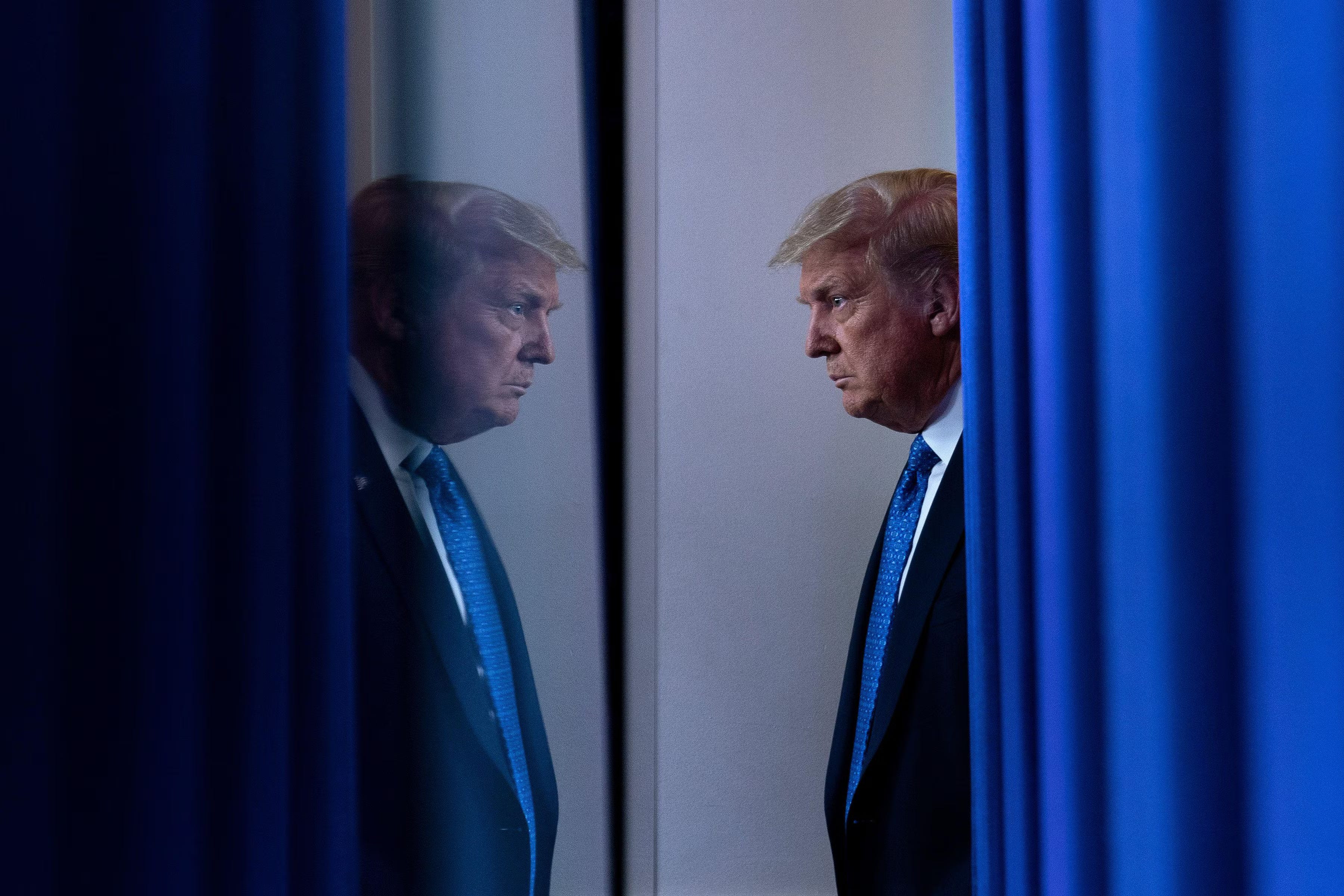
Here is my theory, developed over a bowl of Metamucil flavored oatmeal and formalized somewhere around my second cup of coffee: The President of the United States does not negotiate with other people. He negotiates with himself. Everyone sitting across the table is, in his mind, a slightly different version of himself — usually weaker than him, but someone who haggles, blusters, calculates the costs, and ultimately settles when the price gets too high. His entire approach to dealmaking, foreign and domestic, rests on the assumption that his counterpart is running the same internal software: an American-style rational actor model that says push hard, see what sticks, and cut your losses before things get ugly.
This works more often than it should. It also explains why, when it doesn’t work, it fails so spectacularly that people in my former profession lose sleep over it.
I should disclose my credentials (and their um… limitations). I spent a few decades in the Army, with a master’s degree (or two), one from a War College and one from a certain northeast crimson colored university that can no longer be named, and an assignment or two (or three) in our embassies overseas. This qualifies me to have opinions about international negotiations the way owning a stethoscope qualifies Elon Musk to have opinions about cardiology — technically he has the equipment, but he probably shouldn’t be performing surgery. That said, I’ve sat across enough negotiating tables in enough countries to know what it looks like when someone assumes their counterpart thinks like they do. In foreign policy circles, this error has a name — mirror imaging — and it has been a contributing factor in nearly every major American foreign policy disaster since World War II. We assumed the Soviets calculated nuclear risk the way we did. We assumed Ho Chi Minh could be bombed into peace talks. We assumed Saddam Hussein would behave “rationally” by our definition. We assumed the Taliban would negotiate like a Western government. Each time, the assumption produced a gap between expectation and reality that cost a lot of blood and treasure.
It’s also a perfectly natural thing to do, which is what makes it so dangerous.
(Note: Turns out, mirror imaging is common in personal relationships too, but we’re not here to discuss my marriage).
Consider the following pattern. The President announces an extreme opening position — tariffs of 50 percent, 125 percent, 145 percent — and waits for the reaction. Markets drop. Trading partners call in alarm. Cable news erupts. Then comes the extension: a 90-day pause, a revised deadline, a framework for further talks. Markets recover. The President declares progress. The cycle repeats. Liberation Day tariffs in April 2025: announced, paused within a week, eventually implemented at lower rates. China: tariffs escalated to 145 percent, negotiated down to 30 percent over a series of 90-day truces. The EU, Japan, South Korea, Canada — all received the same treatment. The outrageous opening demand, followed by the extended deadline, followed by a more modest outcome framed as a historic victory. Wall Street noticed the pattern and coined an acronym for it. I won’t repeat it here, because it’s become more bumper sticker than analysis, but the underlying observation is sound: the President’s opening positions have a reliable expiration date.
This is not, in itself, a criticism. Most experienced negotiators will tell you that ambitious opening positions are standard tactics. You ask for the moon, you settle for a distant star in the Orion Nebula named after your wife, and everyone goes home feeling like they got something. It’s Negotiation 101. The Art of the Deal, if you will.
The problem isn’t the tactic. The problem is the assumption underneath it.
Every time the President extends a deadline or walks back a tariff rate, he’s operating from a specific theory of his counterpart’s psychology: they’re doing the same math I am. They’re calculating costs, weighing consequences, looking for the off-ramp. The EU responds to tariff threats by calling and asking for more time — and in the President’s framework, this confirms the theory. They’re rational actors. They looked at the numbers. They blinked first.
And with Western trading partners, this theory is largely correct. The EU, Japan, South Korea, Canada — these are democracies with market economies, independent central banks, and leaders who answer to electorates that care about GDP growth and consumer prices. When faced with an extreme demand, their leaders do in fact run a cost-benefit analysis. They do look for the off-ramp. The cycle completes because both sides are, roughly speaking, playing the same game with the same rules and the same definition of winning.
Which is why what’s happening in Iran should concern everyone, regardless of where they fall on the political spectrum.
I wrote about the Iran war a few weeks ago from a strategic planning perspective, so I won’t rehash the full situation. But let me describe what the last ten days have looked like through the lens of negotiation behavior, because it’s a case study in what happens when the mirror cracks.
On Friday, March 20th, the President said the war was “winding down” and that responsibility for the Strait of Hormuz would fall to the countries that depend on it. In negotiation terms, this is a signal: I’m looking for the exit, and I’d like you to help me find it. Twenty-four hours later, he posted that he would “obliterate” Iran’s power plants if the Strait wasn’t fully opened within 48 hours. In negotiation terms, this is… errrr… an extreme bargaining position — the demand designed to shove your counterpart toward the door you’ve opened for them.
What happened next is instructive. Iran’s Revolutionary Guards responded that if their power plants were hit, they’d shut the Strait and start targeting desalination plants across the Gulf — the facilities that produce a substantial portion of fresh water for America’s regional allies. Gulf states called Washington in a panic. Oil surged past $114 a barrel. And then, on Monday morning — with markets about to open — the President announced he was giving Iran five more days, citing “very good, productive dialogue” toward a resolution.
Iran immediately denied any dialogue was taking place. Their parliament speaker posted on social media that there had been no negotiations and that Trump’s retreat was an attempt to escape a “quagmire.” Which, if you squint, is also a form of negotiation, just not the kind Trump recognizes. Markets rallied. Oil dropped. The familiar cycle appeared to complete.
Except this time, the cycle is lying to us.
Tariffs have an off switch. You can raise them on a Saturday and lower them on a Monday and the only casualties are some cargo containers stuck in Long Beach. Wars don’t work that way. When you’ve killed the Supreme Leader, bombed nuclear facilities, triggered retaliatory strikes across six countries, and sent 50,000 troops to the region, you can’t post on social media that you’ve decided to give everyone an extra 90 days. The negotiation framework that works with trading partners — create the crisis, let the pressure build, extend the deadline, declare victory — requires that you control both sides of the equation. That is, it requires you and your negotiating partner to share the same world view. In a trade dispute, that works. In a shooting war, as we keep hearing, the enemy gets a vote.
Iran’s leadership — what remains of it — is not running the same cost-benefit analysis as the President of France or the Prime Minister of Japan. They’re running a survival calculation. The Islamic Republic’s legitimacy rests on resistance to American pressure. That’s not a negotiating position; it’s the regime’s foundational identity. Capitulating to a 48-hour ultimatum from Washington wouldn’t just be strategically unwise. It would be existentially fatal to their very identity. The President looks across the table and sees someone who will eventually fold, because that’s what a rational actor would do, because that’s what he would do. Iran’s leaders look across the table and see a man whose threats come with expiration dates, whose attention shifts with the markets, and whose pattern of retreat is now so well-documented that traders have built investment strategies around it.
This is the uncomfortable irony: the very predictability that makes the President a reliable market signal also makes him a readable opponent. Iran doesn’t need to call the bluff. They just need to wait for the deadline to pass. They’ve been doing it for forty-five years with various American presidents. They are, not to put too fine a point on it, exceptionally practiced at this.
And you know, as my wife enjoys pointing out, I might be wrong (she prefers to quietly whisper “full of it,” which I pretend not to hear). Iran may fold faster than Chuck Schumer’s Broadway musical debut.
But let’s take a minute to imagine this dynamic applied to China.
Beijing has been watching these cycles with what I can only describe as professional interest. They watched tariffs escalate to 145 percent and then come down without meaningful concessions extracted. They watched 90-day truces get extended, and extended again, and extended again. They’re not panicking. They’re taking notes.
China can wait out any American president. That’s not a political statement; it’s a structural observation. Xi Jinping doesn’t face midterm elections. He doesn’t answer to a stock market that moves when he posts on social media. He operates on five-year plans, twenty-year plans, hundred-year plans. If you’re a Chinese communist authoritarian, approval polls are not all that relevant. China’s leverage in rare earth minerals alone gives Beijing the ability to inflict targeted economic pain without firing a shot — which, if you’re keeping score, is approximately what Sun Tzu recommended about 2,500 years ago. One would hope someone has mentioned this at a briefing. (I’m available for consultation. My rates are reasonable).
Or let’s consider a different yet reliably unpredictable potential adversary: North Korea. Kim Jong Un’s entire governing framework is built around resistance to external pressure. The regime’s survival — literally, its continued existence — depends on convincing its own population and military that it will never capitulate to the United States, regardless of the cost. In the mirror, the President sees a fellow dealmaker who will eventually accept a photo op and some vague promises. From Pyongyang’s perspective, the view is different: three summits, no denuclearization, a lot of commemorative coins, and an American president who provided international legitimacy in exchange for nothing concrete. That’s not a negotiation failure for Kim. That’s a master class.
The uncomfortable truth that transcends partisan politics is this: the negotiation approach works just well enough with like-minded counterparts to seem like genius. Western trading partners play the game because they share the underlying assumptions about how rational actors behave. But the world is not exclusively populated by Western trading partners. Iran doesn’t share those assumptions. China doesn’t share them. North Korea doesn’t share them. And the moment you encounter an adversary whose decision-making isn’t governed by quarterly earnings reports and approval ratings, the extended deadline doesn’t produce a deal. It produces a signal that patience will be rewarded.
The Goldens are still sleeping. The rain hasn’t stopped. Somewhere, a deadline is being extended, and someone is calling it progress.
And I keep coming back to something a Brigade Commander once told me, which I’m paraphrasing because it was like thirty years ago and I was probably thinking about lunch: “The most dangerous assumption in any conflict is that your enemy thinks the same way you do.” The President wants a deal. He always wants a deal. He wants the handshake and the press conference and the announcement that something tremendous has been achieved. He assumes everyone else wants that too, because why wouldn’t they? Deals are great. Everybody loves deals.
But some adversaries don’t want a deal. Some want to run out the clock. Some just want to stay in power, are even willing to die to stay in power. And some want to demonstrate that the most powerful nation on earth can be outlasted by anyone willing to absorb the pain longer than the American news cycle allows.
I might be wrong. But here, sitting in Seattle with two snoring Golden Retrievers and a third cup of coffee, is where my theory gets uncomfortable: What if the most predictable man in the world is only unpredictable to himself?