Profiles: Prophets or Madmen?
David Lynch: Looking Beyond Our Shared Reality.

If you’re not a fan of David Lynch, its unlikely anything I write will persuade you to change your mind, but if you have even a sliver of curiosity about what you may be missing, read on.
She was in her sixties, well-dressed, articulate, and as I walked up to the hotel bar, she was explaining to her captive acquaintance that she’d been forced to abandon her home because of government surveillance.
I had just dropped my daughter off at college that afternoon—her first foray into geographical independence, her first tentative steps into adulthood. It had been an emotional day for both of us, full of forced smiles and careful optimism masking deeper anxieties. I was staying at a nearby Courtyard Marriott for the night before the long drive home, and something drew me to the lobby bar. Perhaps it was the loud guests enjoying themselves over a drink, the telltale signs they were veterans attracting my attention. Perhaps it was my need for social distraction after a hard goodbye. Or perhaps it was this one person, sitting quietly apart from all the social chaos and chatter, who seemed oddly out of place in a hotel bar with all the charm of a formica-covered Applebee’s.
The more she spoke, the more I was unable to disguise my eavesdropping. The woman wasn’t ranting or incoherent. Her narrative was elaborate, internally consistent, and delivered with the calm authority of someone recounting facts. Her father had been a government scientist, she explained. Experiments had been conducted on her brain as a child. Her Freedom of Information Act requests had been denied, but she was in possession of court documents—heavily redacted, naturally—proving her non-consensual participation in classified extra-sensory research. The surveillance of her home had become unbearable, forcing this extended hotel stay while she pursued legal remedies.
What grabbed me wasn’t the content of her story, but the psychological architecture underlying it. Here was someone who had constructed a complete explanatory framework for her distress—one that provided agency, meaning, and a path forward in circumstances that might otherwise feel overwhelming. The younger man beside her, clearly dependent on her financial support, nodded along with the practiced fluency of someone who had learned to inhabit her reality.
I found myself both troubled and fascinated. This wasn’t madness in any simple sense; it was an extreme version of something recognizably human. We all edit difficult memories, rationalize painful choices, and maintain preferred versions of ourselves and our circumstances. Most of us operate within narrowly defined parameters. This woman had simply pushed beyond the elusive boundaries of our shared reality.
That evening, scrolling through hotel cable channels in my room, I landed on Lynch’s masterful Mulholland Drive and experienced one of those crystallization moments. David Lynch, I realized, had been mapping this exact psychological territory for decades—not the pathology of alternate reality construction, but its universal human necessity.
Lynch operated in the space between the wholesome and the horrific, transforming suburban normalcy into something borrowed from fever dreams. His films suggest that beneath every white picket fence lurks something unspeakable, that behind every cheerful diner counter waits a conspiracy of shadows. But this wasn’t calculated shock for its own sake; it was recognition that reality itself might be far more unstable than we prefer to acknowledge.
Consider Mulholland Drive, which follows aspiring actress Betty through what appears to be a straightforward Hollywood mystery until the narrative fractures, revealing Betty as Diane, a failed performer whose elaborate fantasy provides refuge from devastating guilt and professional failure. The film doesn’t present this psychological defense as pathological—it presents it as profoundly human. When reality becomes unbearable, consciousness protects itself through story.
This is what made watching Lynch’s masterpiece that particular night feel like a revelation. The woman at the bar wasn’t engaged in anything fundamentally different from what Diane does in Mulholland Drive—she was building a narrative that transformed overwhelming circumstances into something comprehensible, even actionable. Her surveillance conspiracy gave structure and meaning to experiences that might otherwise feel random and terrifying.
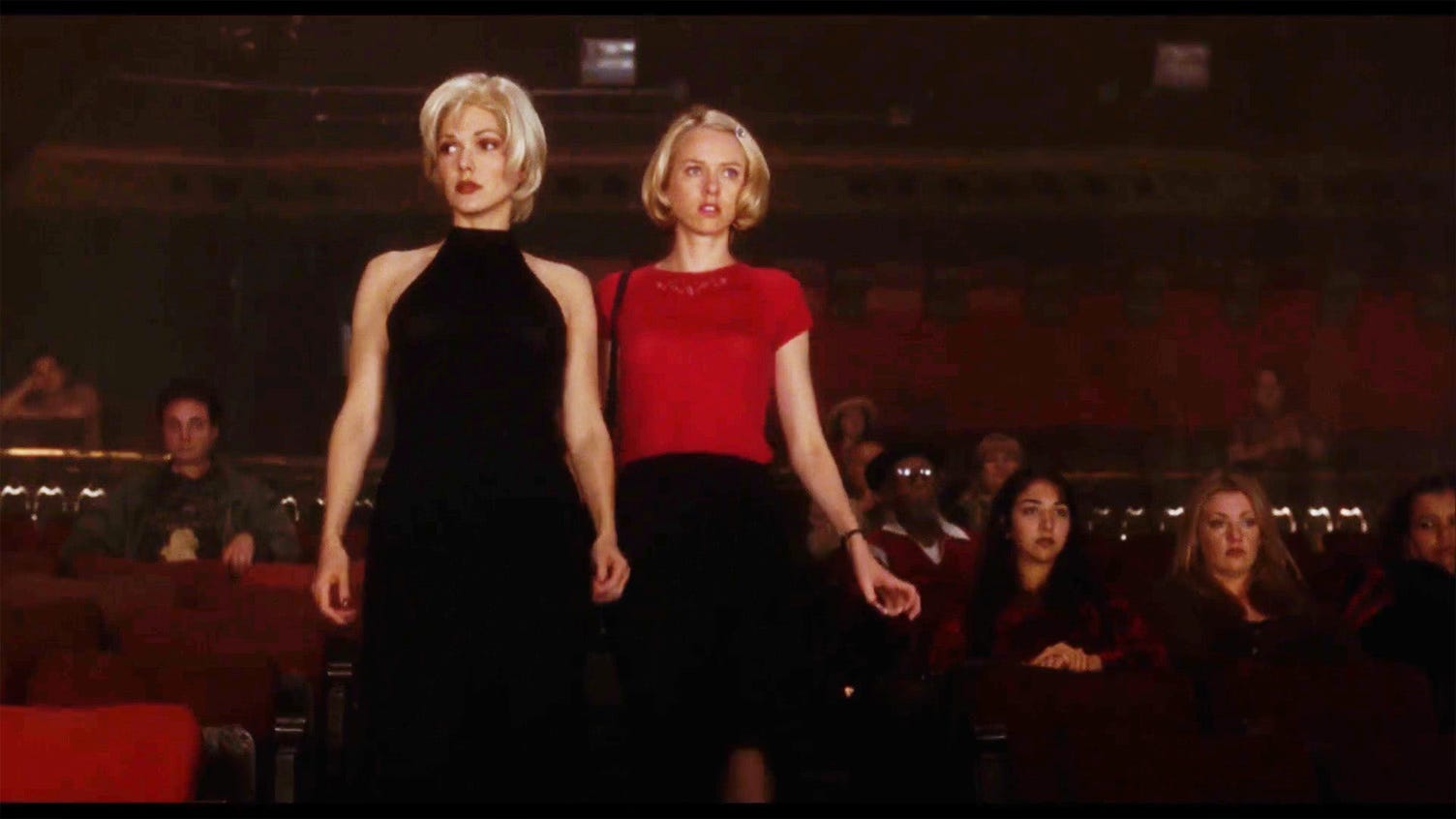
Lynch understood something our best storytellers understand intuitively: the human mind is more engaged when forced to work, when it must become detective, psychologist, and philosopher simultaneously. His films don’t withhold information to be coy; they withhold information because that’s how our subconscious works.
But Lynch wasn’t simply creating confusion—he was teaching viewers how to navigate uncertainty productively. His techniques mirror the intellectual skills our culture increasingly discourages: the willingness to sit with ambiguity, to find patterns in chaos, to resist the urge to Google your way to quick answers. When the narrative fractures in Mulholland Drive, when the Red Room sequences defy spatial logic in Twin Peaks, when the industrial soundscape of Eraserhead creates meaning through atmosphere rather than plot, Lynch trains viewers in what might be called bewilderment as discipline. He showed that confusion could be a creative state rather than a problem requiring immediate solution.
Take the final scene of Mulholland Drive. Lynch could have provided answers—shown us which timeline was ‘real,’ explained the blue box’s significance. Instead, he leaves us with an image so ambiguous that thousands of viewers have spent decades constructing their own interpretations. That’s not withholding — that’s demonstrating how we participate in creating meaning, rather than passively receiving it.
This deeper genius reveals how fragile the distinction is between “normal” psychological coping and complete dissociation. In Blue Velvet, Jeffrey Beaumont finds a severed ear in a field and can’t resist investigating, despite every rational instinct urging him to walk away. That severed ear becomes Lynch’s perfect metaphor for curiosity itself — the disturbing fragment that demands you follow it into places you probably shouldn’t go.
When Lynch died this past January, tributes poured in from filmmakers, critics, and fans worldwide. But for me, his loss carried a particular weight because of that night in the hotel—the accidental convergence of my daughter’s departure, the woman at the bar, and landing on Mulholland Drive in my vulnerable state. He gave me a framework for understanding what I had witnessed. The woman wasn’t mad in any simple sense. She was engaged in what Lynch understood: narrative-building as a form of meaning-making when standard frameworks fail. Her conspiracy wasn’t a delusion; it was a story sophisticated enough to contain her experience, to give her agency in circumstances where she might otherwise feel powerless.
We live in an age where we’ve become fluent in dismissing alternate realities as dangerous or delusional. But Lynch’s work suggests something more nuanced: that we’re all engaged in this process constantly, just usually within parameters that remain socially acceptable. We construct narratives about why our marriages failed, why our careers stalled, why our children struggle. We create explanatory frameworks that protect us from overwhelming complexity.
The difference between the woman at the bar and the rest of us isn’t that she’s constructing reality while we perceive it objectively. The difference is only in the degree to which her construction has diverged from consensus reality—and perhaps in our collective agreement to call our shared constructions “normal” while labeling her divergent version “delusional.”
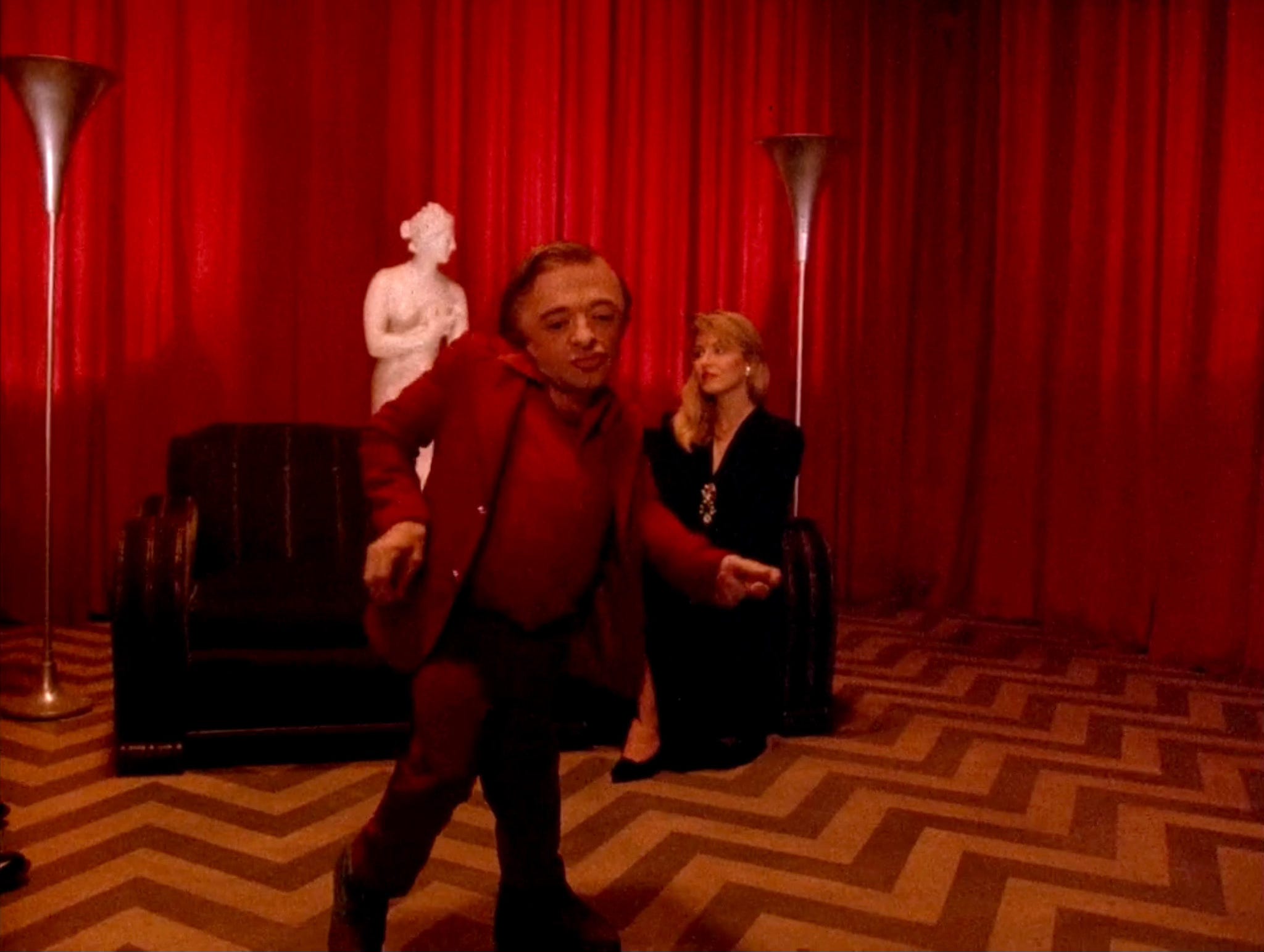
Lynch’s films operate as field guides for understanding these processes—not to judge them, but to recognize our shared humanity in the face of unbearable complexity. He showed us how ordinary people construct protective narratives when standard reality becomes unmanageable, and how thin the line remains between adaptive and maladaptive meaning-making.
I never learned what happened to the woman at the bar—whether she eventually returned to her home, whether her boyfriend escaped her reality or learned to inhabit it with her. But Lynch had given me a way to see her not as a cautionary tale but as human: engaged in the same storytelling we all practice, just pushed beyond the boundaries where it remains invisible.
In our age of algorithmic answers and instant explanations, Lynch’s commitment to productive bewilderment feels like a form of resistance. He reminded us that reality is far stranger and more fragile than our daily routines suggest. Sometimes the most honest response to overwhelming complexity is not explanation but sustained attention to mystery itself.
His influence persists in anyone who has learned that intellectual wandering can be more rewarding than arriving at predetermined destinations. He taught us that the most interesting discoveries happen when you resist easy explanations and allow questions to multiply rather than resolve.
When I think about Lynch’s legacy now, I don’t think about his technical innovations or his influence on contemporary cinema, though both are considerable. I think about how he showed us that consciousness under pressure doesn’t just break—it creates. It builds elaborate architectures of meaning, constructs narratives sophisticated enough to contain overwhelming experience, and sometimes produces art in the process of survival.

In the years since that hotel night, I’ve thought often about the woman constructing her protective mythology, and Lynch’s insistence that reality is always more fragile than we admit. Perhaps the greatest gift Lynch offered wasn’t his films but his permission to acknowledge our own narrative-building—to recognize that we’re all Diane in our own Mulholland Drives, telling ourselves stories sophisticated enough to contain our experiences.
Lynch’s particular rabbit hole awaits, as it always has. He simply taught us how to recognize the beauty in falling—and perhaps more importantly, how to recognize ourselves in those who fall differently than we do. He wasn’t a prophet or a madman. He was something more interesting: someone who showed us those categories are less distinct than we’d prefer to believe, and that our humanity lies not in avoiding the fall, but in how we make meaning from the descent. In the end, we’re all tumbling through constructed realities. The only real question is whether we acknowledge the construction—or pretend our particular version is solid ground. - ∞