
Ptolemy's Lost Cosmographia
Invisible Lines: How a Lost Ancient Text Mapped Our Modern World

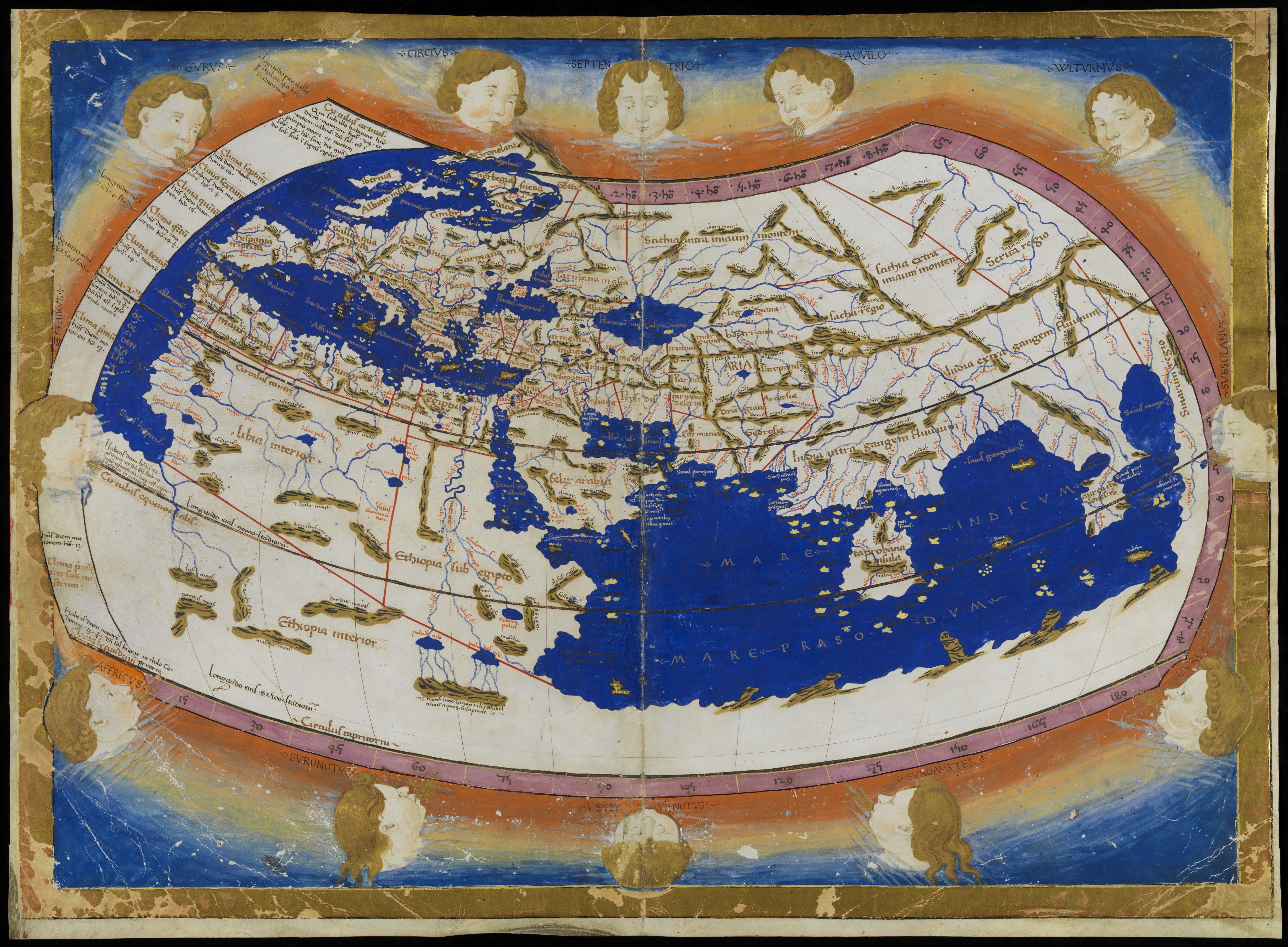
I'm staring at a digital copy of Ptolemy's Cosmographia, lost in the labyrinthine depths of my absolute favorite rabbit hole gateway, the Internet Archive. Actually, it isn’t Ptolemy’s actual Cosmographia, it’s a 15th Century Latin translation by Nicolaus Germanus. The original Greek version is lost to the ages. Modern scholars prefer the name Ptolemy's Geographia, but I'm enamored with its ancient title — Cosmographia!— like something out of a Carl Sagan lecture. I don't remember how I got here, or how long I've been flipping through its medieval texts. Pax, my golden retriever, gives me that look — the one that says we're horrifically late for our walk. But I can't tear myself away from these ancient columns of coordinates, these carefully transcribed plot points for what was then the known Earth , which survived, through a miraculous chain of translations and copies, thirteen centuries to revolutionize Renaissance cartography.
Here's the mind-bending part: we don't have a single page of Ptolemy's original work. Everything we know comes from Byzantine copies of Arabic translations, which were then re-translated into Latin during the Renaissance. It's like a 1,300-year game of telephone, yet somehow the core mathematical principles survived intact enough to transform how we see our world.
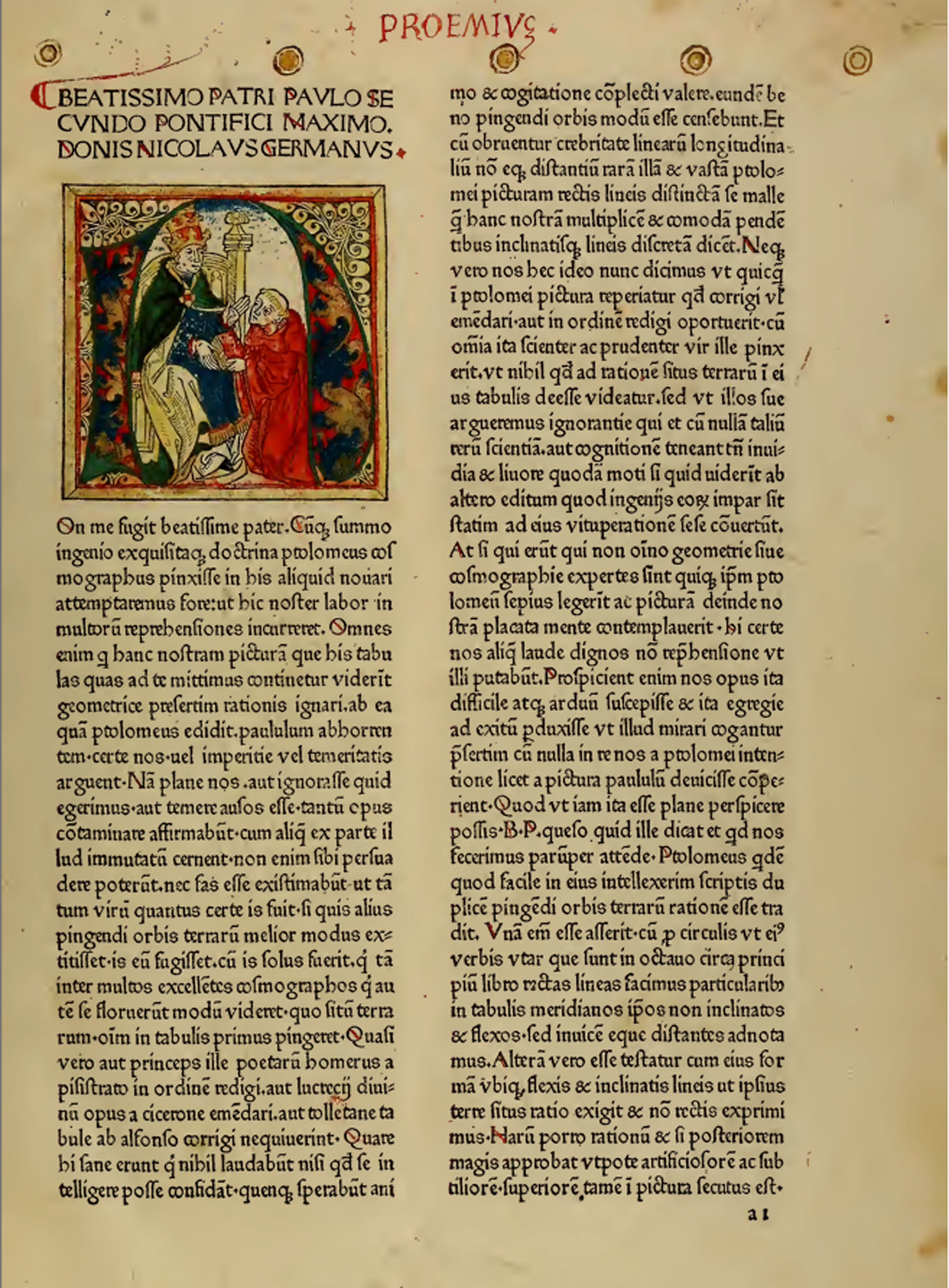
To the Most Blessed Father Paul II, Supreme Pontiff, from Nicolaus Germanus. O most blessed Father, since the distinguished mind of Ptolemy has exquisitely painted the world in his Cosmographia, it seemed fitting to make no alterations to his work in this reproduction, for all who consider these maps will find that they convey both clarity and reason, unlike the erroneous depictions of the ignorant....
Claudius Ptolemy, that brilliant, flawed stargazer of 2nd-century Alexandria, never actually drew a single map in his Geographia. Instead, he created something far more powerful: a mathematical framework for mapping our spherical Earth onto a flat surface. His coordinate system was wildly inaccurate — stretching the Mediterranean like taffy and bloating Scotland into a bizarre eastern appendage — but his core insight was revolutionary. Earth's surface could be measured, gridded, and projected with mathematical precision.
The truly remarkable part? When Ptolemy's work resurfaced in 15th-century Florence, it sparked a cartographic renaissance that shaped our modern world. Renaissance mapmakers, armed with Ptolemy's coordinate system (and better measurements), began crafting the first "modern" maps. His influence echoes in every GPS ping, every Google Maps direction, every coordinate we use to navigate our world.
Borders confound me. Imaginary lines drawn on a piece of paper. As a 20-something platoon leader, standing watch along the 38th parallel in Korea, I often pondered how these invisible lines came to hold such power. For as long as I can remember, these invisible lines, these all-powerful representational symbols of our all too human relationships fascinated me — not just for where they lead, but for the stories they tell about who we are and how we see our world. The Korean Demilitarized Zone — that indelible source of generational trauma — exists because a bunch of men traced it on to a map. They agreed, and by default, so did we all, to believe in a mathematical abstraction — a line of latitude that Ptolemy's methods helped us define. We've built our entire modern conception of space around his fundamental insight: that the world can be turned into numbers, measured, and mapped with mathematical precision.
Was Ptolemy wrong about almost every other assumption? Absolutely. His Earth was too small, his longitudes wildly distorted, and don't get me started on his geo-centric model of the solar system. But his greatest gift wasn't accuracy — it was imagination. He showed us that the world could be measured, that geography could be more than mere description. He gave us the foundations of how to think about mapping our world, even when his own measurements were comically incorrect.
Sometimes the most profound legacy isn't being right, but simply showing us how to think about problems in an entirely new way. And sometimes, that legacy can survive centuries of translations, copies, and reinterpretations to reshape how we understand our world.
Now, if you'll excuse me, Pax is giving me that look again. But before I go, here's a thought that keeps me up at night: somewhere in the dusty corners of the Internet Archive, in the marginalia of medieval manuscripts, or in the forgotten footnotes of Renaissance translations, lie other revolutionary ways of seeing our world. Ancient scholars weren't just recording what they knew — they were imagining new ways to understand reality itself. What other frameworks for understanding our world are still waiting to be rediscovered, reinterpreted, and re-imagined for our time? There's only one way to find out... follow the white rabbit. Just make sure to feed the dog first. ∞
Care to follow the rabbit? Click the link below: