500 Words: "A Peculiar Shade of Hope"
Short Fiction from the Rabbit's Den

It had been a hard winter and an even crueler spring. The March rains had transformed Hanson's Brook into a raging torrent and rendered the pike road an impassable sea of mud. Elmer Jenkins was lost attempting to rescue his stranded steer, and the town hadn't received a single delivery in five weeks. Then, conjured perhaps by collective desperation, a wagon appeared on Wednesday of Holy Week—a minor miracle considering the spring mud had swallowed lesser carriages. Its sides bloomed with painted lilies and golden crosses that caught the late afternoon light, transforming ordinary maple wood into something almost sacred—a roving cathedral of commerce. “The Apostle of Chemistry, Dr. Thaddeus P. Wakenight, Twice Graduate of the Philadelphia School of Elixirs and Magnetic Healing” read the faded lettering. The proprietor, Dr. Wakenight presumably, sat atop the wagon, resplendent in a white suit, his magnificent beard spread over his enormous belly, like a summer cloud drifting over the weathered landscape of his waistcoat.
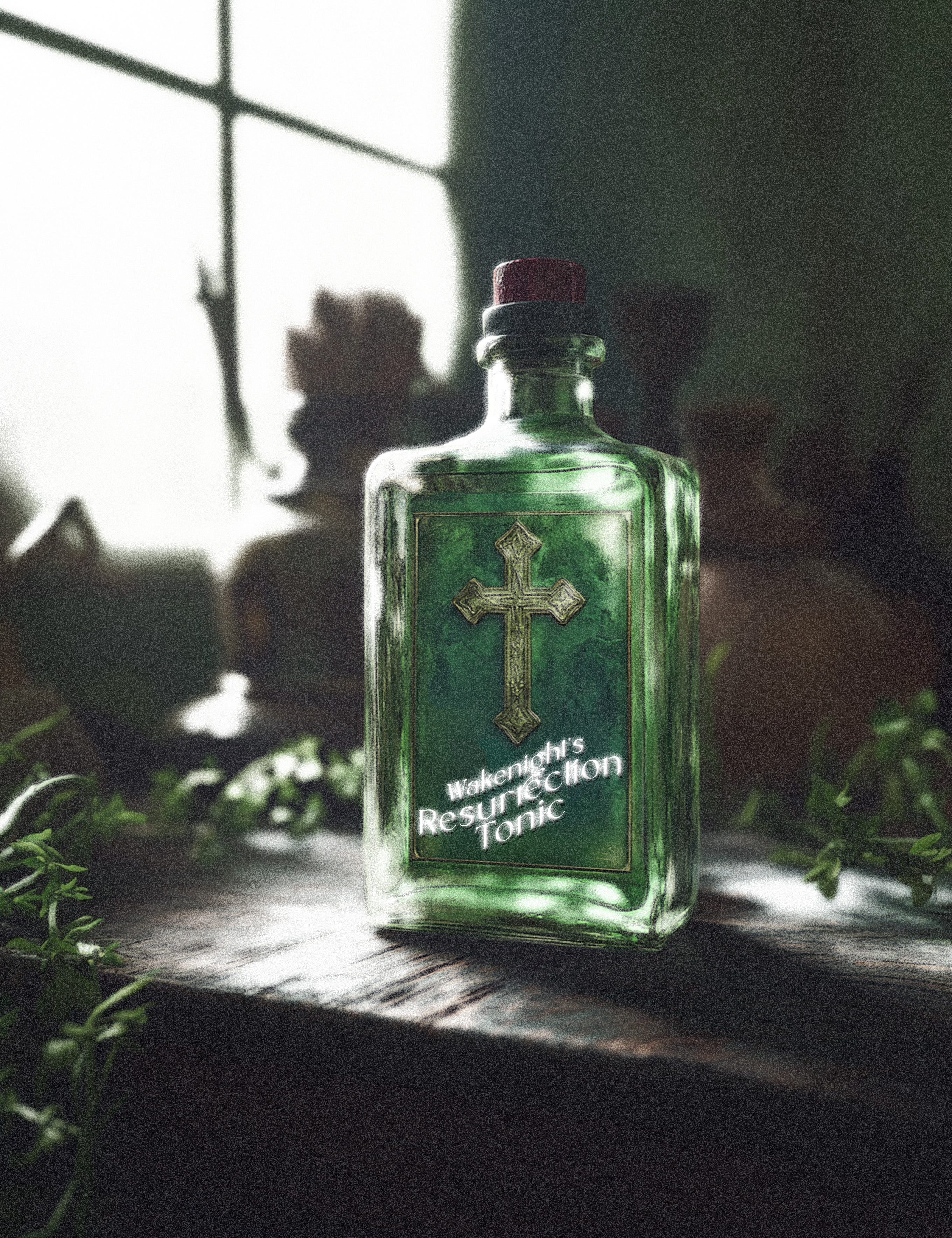
As citizens of Millbrook gathered in the town square, Dr. Wakenight unveiled his creation with the reverence of a priest displaying a sacred relic: "The Resurrection Tonic! Distilled from the same herbs gathered at the hour Christ emerged from his tomb!" The translucent green elixir caught the light in its perfectly square bottles, each sealed with crimson wax and stamped with a cross that seemed to glow with holy promise.
"Just as our Lord rose from death's slumber, so too shall your winter blood be revived!" he proclaimed, voice rising until it seemed to float above the crowd like a benediction, his words hanging in the air like musical notes.
Ephraim Miller, our town cobbler — his fingers so deeply acquainted with stiffness that they curled as if perpetually clutching his awl — was the first to purchase a bottle. Four bits seemed a small price for the promise of spring in one's veins. Others followed: Mrs. Willoughby (for her melancholia), Postmaster Finch (for his gouty foot, which for the past three years served as both his identity and alibi), and a dozen more souls eager to be reborn before Easter morning.
Dr. Wakenight didn’t neglect the fairer sex in his formulations. He offered them "The Madonna's Comfort" — a special blend containing unicorn root and black cohosh, "identical to that used by the Holy Mother herself during times of feminine distress." Mrs. Harrington strode forward and purchased two bottles. She was plagued by what Doc Mayhew delicately termed "the change of seasons in a woman's garden.”
“And extremely effective for those nocturnal visitations of the unsettled mind.” Dr Wakenight winked at the widow Jenkins. She blushed and handed over a shiny dollar and secured three for herself.
Later, by lantern light, I watched Dr. Wakenight count his money. His fingers caressed each coin the way a man might touch his wife's cheek. I knew I should arrest him — county regulations required permits for such sales — but instead I found myself handing over fifty cents for my own bottle of salvation.
Three days later, Easter morning dawned with improbable warmth. Church bells rang as townspeople emerged from their homes wearing curious expressions — faces transformed not by religious fervor but by something altogether more peculiar. Every single tonic-drinker's skin had taken on a vibrant, chartreuse hue, as if spring's revivification had somehow manifested beneath our epidermis — a radiance that made even the most withered among us appear suddenly, improbably youthful.
Dr. Wakenight was gone, of course. His wagon tracks disappeared in the mud at the edge of town, as if he'd ascended skyward.
Yet no one spoke ill of our mysterious apostle, even as our luminous tint persisted through May. There was something oddly comforting about our collective transformation — Mrs. Willoughby laughed with pleasure when Gabriel's wings fell off during the Easter pageant, Ephraim's fingers loosened enough to play checkers on Wednesday evenings, Postmaster Finch delivered mail with a newfound vigor. Mrs. Harrington, astonishingly, organized the church picnic with a zealot’s youthful energy.
Perhaps it was merely the placebo of expectation, or perhaps it was the tonic's secret ingredient, which I later discovered to be nothing more miraculous than vitamins, concentrated chlorophyll and a generous measure of opium tincture, though this revelation I kept to myself, unwilling to tarnish the miracle.
The last bottle sits on my shelf still, untouched. Once a year, on Easter morning, I hold it to the light and consider taking that final sip. Not for its curative properties, but because sometimes we need to believe in resurrections, even when they turn us a peculiar shade of hope — that most stubborn and necessary of human delusions.
- Item from the Millbrook Gazette, "Curious Happenings," April 18th, 1897