
The First Monster Movie
Thomas Edison's 1910 Take on Frankenstein

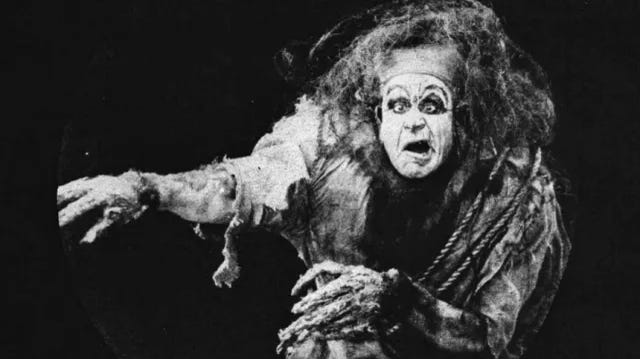
Fifteen years before Lon Chaney terrified audiences in The Phantom of the Opera, twenty-one years before Universal launched their monster movie empire with Boris Karloff’s iconic interpretation, Thomas Edison’s film company quietly made cinema history by adapting Mary Shelley’s Frankenstein for the screen. The 1910 production, directed by J. Searle Dawley, ran approximately sixteen minutes and cost $385 to produce (about $12,000 in today’s money). Edison Studios, already dominant in the emerging film industry through aggressive patent enforcement, saw Shelley’s novel as ideal material for their expanding catalog. The plot had name recognition, gothic atmosphere, and enough spectacle to showcase cinema’s still-novel capabilities.
What makes this version fascinating isn’t just its historical precedence but its philosophical approach. Edison’s catalog description promised the film would be “a liberal adaptation... eliminating all the actually repulsive situations and substituting therefor a mystic atmosphere of awe and dread.” Translation: Edison wanted to avoid alienating viewers who might object to the more gruesome aspects of corpse reanimation. Rather than Shelley’s scientific horror (a creature assembled from corpses, animated through galvanic experiments), Edison’s Frankenstein emerges from a bubbling cauldron in Victor’s laboratory, created through what the film calls “Evil and the Supernatural.” Less surgical theater, more witches’ brew.
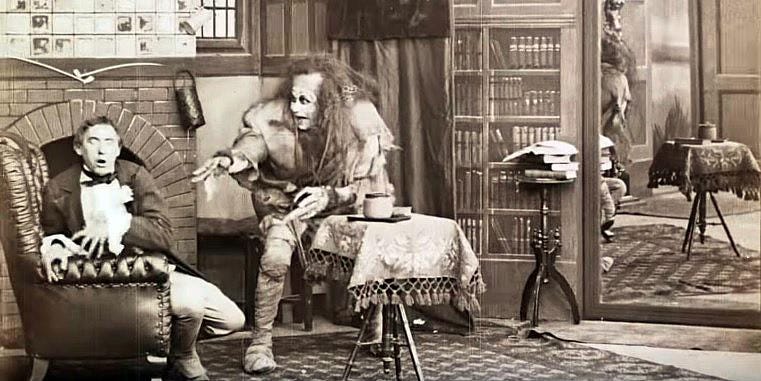
The creation scene itself became a masterwork of early special effects. Filmed in reverse, the sequence shows a dummy being consumed by flames in a cauldron, then the footage was played backward to show the creature gradually forming from fire and smoke. For 1910 audiences accustomed to static theatrical presentations, watching a human form materialize from flame must have seemed genuinely supernatural. It’s a trick that holds up remarkably well over a century later. Practical effects often age better than we expect.
Charles Ogle played the Creature with wild hair, gnarled hands, and exaggerated makeup that would influence monster design for decades. His performance emphasized pathos over menace, presenting the Creature as more tragic than terrifying. The film ends not with the Creature’s destruction but with his disappearance. He fades away when confronted by Victor’s love for his fiancée, suggesting that love and goodness can literally dissolve evil. It’s a remarkably optimistic interpretation of Shelley’s much darker tale. The original novel doesn’t exactly end with everyone holding hands and singing.
For decades, the film was considered lost. Edison’s company had gone bankrupt, the negatives disappeared, and film preservation wasn’t yet a priority in an industry that viewed movies as disposable entertainment. Historians knew Frankenstein (1910) existed through production stills and catalog descriptions, but the actual film seemed gone forever.
Then, in the 1970s, a film collector named Alois Dettlaff discovered he owned a print. He’d purchased it years earlier, unaware of its significance, and it had sat in his collection gathering dust. When word spread that Edison’s Frankenstein had been found, it created a sensation among film historians. Here was the origin point, the first monster movie, the first Frankenstein adaptation, a window into how early cinema approached horror.
The print wasn’t perfect. Time and neglect had damaged sections, the image quality was degraded, and portions were missing or illegible. But it existed, could be studied, could be preserved. Modern restorations have cleaned up the image, and the film is now available online through various archives. Anyone can watch cinema’s first monster emerge from that reversed-footage cauldron.
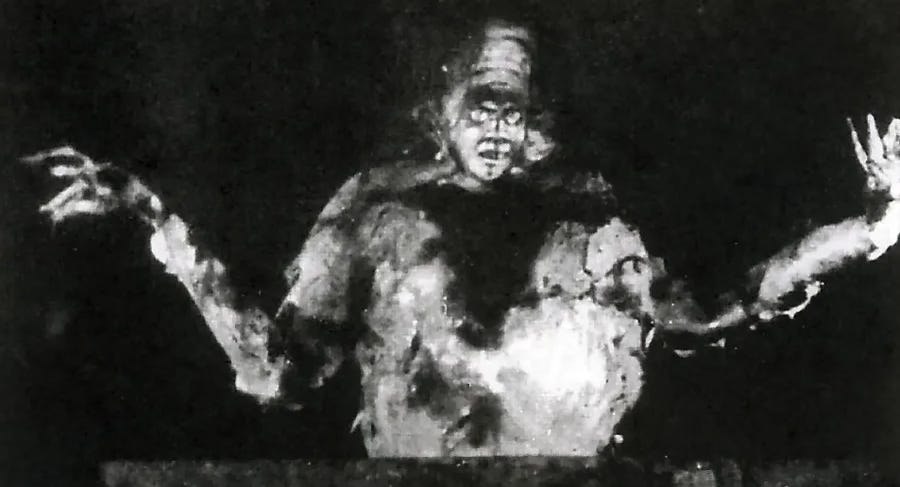
What’s striking about Edison’s Frankenstein is how much of the visual language it established. The gothic laboratory. The transformative moment of creation. The Creature’s initial confusion and rage. The tragic dimension underlying the horror. Every Frankenstein adaptation since has existed in dialogue with this sixteen-minute curio, whether filmmakers knew it or not.
The film also reminds us that early cinema wasn’t primitive or unsophisticated. It was innovative, experimental, pushing against the boundaries of what was possible with the technology available. That creation scene, filmed in reverse and requiring precise timing and effects work, demonstrates creativity that CGI hasn’t necessarily surpassed, just replaced with different techniques.
Edison’s company intended Frankenstein as disposable entertainment, one product among thousands in their catalog. They couldn’t have imagined it would still be studied, analyzed, and celebrated over a century later, or that it would be considered the foundation of an entire genre.
The film survives online in various forms. Some versions have added soundtracks, others remain silent as originally intended. The image quality ranges from barely watchable to reasonably clear, depending on which restoration you find. But even in its roughest form, there’s something mesmerizing about watching that creature take shape in the cauldron, knowing you’re seeing the exact moment when movie monsters were born. - ∞