
The Forgotten Bookshelf: We Have Always Lived in the Castle
Shirley Jackson's Masterpiece of Psychological Horror

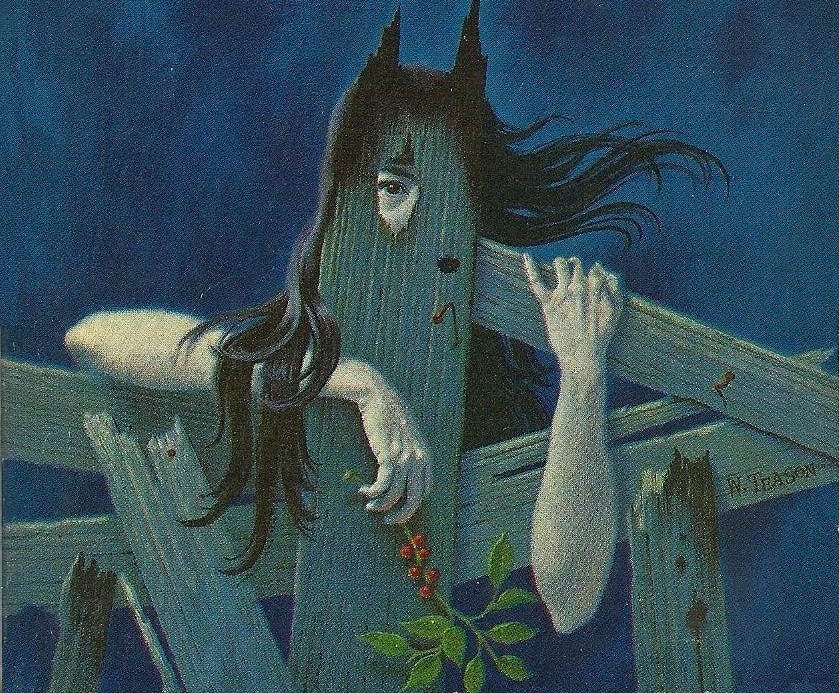
Like many before me, I discovered Shirley Jackson backwards, which is probably the best way to find her.
It was 1999, late night cable, and I stumbled onto Robert Wise’s The Haunting (1963, the black-and-white original, not the CGI disaster remake), the movie based on Jackson’s novel The Haunting of Hill House. The film left an impression on me in ways I couldn’t articulate. No gore, no monsters, just psychology, architecture, and wonderful acting conspiring to create a dread more compelling than any Stephen King adaptation. The next weekend, I came across a battered paperback of Jackson’s novel at a used bookstore, its cover featuring the requisite haunted mansion rendered in lurid 1970s horror-paperback style. The novel was even better than the film—Jackson’s prose created terror through suggestion and implication, through the slow revelation that the house wasn’t haunted so much as it was wrong.
But I didn’t make the connection yet. I didn’t realize this was the same Shirley Jackson whose “The Lottery” I’d encountered in approximately every English 101 anthology ever published. That realization came years later, when I was working diligently on my DIY MFA (Do IT Yourself Masters of Fine Arts), those long months of obsessive reading and re-reading of all the literary works I skipped in my carefree youth. I was working through short story collections and re-read “The Lottery” and it finally clicked: the horror specialist who made me sleep with the lights on was the same writer who’d been hiding in plain sight in every edition of “Great American Short Stories.” Duh…
This is Shirley Jackson’s particular curse and blessing: everyone knows “The Lottery,” but almost nobody reads her novels. She’s simultaneously over-anthologized and completely overlooked, a literary magic trick that would’ve amused her dark sensibility.
We Have Always Lived in the Castle (1962) was Jackson’s final novel, published just three years before her death at age 48. It remains her masterpiece—a work of such controlled malevolence that it makes The Lottery‘s mob violence look crude by comparison.
The novel introduces us to Mary Katherine “Merricat” Blackwood, eighteen years old, who lives in isolated splendor with her older sister Constance and their ailing Uncle Julian in the Blackwood family mansion. The rest of the Blackwood family died six years earlier from arsenic-laced sugar, and while Constance was tried and acquitted for the murders, the townspeople have never forgiven them. Merricat ventures into the village twice a week for supplies, enduring the hatred and whispers of the locals, then returns to the safety of their home where the sisters have created their own private world, governed by Merricat’s elaborate magical thinking and rituals.
This is the entire setup, and Jackson never needs anything more. She’s created a pressure cooker of paranoia, isolation, and the question that hangs over every page: who actually poisoned the Blackwoods?
What makes the novel extraordinary isn’t the mystery—Jackson reveals the truth early on, though so subtly that many readers miss it on first reading—but rather her complete commitment to Merricat’s perspective. We’re trapped inside the consciousness of an unreliable narrator whose magical thinking, obsessive rituals, and fierce protectiveness of her sister might be survival mechanisms or might be symptoms of something far more disturbing. Jackson never tells us which, and that ambiguity is precisely the point.
Merricat buries objects around the property for protection, nails talismans to trees, and believes she can control reality through force of will. She’s convinced that if she performs her rituals correctly, nothing can disturb their sanctuary. The reader understands that her magic doesn’t work—that it’s a psychological defense against overwhelming guilt and trauma—yet Jackson’s prose is so assured that we almost believe in Merricat’s power. Almost.
The novel accelerates when cousin Charles arrives, a smooth-talking interloper who sees opportunity in the Blackwood fortune. His presence disrupts the careful equilibrium the sisters have constructed, and what follows is a masterclass in domestic psychological warfare. Charles wants to modernize the household, to bring the sisters back into contact with the outside world, to take control of the estate. Merricat sees him as an existential threat to everything she’s built.
Jackson understands something profound about family dynamics: the most vicious battles are fought over dinner tables and in sitting rooms, using politeness as a weapon and silence as torture. Charles and Merricat circle each other like apex predators, while Constance tries desperately to maintain peace. Every meal becomes a battlefield. Every conversation contains landmines.
The novel’s climax—I won’t spoil it for those who haven’t read it—transforms the Blackwood mansion from prison into fortress, and Merricat’s delusions into a kind of grim victory. By the end, Jackson has created something genuinely unsettling: a horror story where the monster wins, and we’re not entirely sure we wanted any other outcome.
Understanding Castle requires understanding Shirley Jackson herself, because the novel emerged from her own experience of persecution and isolation.
Jackson was born in 1916 in San Francisco, moved to Rochester, New York as a child, and eventually settled in Vermont with her husband, literary critic Stanley Edgar Hyman, and their four children. On paper, she lived a conventional 1950s life: housewife, mother, dutiful faculty spouse at Bennington College. She wrote domestic humor columns for women’s magazines, published charming essays about raising children, and maintained the appearance of normalcy.
But Jackson was also writing some of the darkest fiction in American literature, and the cognitive dissonance destroyed her.
When “The Lottery” appeared in The New Yorker in 1948, the magazine received more mail than for any story they’d ever published—hundreds of letters, most of them hostile. Readers were genuinely disturbed, even angry, that such a story existed. People cancelled their subscription. The town where Jackson lived began treating her with suspicion. Neighbors whispered. Local merchants were cold. The very people who’d been friendly suddenly weren’t.
Jackson internalized this persecution, developing severe agoraphobia and anxiety that worsened throughout the 1950s. She began having difficulty leaving her house. The woman who wrote about isolation was becoming increasingly isolated herself. She gained weight. She struggled with prescription drug dependence. Her mental health deteriorated while she continued producing immaculate prose about psychological dissolution.
By the time she wrote Castle in the early 1960s, Jackson had lived for over a decade with the experience of being simultaneously celebrated (her work was critically acclaimed and commercially successful) and ostracized (her own community treating her as dangerous, unwholesome, not quite right). Is it any wonder she created Merricat and Constance—sisters who retreat from a hostile world into their own private universe, who are persecuted for a crime only one of them committed, who find freedom only in complete isolation?
The novel is semi-autobiographical, though Jackson would never have admitted it. Like Merricat, she performed private rituals to ward off anxiety. Like Constance, she maintained domestic routines as a form of psychological stability. Like both sisters, she experienced the peculiar horror of being blamed for something she couldn’t control—in Jackson’s case, writing a story that made people uncomfortable about their own capacity for violence.
Jackson died in 1965 at age 48, in her sleep, from heart failure exacerbated by years of medication, obesity, and psychological stress. She never completed another novel after Castle. Some scholars speculate that she’d said everything she needed to say—that having written a novel about complete retreat from the world, she had nowhere else to go artistically. Others suggest her health had simply deteriorated too far.
In the decades after her death, Jackson’s reputation went through curious transformations. “The Lottery” remained a standard anthology piece, taught in high schools and colleges, but her novels fell out of print. She was remembered, if at all, as the woman who wrote that one disturbing story about a stoning.
Then something shifted. Women writers—particularly those working in horror and psychological suspense—began reclaiming Jackson as a literary ancestor. Joyce Carol Oates wrote extensively about her influence. Kelly Link, Carmen Maria Machado, and others cited her as essential. The Library of America published a definitive collection of her work in 2010. Suddenly Jackson was being recognized not as a genre curiosity but as one of American literature’s most sophisticated psychological realists.
We Have Always Lived in the Castle became a cult classic, particularly among readers who understood what Jackson was really writing about: the experience of being gaslit by an entire community, the psychology of women who refuse to perform acceptable femininity, the way families create private mythologies to survive trauma, and the fine line between self-protection and self-destruction.
The novel feels unnervingly contemporary. Merricat’s magical thinking mirrors our own era’s conspiracy theories and alternative facts. The townspeople’s mob mentality—their willingness to believe the worst about the Blackwoods, their pleasure in persecution—anticipates social media pile-ons. The sisters’ retreat into isolation predicts our own pandemic-era reckonings with who we are when the outside world disappears.
But more than topical relevance, Jackson’s novel endures because it does something most horror fails to do: it makes us complicit. We like Merricat. We understand why she did what she did. We root for her, even as we recognize she’s dangerous. Jackson never asks us to approve—only to understand. And in that understanding lies the novel’s deepest horror: recognition that under the right circumstances, with the right pressures, we might make similar choices. - ∞