
The History of "Harvest"
Notes from The Wonderfully Absurd World of Words

Save for a slip of the tongue, we might all be holding coffee mugs that say “Hærfest Diem!”
Ever since Robin Williams whispered them in his Oscar-nominated performance in Dead Poets Society, we’re all too familiar with the Latin phrase “carpe diem!“ But who among us can recall who said it first? Yes, you’re right! It was Horace, the famous Roman poet, speaking to his friend Leuconoe in the Odes:
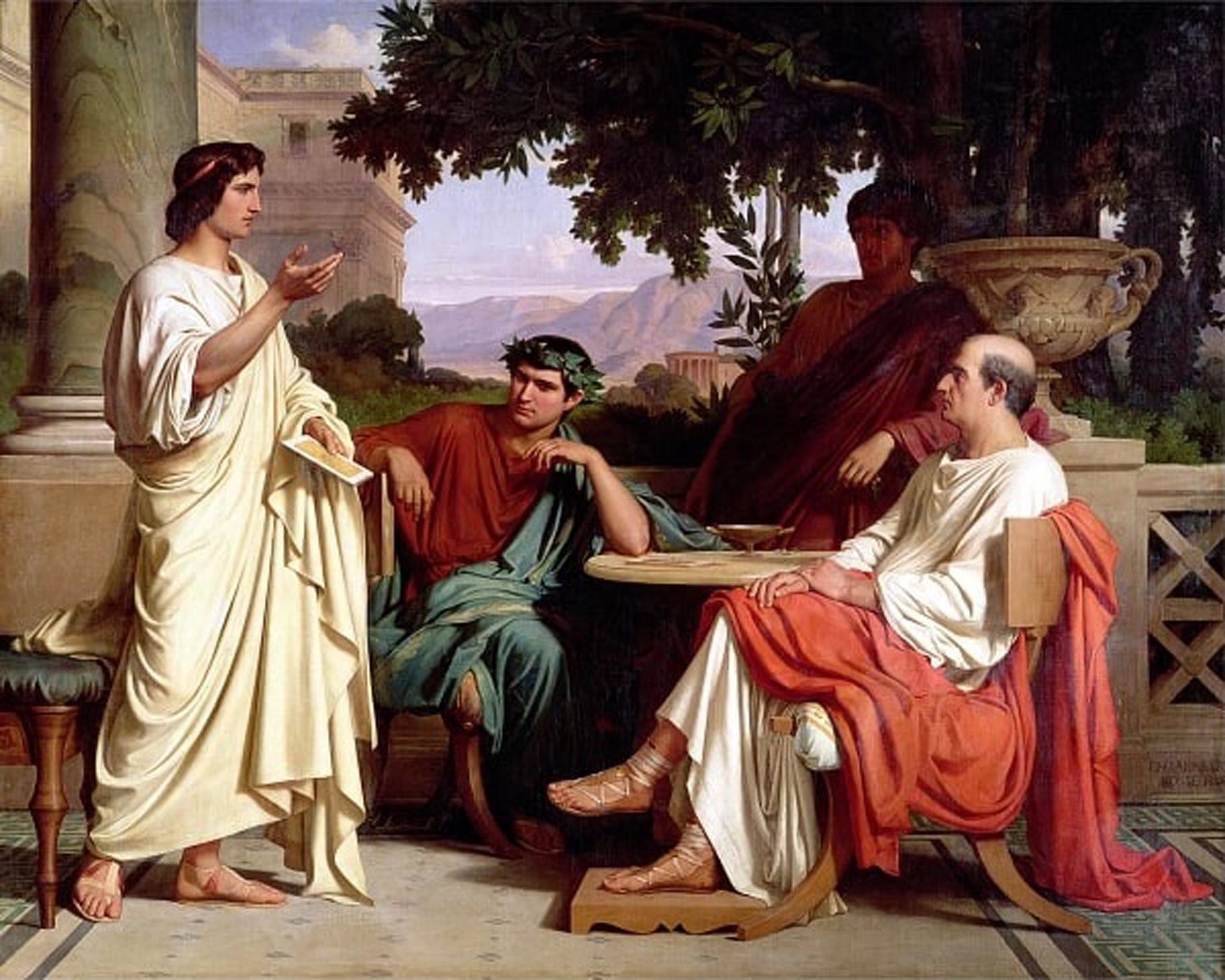
“Dum loquimur, fugerit invida aetas: carpe diem, quam minimum credula postero.”
“While we talk, envious time will have fled: pluck the day, trusting as little as possible to the future.”
In full context, Horace is saying “Don’t try to predict the future, Leuconoe; the gods don’t like it. Enjoy the day, pour the wine and don’t look too far ahead.” Advice that either seems extremely practical or catastrophically ignorant these days.
Of course, he wasn’t just telling Leuconoe to “seize the day.” Horace was thinking like a farmer. It turns out carpere—the Latin verb at the heart of his famous phrase—literally means “to pluck, to gather, to harvest.” So when we translate “carpe diem” as “seize the day,” we’re missing something essential: Horace was telling us to harvest the day, to pick it like ripe fruit before it rots on the vine. And here’s where it gets deliciously weird: both “carpe diem” and our English word “harvest” spring from the exact same ancient root!!
Welcome to the wonderfully absurd world of Proto-Indo-European linguistics, where scholars gesticulate wildly about a theoretical language spoken 6,000 years ago by people who left absolutely zero written records. PIE (as the cool kids call it) is simultaneously the most rigorous academic discipline and the most spectacular “trust me bro” exercise in intellectual archeology. Linguists basically draw red strings between words on a conspiracy theory board and announce, “Somewhere between the Black Sea and Central Asia, hypothetical people definitely said *kerp- and that’s why English ‘harvest,’ Latin ‘carpet,’ Greek ‘fruit,’ and Sanskrit words for ‘sword’ are all cousins!”
And you know what? They’re right. Probably. The evidence is actually quite compelling, even if the whole enterprise feels like linguistic fortune-telling.
So let’s talk about *kerp-*, this ancient root meaning “to gather, pluck, harvest.” It spawned an absolutely unhinged family tree of words. Latin got carpere (to pluck, to seize), which gave us not only “carpe diem” but also “carpet” (originally woven from plucked fibers), “excerpt” (literally “plucked out”), and even “scarce” (from the idea of something being “plucked away”). Greek got karpos meaning “fruit”—literally “that which is plucked.”
The Germanic languages received their own branch of the family, and that’s where our story really gets interesting. Through Proto-Germanic harbistaz (which underwent the typical sound shift from PIE *k to Germanic *h—linguists call this Grimm’s Law, because of course they do), the root *kerp- eventually became Old English hærfest. And here’s where things get deliciously weird.
Old English hærfest originally meant just one thing: autumn. The season. The third one. Period. Not the activity of gathering crops—just the time of year when leaves turn colors and the air gets crisp. But here’s where language does something absolutely feral: the season became so inextricably linked with gathering food that the word hærfest essentially devoured its own meaning and became the action itself. By the mid-13th century, “harvest” primarily meant the activity of reaping and gathering crops, and only secondarily referred to the season.
This created a rather awkward vocabulary gap. English speakers suddenly found themselves without a proper name for the third season. So what did they do? They borrowed “autumn” from French (who got it from Latin autumnus, a word of mysteriously unknown origin—possibly Etruscan, because why not make things more complicated?). And when that felt too fancy, English simply repurposed “fall” as in “the fall of the leaf.” Problem solved! Sort of.
Meanwhile, hærfest had transformed completely. The season became the action became the product. By the 1300s, you could harvest crops, have a good harvest, and celebrate at harvest time—but if you wanted to talk about the actual season, you’d better say “autumn” or “fall” because “harvest” was too busy being a verb or a noun and forgot that it was once just a season.
The linguistic family reunion gets even weirder when you consider harvest’s Germanic siblings. There’s German Herbst(autumn), Dutch herfst (autumn), and Old Norse haust(harvest)—all descendants of that same Germanic harbistaz. They’re linguistic siblings who all decided to handle the season-versus-verb confusion in slightly different ways, like brothers who inherit the same house and each claim a different room.
And then there are the distant cousins: Lithuanian kirpti (to cut), Middle Irish cerbaim (cut), Sanskrit krpana (sword). They all trace back to that same Indo-European impulse—the fundamental human action of cutting, plucking, gathering. Whether you’re harvesting grain in medieval England, plucking flowers in ancient Rome, or cutting cloth in Greece, you’re performing variations on an ancient theme.
So the next time you see a “carpe diem” motivational poster at HomeGoods, remember: you’re looking at harvest’s fancy Latin cousin. One became famous as a philosophical catchphrase plastered on coffee mugs; the other became sidelined in agriculture and pumpkin picking. But remember, they both came from the same place—a hypothetical root word spoken by theoretical people in a reconstructed language that may or may not have existed. Which is either the most beautiful thing about language or the most ridiculous, depending on how much you drink at Thanksgiving.
Either way, when you gather around the table this fall—sorry, this autumn—sorry, this harvest season—remember that you’re participating in a 6,000-year-old linguistic tradition of plucking, gathering, and making the most of what’s ripe right now.
Carpe hærfest, friends. Or hærfest diem? Anyway, harvest the day! - ∞

Regarding Quintus Horatius Flaccus (65–8 BCE)
Horace is widely considered one of Rome’s greatest lyric poets. His works continue to be studied and enjoyed for their witty observations on life, timeless wisdom, and masterful use of language. He is particularly known for his Odes, a collection of short poems that explore themes of love, friendship, philosophy, and politics, but he was also known to have a spry sense of humor.
While scholars have long studied Horace’s four books of Odes, Down the Rabbit Hole has recently uncovered several previously unknown works that reveal a side of the poet rarely discussed in classical circles. While Horace gave us “carpe diem“ and timeless wisdom about mortality, these newly discovered works reveal a fixation with Roman daily life:
Ode I.38b - “De Toga Adhuc Umida” (”On the Toga Still Damp”) A meditation on the philosophical implications of doing laundry the night before an important Senate meeting.
Ode II.14f - “De Longa Linea Ad Vomitarium” (”Regarding the Long Line at the Vomitarium”) In which Horace questions Roman engineering priorities during an ambitious feast.
Ode III.27r - “De Illo Qui Ventrem Dimisit Durante Tragoedia Sophoclis” (”On He Who Released Wind During the Sophocles Tragedy”) A cautionary tale about lentils and amphitheater acoustics.
Ode I.17w - “De Frustatione Togae Longae Cum Necessitates Corporis Urgeant” (Regarding the Toga When Nature Urgently Calls”) Six yards of wool, zero practical design considerations, one very urgent situation.
Ode IV.8k - “De Portia, Femina Superba Capillorum Brevium Quae Semper Rogat ‘Possum Loqui Cum Praeposito?’”(”Regarding Portia, the Entitled Woman of Short Hair Who Always Must “Speak to the Manager?’”) Before “Karen” there was Portia, terrorizing Forum merchants since 12 BCE.