
Essay: We Are All Guy Montag
It's time to read Fahrenheit 451 again.

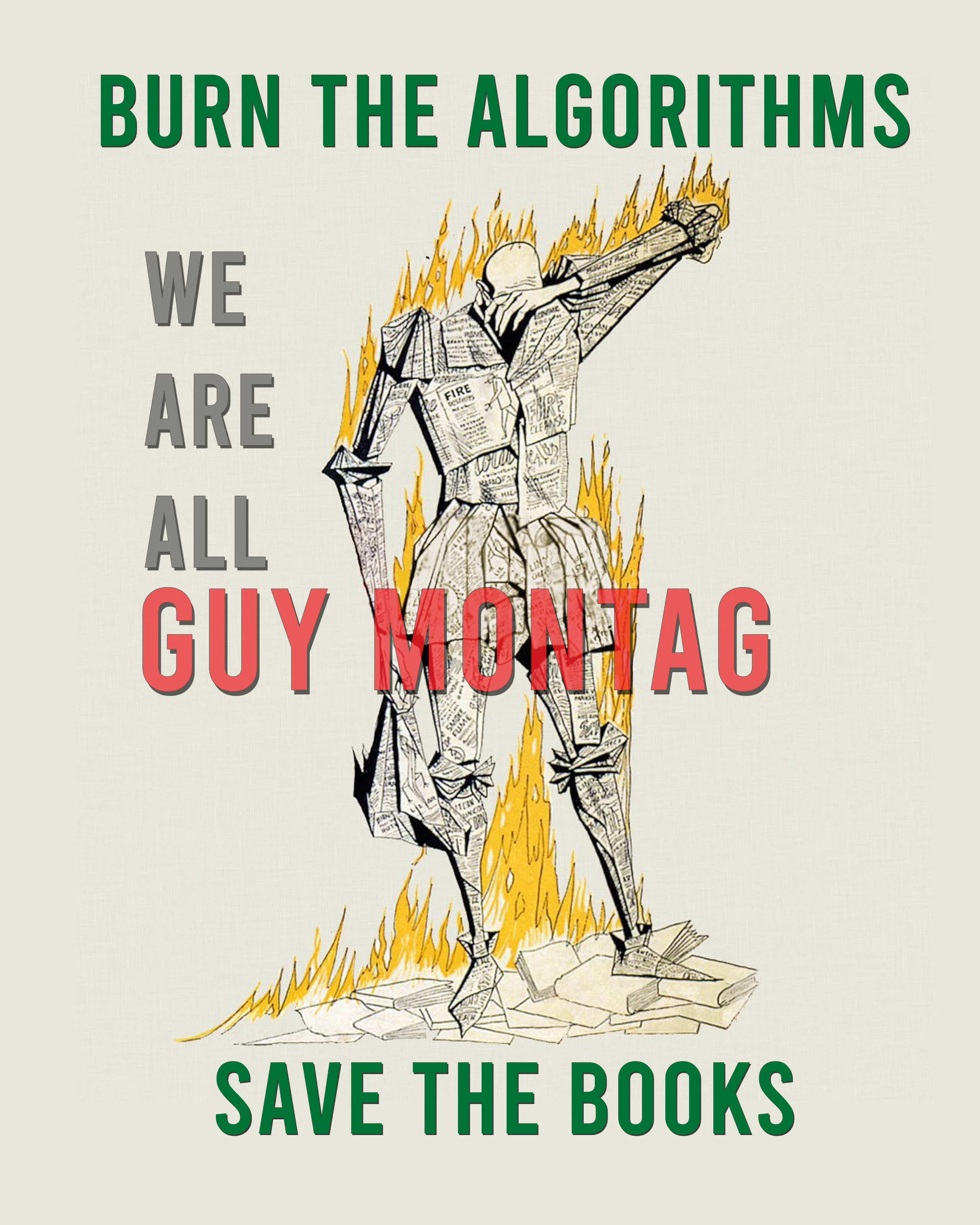
Author’s Note: I rarely publish opinion pieces. No one needs another righteous voice in our already-crowded inbox. And then there’s the title: we see "Fahrenheit 451,” and we’re tempted to scroll past or dismiss it; sounds like another political screed about our current moment. This isn't that. Beneath the barrage of daily distractions, there’s a deeper trend that keeps tapping me on the shoulder. What keeps me awake at night isn't our cyclical social upheavals—this country weathers existential threats every few decades. No, what keeps me up is something altogether more distressing: our collective disengagement from depth, from each other, from ourselves. These thoughts arrive in the quiet hours before dawn, demanding to be written. This essay is the result. I hope you'll take a few minutes to read it.
I am Guy Montag.
Every morning, I awaken and immediately reach for my screen. I scroll through a curated feed perfectly calibrated to trigger my outrage, validation, or amusement. I consume content selected by invisible algorithms, designed to maximize my engagement rather than my understanding. I react to the same trending topics, discuss the same viral newsfeeds with predictable righteous indignation. And somehow I manage to feel uber-connected and utterly alone at the exact same time.
If that name—Guy Montag—doesn't ring a bell, he's the protagonist of Ray Bradbury's 1953 dystopian classic Fahrenheit 451. Bradbury was just 30 years old when he published "The Fireman" in Galaxy Science Fiction, the novella that he would later expand into what became a high school English staple. Montag is "The Fireman" – but not as we understand the profession today. In Bradbury's future vision, firemen don't extinguish flames; they ignite them. Their brass-fitted black uniforms and kerosene hoses serve one purpose: to burn books.
What makes Bradbury's masterpiece so unsettling to revisit in 2025 isn't just its technological prescience, but its social insight. Many readers misinterpret Fahrenheit 451 as primarily a critique of government censorship. It's far more uncomfortable than that. Through the character of Fire Captain Beatty, Bradbury delivers his most chilling revelation: the dystopia wasn't imposed by tyrannical force; it was welcomed by a passive society.
"It didn't come from the Government down," Captain Beatty explains to Montag. "Technology, mass exploitation, and minority pressure carried the trick." Long before the government began burning books, people had already stopped reading them. They had willingly traded depth for distraction, complexity for comfort.
Bradbury wasn't just criticizing a fictional government; he was making a profound statement about the society that allowed such a government to prosper. He recognized that the greatest threat to intellectual freedom isn't necessarily authoritarian decree but our own willingness to surrender challenging thought for easy entertainment. This insight transcends any specific administration or political era—it warns us about human tendencies that persist regardless of who holds office.
At the novel's opening, Montag takes pride in his work, feeling "the fierce grin of all men signed and driven back by flame" as he reduces forbidden literature to ash. He returns each night to a home dominated by wall-to-wall television screens, where his wife Mildred drifts through life, headphones on ("seashell" shaped radio receivers that eerily prefigure today's AirPods), disconnected from reality and even from her own emotions.
But after a chance encounter with a curious teenager named Clarisse and a traumatic emergency call where a woman chooses to burn alive with her books rather than live without them, cracks begin to form in Montag's certainty. For the first time, he begins to wonder about the contents of the volumes he's destroying and the emptiness of the life he's living.
When Bradbury described Montag's society, people with their "thimble radios" tucked into their ears, he wasn't just inventing a fictional technology—he was prophesying our AirPods culture. We walk through life encased in our personal soundtracks, curated playlists, and endless podcasts that simultaneously connect us to distant voices while isolating us from the person sitting across the table. The seashell radios that whispered "time, weather, and news" to Montag's wife have materialized as the constant notifications that punctuate our days, demanding immediate attention while offering minimal substance.
Just like Montag, I'm an efficient machine, performing my designated functions within a system designed to keep me comfortable, distracted, and just satiated enough to avoid raising a stink. And I suspect many of us recognize this same pattern—not because of government mandate, but because of our own choices, day after day, to choose the easy path of digital distraction.
But if Bradbury's novel is accusatory—it's also redemptive. Because I'm also Guy Montag awakening. I'm Montag feeling that ongoing discomfort with the emptiness of my digital life. I'm Montag sensing that something essential has been lost in my rush toward technological convenience. When I look around, share a drink with friends, group chat with my high school buddies, or talk with my kids over FaceTime, it dawns on me: We Are All Montag.
Montag's character arc represents the quintessential hero's journey: from unquestioning conformist to enlightened individual, trading his privileged numbness for authentic, if dangerous, purpose. This journey remains available to all of us, regardless of our political leanings or social circumstances.
What gives me hope—and what makes Fahrenheit 451 more than just a doom-scroll in novel form—are the "book people" Montag discovers at the novel's end. These individuals have each memorized entire books to preserve them for future generations. They offer us a template for resistance that feels startlingly relevant to our times.
What might their modern equivalents look like today? Perhaps they're the people who deliberately unplug from social media for deep reading. Maybe they're the parents who prioritize family conversation over screen time, or the friends who gather to discuss ideas rather than just share viral content. They are the journalists committed to nuance in a world of hot takes, or educators who teach critical thinking despite pressure to teach to the test. They aren't defined by their politics but by their commitment to depth over distraction.
These modern "book people" have chosen the hard path of deep engagement over passive consumption. They've committed to becoming living vessels of the very ideas that society deems too inconvenient or too challenging. In their choices, we glimpse our own potential path from passive consumers to active thinkers. From algorithm-dependent scrollers to independent explorers. From comfortable numbness to uncomfortable awakening.
In Montag's dual identity—the sleepwalking conformist versus the awakening rebel—lies the un-comfortable truth about our own lives. Bradbury's vision wasn't just predictive; it was preventative—a warning we still have time to heed.
If you've never experienced Fahrenheit 451, or haven't revisited it since high school, now is the perfect moment to discover its uncanny prescience. It's not just a book about burning books—it's about what happens when we willingly surrender our capacity for complex thought. And in that warning lies hope: we can choose a different path. We are all Guy Montag. The question is: which version will we choose to be? ∞